13 Apr

Let’s be honest—most people treat invoices like a boring admin task. Send it, get paid, move on.
But here’s the problem: if you don’t understand what is a proforma invoice and a regular invoice, you’ll mess up pricing, confuse clients, or worse—delay your own payments.
So let’s break it down clearly.
First, the basics
- Proforma invoice = a preview or estimate before the actual sale
- Invoice (standard/commercial/sales) = a final bill requesting payment
Simple? Yes. But the nuance matters.
“A proforma invoice is a promise. A final invoice is a demand.”
That one line alone explains 80% of the confusion.
What Is a Proforma Invoice (Plain English)
A pro forma invoice (or pro forma invoice mean, pro forma invoice definition) is basically:
👉 A non-binding document sent before goods or services are delivered
👉 Used to outline pricing, scope, and terms
👉 Helps clients approve costs before commitment
Think of it like a preview checkout page before hitting “Pay Now.”
Common use cases:
- International trade (especially for customs)
- Freelancers pitching project costs
- Contractors giving early cost breakdowns
- Businesses dealing with deposits (deposition invoice)
What Is an Invoice (The Real One)
Now, a standard invoice—also called:
- sales invoice
- commercial invoice
- tax invoice
—is the actual payment request.
It includes:
- Final price
- Invoice number (important for invoice numbering)
- Payment terms (what does net 30 mean on an invoice, net 15)
- Due date (calculate invoice due date)
- PO reference (invoice po number)
This is what turns into:
- invoice is outstanding
- invoice past due
- or… ideally… paid
Key Differences (Don’t Skip This Table)
| Feature | Proforma Invoice | Regular Invoice |
|---|---|---|
| Legal Status | Not binding | Legally binding |
| Payment Required | No | Yes |
| Timing | Before sale | After sale |
| Purpose | Estimate/approval | Payment request |
| Accounting Entry | Not recorded | Recorded |
| Used in Tax | No | Yes |
Why This Confusion Happens (And Costs You Money)
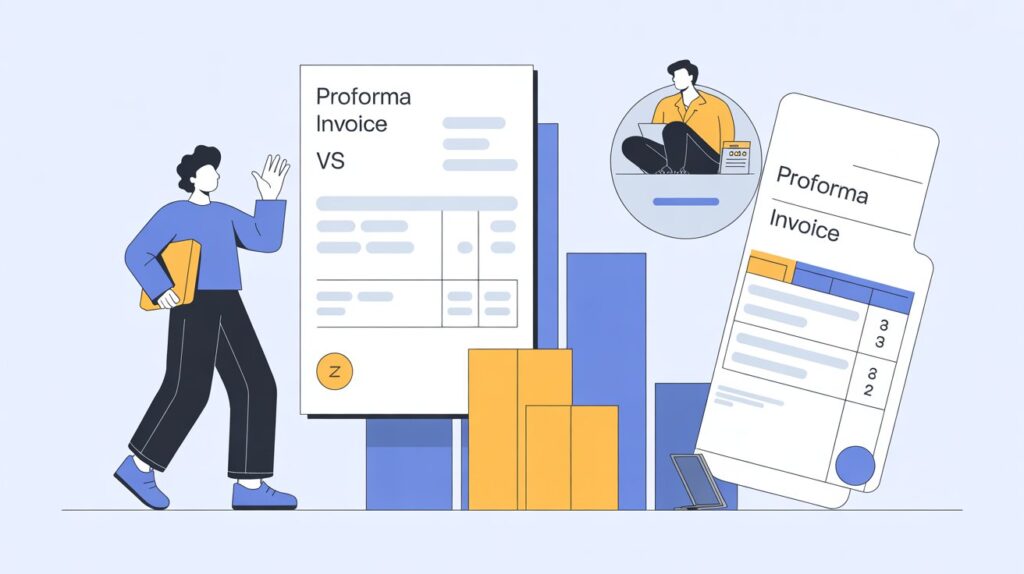
Here’s the brutal truth:
Most freelancers and small businesses mix these up.
They:
- Send a proforma invoice expecting payment
- Or send a final invoice too early
- Or don’t include terms and conditions for the invoice
Result?
👉 Clients delay payment
👉 Disputes happen
👉 Cash flow suffers
And then you’re googling things like:
- invoice vs bill
- difference between invoice and receipt
- invoice versus statement
Too late.
What Is a Proforma Invoice vs Commercial Invoice
This is where it gets interesting.
A commercial invoice is used in international trade—especially shipping.
- Used by courier companies like FedEx (commercial invoice template fedex, fedex invoice number, fedex pay invoice)
- Required for customs clearance
- Shows actual transaction value
Difference:
| Aspect | Proforma Invoice | Commercial Invoice |
|---|---|---|
| Purpose | Estimate | Official trade document |
| Customs Use | Sometimes | Always required |
| Payment | Not required | Required |
| Legal Value | Low | High |
👉 If you’re exporting products—even small Shopify items—you must use a commercial invoice, not a proforma.
What Is a Proforma Invoice vs Tax Invoice
Now we’re stepping into accounting territory.
A tax invoice:
- Includes VAT/GST details
- Used for tax reporting
- Mandatory in many countries
A proforma invoice:
- Does NOT include tax liability
- Is NOT used for accounting
Key Difference:
| Feature | Proforma Invoice | Tax Invoice |
|---|---|---|
| Tax Included | No | Yes |
| Legal Record | No | Yes |
| Used in Accounting | No | Yes |
So if you’re wondering what is the meaning of invoice in accounting—it’s the tax/commercial invoice, not the proforma.
What Is Proforma Invoice vs Sales Invoice
Honestly, this one is simple.
- Proforma invoice = before sale
- Sales invoice = after sale
But here’s where people mess up:
They send a sales invoice before work starts… and then revise it later.
Bad move.
Instead:
- Send a proforma invoice
- Get approval
- Then issue the sales invoice
Clean. Professional. No confusion.
What Is a Proforma Invoice vs Quote
Now we’re getting into subtle territory.
A quote (quotation):
- Informal or semi-formal price estimate
- May not include full breakdown
A proforma invoice:
- Looks like a real invoice
- Includes detailed pricing
- Feels more “official.”
Difference:
| Feature | Quote | Proforma Invoice |
|---|---|---|
| Formality | Low | High |
| Format | Simple | Invoice-style |
| Client Trust | Medium | High |
“A quote says ‘this might cost.’ A proforma says ‘this will cost.’”
What Is a Proforma Invoice vs Quotation
Yes, this looks repetitive—but there’s a nuance.
“Quotation” is just the formal word for “quote.”
But in business:
- A quotation is often negotiated
- A proforma invoice is closer to final pricing
So if you’re working with:
- contractors (example contractor invoice, construction invoice example)
- consultants (consultant invoice example, example invoice for consulting services)
👉 Always move from quotation → proforma → final invoice
What Is Proforma Invoice and a Commercial Invoice (Together)
In real workflows, both are used like this:
- Send a proforma invoice
- Client approves
- Ship goods
- Generate a commercial invoice
- Get paid
That’s the full pipeline.
Skip step 1, and you risk disputes.
Real-World Examples (So You Actually Get It)
Freelancer Scenario
You:
- Send proforma invoice (project scope)
- Client agrees
- You deliver work
- Send final invoice
Tools you might use:
- how to make an invoice in excel
- How can i make an invoice in Excel
- invoice template for hourly work
- invoice template for artists
Contractor Scenario
Includes:
- handyman invoice example
- roofing invoice example
- cleaning invoice example
Workflow:
- Quote → proforma → invoice → payment
eCommerce Scenario
- how to print an invoice from amazon
- how to download amazon invoice
- Amazon.in invoice
Here, invoices are auto-generated—but proforma invoices are used for:
- bulk orders
- B2B clients
Common Invoice Terms You Should Actually Understand
Let’s clear some confusion fast:
- Invoice in arrears → billed after service
- Invoice factoring → selling invoices for cash
- Invoice discounting factoring → similar, but you keep control
- What is invoice factoring? → A financing method
- Invoice vs PO (purchase order) → PO comes first
- What is PO number on the invoice → reference from the buyer
- Invoice vs sales order → sales order = internal, invoice = external
Payment Terms (Where Money Is Won or Lost)
- Net 15 / Net 30
- Past due invoice
- Outstanding invoice meaning
If you don’t define these clearly:
👉 Clients delay
👉 You chase payments
👉 Cash flow breaks
Use:
- email template for invoice
- past due invoice email template
Tools & Practical Setup (Stop Overcomplicating It)
You don’t need fancy software to start.
Basic tools:
- Google Docs (Google Docs templates, invoice, how to make an invoice on Google Docs)
- Excel (how to fill out an invoice)
- PayPal (how to send paypal invoice, paypal invoice charges)
Advanced tools:
- InvoiceGeneratorPro.io (How to generate a free Proforma invoice online)
- Custom invoice tools (this is where things scale)
Table: Common Invoice Types & Use Cases
| Invoice Type | Best For |
|---|---|
| Proforma Invoice | Pre-sale agreement |
| Sales Invoice | Final billing |
| Tax Invoice | Compliance |
| Commercial Invoice | International shipping |
| Deposit Invoice | Advance payment |
| Recurring Invoice | Subscriptions |
A Hard Truth Most People Ignore
If your invoicing system is disorganized, your business is likely to be as well.
No exceptions.
- No proper invoice numbering → chaos
- No terms and conditions for invoice → disputes
- No clear process → delayed revenue
And then people blame clients. No. It’s your system.
Subtle but Important: Language & Global Use
You’ll see variations like:
- invoice in Spanish / qué es un invoice / cómo hacer invoice
- invoice que es
Same concept, different regions.
But structure? Universal.
Key Takeaways (Read This Twice)
- Proforma invoice = estimate before payment
- Invoice = official payment request
- Never mix the two
- Use a proforma for clarity, invoice for cash
- Always include:
- invoice number
- due date
- payment terms
- Move clients through a clear pipeline:
👉 Quote → Proforma → Invoice → Payment
Final Thoughts (And a Straight Reality Check)
You don’t need more traffic.
You need:
- Better invoicing structure
- Clear workflow
- Professional presentation
Because here’s the truth:
“People don’t delay payments because they’re bad clients. They delay because your system allows it.”

Akbar Ali is the Founder of InvoiceGeneratorPro.io, a platform dedicated to helping freelancers, small businesses, startups, agencies, and entrepreneurs create professional invoices quickly and efficiently. With years of experience in digital business, SEO content strategy, and online entrepreneurship, he focuses on developing practical tools and educational resources that simplify invoicing, payment management, and financial documentation.As a business writer and digital entrepreneur, Akbar creates in-depth guides, industry insights, and actionable content covering invoicing, freelancing, accounting basics, business finance, taxation, productivity, and payment solutions. His goal is to make complex financial processes easy to understand while helping professionals save time and present their businesses more professionally.Through InvoiceGeneratorPro.io, he continues to build reliable, user-friendly solutions that empower businesses worldwide to streamline their billing workflows and improve financial organization.
Akbar Ali