07 Apr
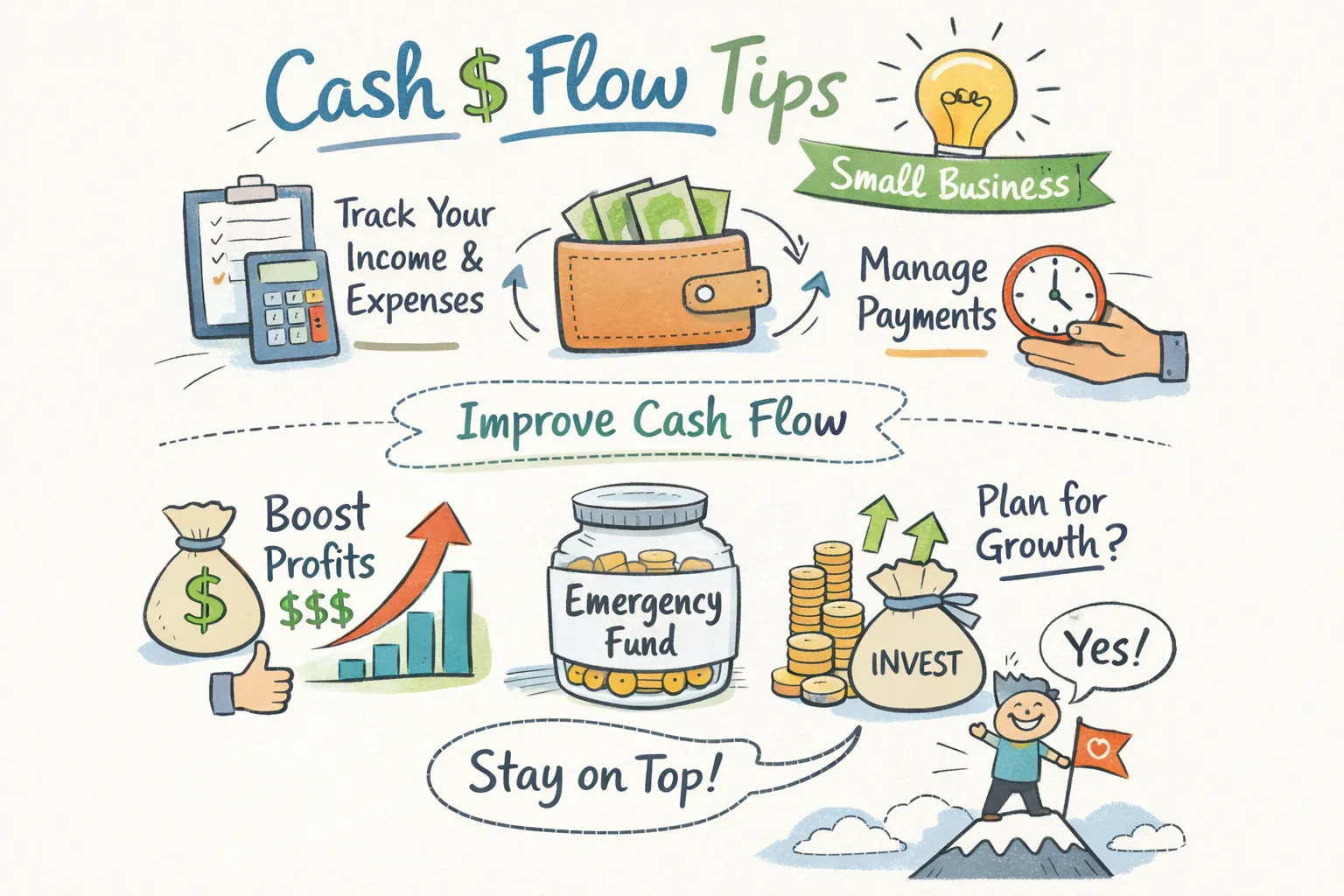
82% of small business failures trace back to cash flow problems, not a weak product or a shrinking market. The business runs out of money before it runs out of potential. That’s a stark statistic, but it points to something specific: the problem is almost always timing, not fundamentals. Understanding how small businesses manage cash flow, and where timing breaks down, is the first step toward fixing it.
Revenue looks healthy on paper, but the bank account tells a different story. This gap is where most small businesses quietly struggle. You invoice a client, they pay in 45 days, and meanwhile payroll is due in 10. The business is profitable and broke at the same time, which is a genuinely disorienting position to be in.
Controlling cash flow means actively managing the timing of money coming in and money going out. It’s not about watching your balance and hoping for the best. This article gives you a practical framework: a forecast to see what’s coming, tactics to speed up collections and stretch payables, the right financing when a real gap appears, and three KPIs to track it all monthly.
1. Build your monthly cash flow forecast before anything else
A cash flow forecast is the foundation of everything else in this article. Without one, you’re reacting to problems after they’ve already arrived. With one, you see them two or three months out, exactly enough time to do something about them.
The structure is simple. Every forecast has four core rows: starting balance, total inflows, total outflows, and ending balance. The formula is: Ending Balance = Starting Balance + Total Inflows − Total Outflows. Each month’s ending balance rolls forward and becomes the next month’s starting balance, giving you a continuous, rolling picture of your cash position. This is the backbone of any solid cash flow statement.
Build this in Google Sheets or Excel with 12 columns for months and rows for each cash category. Under inflows, include sales revenue, client payments, and any expected deposits. Under outflows, separate fixed costs (rent, payroll, insurance) from variable ones (inventory, marketing, contractor payments). Fixed costs are predictable; variable costs need a range. Use 3, 6 months of actual historical data as your baseline, not memory or optimism.
Apply one conservative adjustment throughout: slightly overestimate outflows and slightly underestimate inflows. This builds a natural buffer into the model. If the forecast shows a negative ending balance two months from now, that’s two months of runway to act. Review it monthly at minimum, or weekly when cash is tight. A forecast you don’t look at is just a spreadsheet collecting dust.
2. How small businesses manage cash flow faster: rethink how you invoice
A common invoicing mistake small businesses make is waiting days or even weeks after completing work to send the bill. Every delay shifts the payment due date forward by exactly the same number of days. A Net 30 invoice sent five days late is functionally a Net 35 invoice, and that adds up fast when you’re watching your cash cycle. Strong accounts receivable management starts with sending the invoice the moment the work is done.
A professional invoice that arrives immediately signals that you take billing seriously, and clients prioritize invoices that look clean and land quickly. Invoice Generator Pro fits naturally into this workflow. You can build a complete, professional PDF invoice in under a minute, email it directly to the client from the same screen, and move on, no sign-up needed, no subscription required. Getting the invoice out the same day is the easiest lever you have for getting paid faster.
Take a hard look at your default payment terms as well. Net 30 is industry standard, but it doesn’t have to be yours. Switching to Net 15 cuts your receivables window in half. For clients with good payment history, a 2/10 Net 30 structure (2% discount for payment within 10 days) can compress your average collection time significantly. Businesses using this structure regularly report collection times dropping by two weeks or more. The discount costs less than the cash gap hurts.
Remove every friction point between your client and payment. Offer ACH, credit card, and digital payment links. Put payment instructions directly on the invoice so clients never have to ask how to pay you. Every extra step between invoice received and payment sent is a delay you’re creating yourself.
3. Slow the money going out without damaging vendor relationships
While you’re speeding up inflows, you want to slow outflows in a deliberate, relationship-preserving way. The gap between when cash comes in and when it goes out is your working capital buffer, and working capital management is just as important as chasing faster payments. The wider that gap, the more breathing room you have.
Start by negotiating extended payment terms with your suppliers. Most vendors default to Net 30, but Net 45 or Net 60 is often available to businesses with a clean payment history. You don’t get what you don’t ask for. Longer payables terms directly widen your working capital window without costing you anything except a brief, professional conversation.
Pay invoices on their due date, not before. Paying early when you’re managing cash carefully is essentially an interest-free loan to your vendor. Unless a supplier offers an early payment discount worth taking, hold your cash until the due date. Batch your payment days to two or three fixed days per month. This creates predictability in your outflows and keeps your bank balance clearly visible between runs.
Do a quarterly audit of recurring expenses. Subscriptions, software licenses, and service retainers accumulate quietly. A line-by-line review every three months regularly turns up nonessential recurring spend that isn’t actively generating revenue. Cancelling a $200/month tool you’ve outgrown isn’t just an expense cut, it’s $2,400 returned to your cash reserve annually.
4. How much cash reserve your business actually needs
The widely recommended baseline is 3, 6 months of operating expenses held in liquid reserve. Note the word “expenses,” not revenue. If your monthly overhead runs $20,000, your target reserve is $60,000 to $120,000. That buffer absorbs a slow month, an unexpected expense, or a client who pays late without forcing you into emergency mode.
Seasonal businesses operate on a different rule. Retail, landscaping, event planning, and similar businesses face revenue swings that make the standard baseline inadequate. For these businesses, 15, 30% of annual revenue held in reserve is the more practical target. Early-stage businesses and those in active growth phases should also aim for the higher end of the range, because cash flow is harder to predict when the business model is still maturing.
The practical path to building reserves is consistent, automatic, and small. Set aside a fixed percentage of every client payment before anything else. Even 5, 10% per inflow builds meaningful reserves over 6, 12 months. Keep the reserve in a separate high-yield savings account. Separation prevents you from spending it accidentally. Yield makes it work while it waits. For guidance on how much cash reserves a business should hold, see recommendations on how much cash reserves should a business have.
5. How small businesses manage cash flow gaps: short-term financing options
Sometimes the forecast shows a gap that you can’t close through invoicing or payables adjustments alone. That’s when short-term financing enters the picture. The right option depends on the size of the gap, how quickly you need funds, and what your credit profile looks like.
A business line of credit is the most flexible tool available. It gives you revolving access to capital that you draw and repay as needed, similar to a credit card but designed for operating needs. APRs typically run 8, 60%, with businesses above a 700 credit score accessing the better end of that range. A line of credit works best for predictable, temporary shortfalls like covering payroll before a large client payment clears.
Invoice financing converts unpaid invoices into immediate cash, usually within 1, 24 hours. Eligibility is based on your clients’ creditworthiness rather than your own, which makes it accessible for B2B businesses waiting on 30, 90 day payments. It’s a clean option when the gap is caused by slow-paying clients rather than underlying business weakness. Merchant cash advances offer faster access, often same-day, but at factor rates of 1.1, 1.5, which translates to an effective APR of 15, 150%. They work for businesses with consistent daily sales volume, but the cost structure makes them a last resort, not a first choice.
6. Three cash KPIs worth checking every single month
Managing cash flow without tracking it is guesswork. Three specific metrics give you a clear, monthly read on how your cash position is actually moving. Reviewing them monthly matters because monthly cycles match your billing and payables rhythms, giving you enough data to spot trends without waiting so long that a problem becomes a crisis.
Days Sales Outstanding (DSO) measures how long it takes to collect payment after invoicing. Formula: (Accounts Receivable ÷ Total Credit Sales) × Number of Days. A falling DSO month over month means your invoicing and collections process is tightening. A rising DSO is an early warning sign, and early warning signs are exactly what you’re building this system to catch.
The Cash Conversion Cycle (CCC) gives you a broader view of working capital efficiency. Formula: CCC = DSO + Days Inventory Outstanding − Days Payable Outstanding. A shorter CCC means your business converts resources into cash faster. Most of the tactics covered in this article directly shrink the CCC: faster invoicing reduces DSO, negotiated payables increase DPO, and both pull the cycle tighter in your favor.
The operating cash ratio tells you whether your operations are self-sustaining. Formula: Monthly Operating Cash Flow ÷ Monthly Operating Expenses. A ratio above 1.0 means your business generates enough cash to cover itself without outside help. When it drops below 1.0 consistently, it’s time to revisit your receivables pace, your expense structure, or both. Don’t wait for the bank balance to make this obvious.
Start with the first step and build from there
Cash flow management is fundamentally about timing. Revenue is when you earn it; cash is when you actually have it. The gap between those two things is where the stress lives, and learning how small businesses manage cash flow effectively comes down to closing that gap deliberately, one step at a time.
The action framework looks like this: build a rolling forecast so you can see shortfalls before they arrive, invoice fast and professionally so money moves in quickly, control your payables timing so money stays in longer, hold a reserve so surprises don’t become crises, use the right financing when you need it, and track your three KPIs so nothing catches you off guard.
If you’re not already sending professional invoices the same day work is completed, start there with useful resources for freelancers and small businesses. Invoice Generator Pro’s blog also offers practical tips and examples to help you implement these tactics quickly. Invoice Generator Pro is free to use, requires no sign-up, and produces a polished, client-ready PDF invoice in under a minute, making it a practical first step toward tightening your payment cycle. Cash flow management is a skill, and the businesses that get it right aren’t luckier than yours. They’re just more deliberate about it.

Akbar Ali is the Founder of InvoiceGeneratorPro.io, a platform dedicated to helping freelancers, small businesses, startups, agencies, and entrepreneurs create professional invoices quickly and efficiently. With years of experience in digital business, SEO content strategy, and online entrepreneurship, he focuses on developing practical tools and educational resources that simplify invoicing, payment management, and financial documentation.As a business writer and digital entrepreneur, Akbar creates in-depth guides, industry insights, and actionable content covering invoicing, freelancing, accounting basics, business finance, taxation, productivity, and payment solutions. His goal is to make complex financial processes easy to understand while helping professionals save time and present their businesses more professionally.Through InvoiceGeneratorPro.io, he continues to build reliable, user-friendly solutions that empower businesses worldwide to streamline their billing workflows and improve financial organization.
Akbar Ali