
Let’s be honest for a second.
If you’ve ever stared at your accounting folder and thought, “Wait… is this an invoice or a receipt?” — you’re not alone.
Many people search questions like invoice vs receipt, is an invoice a receipt, or is invoice the same as receipt because the two documents look very similar.
Business owners, freelancers, accountants, and even experienced managers sometimes mix them up. And honestly, it makes sense. They both deal with money, transactions, and business records.
But here’s the truth: the difference between invoice and receipt isn’t just about wording. It has legal, financial, and tax implications.
So let’s break down invoice vs receipt meaning in simple language — no accounting jargon, just clear explanations.
First Things First: What Is an Invoice?
An invoice is a request for payment.
In simple terms, an invoice tells a customer how much they owe and what they are paying for. This is why people often search questions like is invoice a receipt or is an invoice the same as a receipt.
The answer is no.
An invoice is sent before payment.
Typical invoice details include:
- Seller and buyer details
- Description of goods or services
- Quantity and price
- Taxes (if applicable)
- Payment terms and due date
A sales invoice vs receipt comparison shows that a sales invoice records what was sold but payment has not yet been completed.
This is why the invoice and receipt difference matters in accounting and bookkeeping.
And What About a Receipt?
A receipt is proof that payment has already happened.
In other words:
- The invoice asks for money
- The receipt confirms the money was paid
This explains the common question receipt vs invoice or receipt versus invoice.
A receipt usually includes:
- Payment date
- Payment method
- Amount paid
- Seller information
- Transaction reference
So if someone asks is invoice a receipt or is invoice same as receipt, the answer is still no.
An invoice comes before payment, while a receipt comes after payment.
The Core Invoice and Receipt Difference (No Jargon)
The easiest way to understand the invoice and receipt difference is this:
- Invoice = Payment request
- Receipt = Payment confirmation
Many searches like difference between invoice and receipt, difference between a receipt and invoice, and what is the difference between invoice and receipt are simply asking about this timing difference.
But business situations can be more complex, so let’s explore deeper.
Invoice vs Receipt vs Bill — Why So Many Names?
Another common confusion is invoice or receipt vs bill.
People often search terms like invoice vs receipt meaning or difference of invoice and receipt because businesses use these words differently.
Here’s the simplified breakdown:
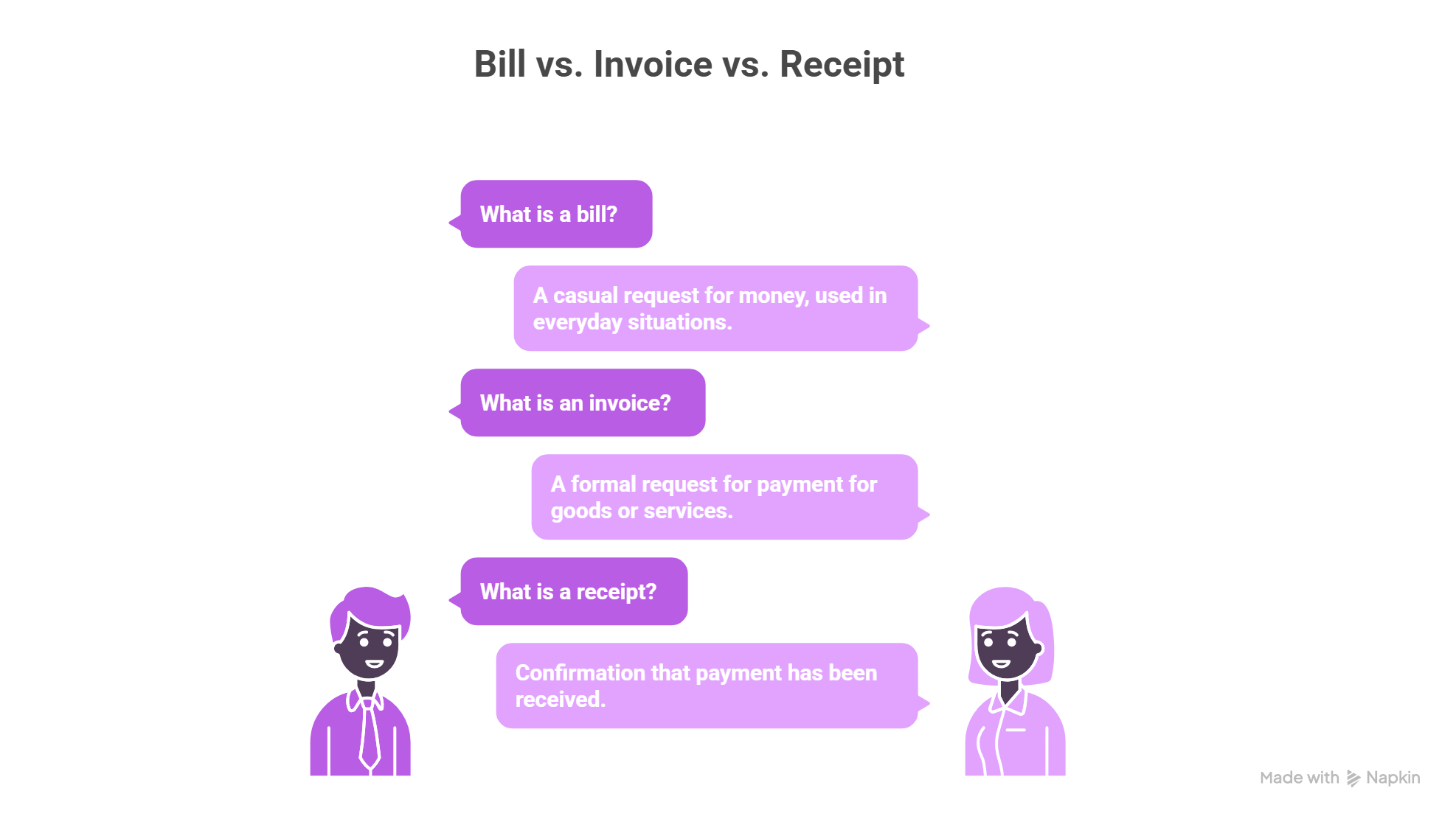
- Bill → informal payment request
- Invoice → formal payment request used in business
- Receipt → proof that payment was made
So when someone asks about the bill invoice receipt difference, they’re really asking about when the document is used during a transaction.
Bill and Receipt Difference (Everyday Example)
Let’s imagine a simple situation.
You go to a café.
- The waiter gives you a bill
- You pay the bill
- You receive a receipt
This everyday example explains the difference between receipt and invoice in practical life.
Sales Invoice and Receipt Difference (Business Reality)
In business accounting, the sales invoice vs receipt difference becomes important.
A sales invoice shows what the customer still owes.
A sales receipt vs invoice comparison shows that the receipt only appears after the payment is completed.
Many people ask questions like:
- is a sales invoice a receipt
- is sales invoice same as official receipt
- sales invoice vs official receipt
The answer again depends on payment timing.
A sales invoice records the transaction request.
A receipt confirms the transaction was completed.
Modern tools like Invoice Generator Pro help businesses create invoices and receipts quickly, keeping financial records organized and reducing confusion between documents.
Tax Invoice and Receipt Difference (Where Things Get Serious)
Now we’re stepping into compliance territory.
A tax invoice includes specific tax details required by law:
- VAT or GST number
- Tax amount
- Seller’s registered details
A receipt may show tax, but it doesn’t replace a tax invoice for claiming input tax credits.
This distinction the tax invoice and receipt difference can literally affect how much tax you pay or recover.
Invoice and Official Receipt Difference
Invoice vs Receipt Comparison Table
| Feature | Invoice | Receipt |
|---|---|---|
| Purpose | Request payment | Confirm payment |
| Timing | Before payment | After payment |
| Tax Use | Required for tax reporting | Proof of payment |
In many countries, especially across Asia, businesses issue official receipts.
An invoice says, “You owe this.”
An official receipt says, “We’ve received this.”
So when people ask about the invoice and official receipt difference, the answer again comes back to timing and legal weight.
Invoice and Goods Receipt Difference (Logistics Angle)
Here’s a curveball many businesses overlook.
A goods receipt confirms that items were physically received — usually in warehouses or supply chains.
The invoice and goods receipt difference is critical in inventory management:
- Invoice → financial document
- Goods receipt → operational document
Mismatch between the two? That’s how disputes begin.
Difference Between Invoice and Delivery Receipt
Closely related, but not the same.
A delivery receipt proves goods were delivered.
An invoice proves payment is expected.
The difference between invoice and delivery receipt matters during shipping claims, damaged goods, or supplier disagreements.
Difference Between Tax Invoice and Receipt Voucher
A receipt voucher is an internal accounting record — not a customer-facing document.
The difference between tax invoice and receipt voucher is mostly about audience:
- Tax invoice → customer & tax authority
- Receipt voucher → internal bookkeeping
Accountants care. Auditors care even more.
E-Invoice and Receipt Difference (Welcome to Digital)
Digital documents didn’t erase the difference — they just made it faster.
An e-invoice is an electronic version of an invoice, often submitted to tax systems automatically.
A digital receipt confirms payment electronically.
The e invoice and receipt difference still follows the same rule:
Request vs confirmation.
Invoice and Receipt Law Around the World
Disclaimer: I am not a financial advisor or lawyer. What follows is based on publicly available information as of early 2026, and laws may change. Always consult a qualified tax professional or legal expert before making decisions based on tax or regulatory requirements.
Understanding the invoice and receipt difference law matters far beyond semantics — it affects tax compliance, audit readiness, and your legal standing with clients and authorities. Laws vary widely depending on where you do business, so let’s break things down in plain language.
United States 🇺🇸
In the U.S., there’s no single federal law that strictly defines how invoices must look for all businesses. An invoice is mainly a business request for payment, shaped by contracts and accounting standards rather than a national invoice law.
Receipts matter more when sales tax is involved. Many states expect businesses to provide receipts showing tax collected. So legally speaking, invoices help you get paid, while receipts help prove tax collection and completed transactions.
United Kingdom 🇬🇧
In the UK, the difference between invoice and receipt becomes clearer once VAT enters the picture.
If you’re VAT-registered, issuing a VAT invoice is legally required. It must include your VAT number, tax amounts, and clear transaction details. A receipt, on the other hand, confirms payment and may or may not replace a VAT invoice depending on the situation.
No VAT registration? Then invoices and receipts still exist, but the legal pressure is lighter.
European Countries 🇪🇺 (General Rule)
Across most European countries, invoices are strongly tied to VAT law. A proper invoice isn’t optional for VAT-registered businesses—it’s a legal document that allows tax reporting and VAT recovery.
Receipts usually confirm payment, especially for consumer sales, but invoices carry more legal weight in business-to-business transactions. Many EU countries are also shifting toward mandatory electronic invoicing.
Germany 🇩🇪
Germany follows EU VAT rules but is stricter in practice. Invoices must contain detailed information, and businesses are expected to store them carefully for audits.
Germany is also moving toward mandatory e-invoicing, meaning invoices will increasingly need to be issued and received in structured digital formats. Receipts still prove payment, but invoices remain the backbone of tax compliance.
Pakistan 🇵🇰
In Pakistan, invoices and receipts are regulated mainly through Sales Tax laws and FBR rules.
Registered businesses must issue tax invoices with proper registration numbers and tax details. Recently, e-invoicing has been introduced for certain sectors, linking invoices directly to the tax authority.
Receipts confirm payment, but from a legal and tax perspective, the invoice carries more authority.
India 🇮🇳
India’s GST system clearly defines the invoice and receipt difference by law.
A GST invoice is mandatory for registered businesses and must include GSTIN, tax rates, and HSN/SAC codes. For larger businesses, e-invoicing is compulsory.
Receipts confirm payment, but they do not replace a GST-compliant invoice. For tax filing and input credit, invoices are essential.
Philippines 🇵🇭
In the Philippines, the law traditionally placed strong importance on official receipts as proof of income and payment.
Invoices request payment; official receipts confirm it. However, the system is gradually shifting toward electronic invoicing, especially for larger taxpayers. Both documents now play defined but separate roles in tax reporting.
Australia 🇦🇺
Australia has clear GST rules. If you’re GST-registered, you must issue a tax invoice for taxable sales above a certain amount.
That invoice must show your ABN, GST amount, and transaction details. Receipts may be used for proof of payment, but for GST claims, a valid tax invoice is usually required.
Australia also supports e-invoicing, making compliance easier and faster.
Invoice and Receipt Difference Template (Visual Logic)
If you were to design an invoice and receipt difference template, it would look like this:
Invoice Template Includes
- Due date
- Payment terms
- Outstanding amount
Receipt Template Includes
- Payment date
- Payment method
- Amount received
Same transaction. Different purpose.
Common Mistakes People Make (You Might Recognize These)
- Sending a receipt when an invoice is needed
- Claiming tax on a receipt instead of a tax invoice
- Using “bill” and “invoice” interchangeably in contracts
- Losing receipts and regretting it during audits
Honestly, we’ve all been there.
Why This Difference Actually Matters
Understanding the difference between invoices and receipts is not just paperwork.
It affects:
- Cash flow management
- Tax compliance
- Legal protection
- Business transparency
An invoice protects your right to receive payment.
A receipt proves payment was completed.
Both documents are essential in professional financial management.
Final Thoughts (Let’s Wrap This Up)
The invoice vs receipt debate is simpler than most people think.
Invoices ask for payment.
Receipts confirm payment.
Many search questions like are invoice and receipt the same, is invoice a receipt, or what is difference between receipt and invoice all come down to this simple rule.
Invoices request money.
Receipts prove money was paid.
Once you understand this invoice and receipt difference, managing business finances becomes far easier.
And honestly, that clarity alone makes running a business a lot smoother.

Akbar Ali is the Founder of InvoiceGeneratorPro.io, a platform dedicated to helping freelancers, small businesses, startups, agencies, and entrepreneurs create professional invoices quickly and efficiently. With years of experience in digital business, SEO content strategy, and online entrepreneurship, he focuses on developing practical tools and educational resources that simplify invoicing, payment management, and financial documentation.As a business writer and digital entrepreneur, Akbar creates in-depth guides, industry insights, and actionable content covering invoicing, freelancing, accounting basics, business finance, taxation, productivity, and payment solutions. His goal is to make complex financial processes easy to understand while helping professionals save time and present their businesses more professionally.Through InvoiceGeneratorPro.io, he continues to build reliable, user-friendly solutions that empower businesses worldwide to streamline their billing workflows and improve financial organization.
2 Comments
Ayesha Khan
February 8, 2026This was super helpful, especially the real-life examples like the café scenario, that made it much easier to understand. I also liked how you explained the legal and tax side without making it too complicated
Daniel Brooks
March 25, 2026Honestly, this is one of the clearest explanations I’ve come across on this topic. I used to mix up invoices and receipts all the time, especially when managing freelance projects. The way you broke it down into “request vs confirmation” really made it click for me. It’s true that the timing is everything invoices before payment and receipts after, but most articles don’t explain it this simply. Great job making a confusing topic feel so straightforward.


Akbar Ali