
A surprising number of invoices don’t get delayed because the work was bad. They get delayed because the invoice was confusing.
That’s the part many freelancers, agencies, consultants, and small business owners miss.
You send the invoice. The client opens it. Then comes silence.
Not because they refuse to pay — sometimes they simply don’t understand what they’re paying for.
Honestly, vague invoice descriptions create friction. And friction slows payments.
Think about it like ordering food from a menu with no descriptions. “Special Dish #4.” Sounds suspicious, right? Your invoice line items can feel the same way when they’re too broad, too technical, or stuffed with internal jargon.
Clear invoice descriptions build trust. They reduce disputes. They make you look organized and professional. More importantly, they help clients approve payments faster.
And yes, faster approvals usually mean faster cash flow.
Why Invoice Clarity Matters More Than You Think
A professional invoice isn’t just a payment request. It’s communication.
Clients want transparent billing descriptions because nobody likes guessing where their money went. Even long-term clients appreciate easy-to-read invoices with accurate invoice descriptions.
Here’s the thing — when invoices are unclear, clients start asking questions:
- “What does this charge include?”
- “Why am I being billed for this?”
- “Was this part of the original scope?”
That back-and-forth wastes time for everyone.
“Confusion creates hesitation. Clarity creates confidence.”
Simple sentence. Very true.
Businesses that improve invoice readability often notice fewer payment delays and fewer invoice disputes. It’s not magic. It’s psychology.
People pay faster when things feel straightforward.
The Most Common Invoice Description Mistakes
You know what? Most invoice wording problems are painfully predictable.
Here are a few examples.
| Poor Invoice Description | Why It Fails |
|---|---|
| “Marketing Services” | Too vague |
| “Website Work” | Doesn’t explain deliverables |
| “Consulting” | Missing time, scope, or outcome |
| “Design Changes” | Sounds unclear and open-ended |
| “Monthly Services” | Could mean anything |
Now compare that with stronger invoice item descriptions.
| Better Invoice Description | Why It Works |
|---|---|
| “SEO optimization for 12 blog articles” | Specific deliverable |
| “Homepage redesign and mobile responsiveness updates” | Clear scope |
| “5 hours of business consulting for sales workflow planning” | Time + purpose |
| “Instagram ad creative design – 3 concepts delivered” | Transparent work summary |
| “Monthly bookkeeping for April 2026” | Time period included |
See the difference?
Detailed invoice descriptions remove uncertainty before it even starts.
What Clients Actually Want to See
Clients usually don’t care about your internal workflow. They care about outcomes.
So instead of writing:
“Backend optimization implementation”
You could say:
“Website speed improvements and image compression updates”
Same work. Different language. One sounds robotic; the other sounds understandable.
Professional billing communication works best when it’s simple, direct, and human.
A good invoice description often includes:
- What was done
- Quantity or hours
- Time period
- Deliverables
- Project stage or milestone
That’s it.
You don’t need Shakespeare. You need clarity.
How to Write Professional Invoice Descriptions
Let me explain a simple framework that works surprisingly well.
1. Start With the Service
Mention the core task first.
Examples:
- Logo design
- SEO audit
- Content writing
- Social media management
- Website maintenance
This immediately tells the client what category the charge belongs to.
2. Add Specific Deliverables
Now, clarify exactly what was completed.
Instead of:
“Content Services”
Try:
“Writing and editing 4 finance blog articles”
Or:
“Product page copywriting for Shopify store”
Clear invoice wording reduces unnecessary client questions.
3. Mention Time or Quantity
Especially important for freelancers and consultants.
Examples:
- “8 hours of UI design revisions”
- “Weekly bookkeeping services for May”
- “3 video editing revisions completed.”
This strengthens billing transparency.
4. Keep It Human
A lot of businesses accidentally write invoice descriptions like machine-generated legal text.
Don’t do that.
Simple language wins.
Here’s a good comparison:
| Robotic Wording | Human-Friendly Wording |
|---|---|
| “Digital asset modification services rendered” | “Editing product images for website” |
| “Strategic content dissemination consultation” | “Social media content planning session” |
| “Technical interface debugging operations” | “Fixing website checkout errors” |
Honestly, the clearer version almost always performs better.
A Little Psychology Behind Faster Payments
This part matters more than people realize.
When clients see organized invoice line items, their brains process the payment as legitimate and low-risk.
Messy invoices trigger skepticism.
That’s why customer-friendly billing matters.
There’s actually a subtle emotional layer here. If your invoice feels rushed, vague, or confusing, clients subconsciously assume the work may have been rushed, too.
Fair? Maybe not.
Real? Absolutely.
“People rarely argue with invoices they fully understand.”
And that’s why transparent billing descriptions can directly affect payment speed.
Invoice Description Examples for Freelancers
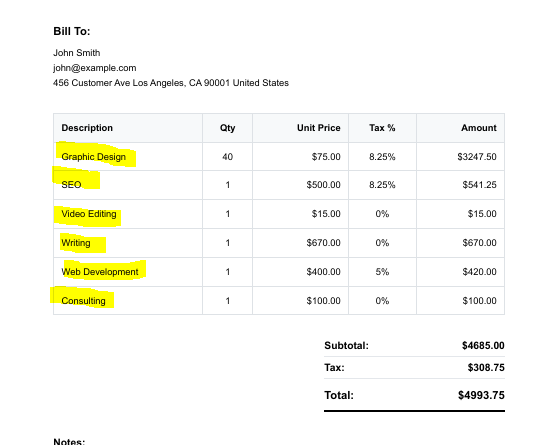
Freelancers often struggle with invoice wording because creative work can feel difficult to describe.
Here are better ways to explain freelance services on invoices.
| Service | Strong Invoice Description |
|---|---|
| Graphic Design | “Design of 3 promotional Instagram banners” |
| SEO | “Keyword research and on-page SEO updates for 10 pages” |
| Video Editing | “Editing and subtitle creation for YouTube video” |
| Writing | “Writing 2 long-form blog articles (1500 words each)” |
| Web Development | “Homepage bug fixes and contact form integration” |
| Consulting | “2-hour sales funnel consulting session” |
These service invoice examples feel professional without sounding stiff.
That balance matters.
The “Too Much Detail” Problem — Yes, It Exists
Now here’s a mild contradiction.
Earlier, we talked about detailed invoice descriptions. But too much detail can also become a problem.
Some businesses overload invoices with paragraphs nobody wants to read.
Clients don’t need your entire workflow diary.
Keep descriptions concise but informative.
Bad example:
“Conducted a collaborative strategic analysis session involving multiple iterations of consumer-oriented optimization techniques…”
Nobody talks like that.
Better:
“Customer journey analysis and landing page improvement recommendations”
Shorter. Cleaner. Easier to approve.
Why Itemized Invoices Feel More Professional
Itemized billing statements make businesses look organized.
Even simple breakdowns improve trust.
For example:
| Invoice Item | Amount |
|---|---|
| SEO audit for an e-commerce store | $200 |
| Technical SEO fixes | $350 |
| Blog optimization (5 articles) | $250 |
This structure makes payment feel reasonable because clients can see the value attached to each service.
That visibility matters psychologically.
Honestly, itemized invoices also protect you during disputes. If a client questions charges later, your invoice explanation examples already provide evidence.
Use Tools That Make Invoice Writing Easier
A lot of freelancers still build invoices manually in Word or Excel.
That usually creates inconsistent formatting, missing invoice details, and sloppy billing descriptions.
Professional invoice tools solve that problem quickly.
If you want cleaner invoice templates with organized invoice line items and client-friendly layouts, try the free professional invoice creator here:
It helps structure detailed invoice descriptions naturally, especially for freelancers, consultants, agencies, and small businesses.
And honestly, presentation matters. A polished invoice instantly feels more trustworthy than a cluttered spreadsheet screenshot.
Small Tweaks That Quietly Improve Invoice Approval Rates
Sometimes tiny wording adjustments make a huge difference.
Here are a few smart improvements:
- Replace “Miscellaneous Work” with actual deliverables
- Include project names where possible
- Mention billing periods clearly
- Keep terminology consistent
- Avoid abbreviations clients may not understand
You’d be surprised how many invoice disputes come from lazy wording.
Not malicious wording. Lazy wording.
There’s a difference.
A Quick Note About Late Payments
Clear invoice communication won’t magically eliminate every late payment. Some clients are simply disorganized.
But unclear invoices definitely make the problem worse.
If your invoices constantly generate follow-up emails, clarification requests, or confusion, the issue probably isn’t your pricing.
It’s your communication.
And fixing that can genuinely improve cash flow.
Key Takeaways
What Makes a Good Invoice Description?
- Use simple, understandable language
- Clearly explain deliverables
- Include quantities, dates, or hours
- Avoid vague wording like “services rendered.”
- Keep invoice line items organized
- Use itemized billing whenever possible
- Write for the client, not for internal jargon
- Professional invoice formatting improves trust
- Clear invoices reduce disputes and payment delays
Final Words
Writing better invoices sounds boring until delayed payments start piling up.
Then suddenly, invoice wording matters a lot.
Clear invoice descriptions help clients feel confident about paying you. They improve professionalism, reduce misunderstandings, and strengthen business relationships over time.
And honestly, they make you look more organized too.
If you want an easier way to create professional invoices with transparent billing descriptions and clean formatting, this free tool is worth trying:
Professional Invoice Generator Tool
Because sometimes getting paid faster isn’t about charging more.
It’s about communicating better.

Akbar Ali is the Founder of InvoiceGeneratorPro.io, a platform dedicated to helping freelancers, small businesses, startups, agencies, and entrepreneurs create professional invoices quickly and efficiently. With years of experience in digital business, SEO content strategy, and online entrepreneurship, he focuses on developing practical tools and educational resources that simplify invoicing, payment management, and financial documentation.As a business writer and digital entrepreneur, Akbar creates in-depth guides, industry insights, and actionable content covering invoicing, freelancing, accounting basics, business finance, taxation, productivity, and payment solutions. His goal is to make complex financial processes easy to understand while helping professionals save time and present their businesses more professionally.Through InvoiceGeneratorPro.io, he continues to build reliable, user-friendly solutions that empower businesses worldwide to streamline their billing workflows and improve financial organization.
Akbar Ali