
Working with clients in other countries can open up a much larger market for a freelancer, consultant, agency, or small business. It also creates a few billing questions that don’t come up when you invoice someone in your own country.
Which currency should you use? Should you charge in USD, EUR, GBP, or the client’s local currency? How should you show an exchange rate? What bank details does the client need? What about payment fees, VAT, or tax information?
These details can affect how much you receive and how easily your client can pay.
A good international invoice should give the client a clear amount, clear payment instructions, and enough business information to process the payment without a long email conversation.
This guide explains how to invoice international clients, how to handle foreign currency, and what to check before sending an invoice.
What Is an International Invoice?
An international invoice is a bill sent to a customer or business in another country for products or services.
The basic purpose is the same as a domestic invoice. You list what you provided, how much it costs, when payment is due, and how the client can pay.
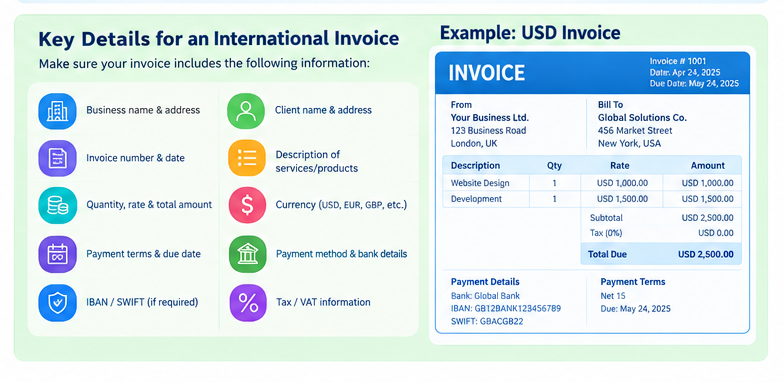
The difference comes from the cross-border details. An international invoice may include:
- Your business name and address
- Client name and address
- Invoice number
- Invoice date
- Description of products or services
- Quantity, hours, or units
- Price per unit
- Subtotal
- Tax, where applicable
- Total amount
- Invoice currency
- Payment due date
- Payment terms
- Bank or payment details
- IBAN or SWIFT/BIC details where applicable
- Tax ID or VAT number where required
For example, a freelancer in Pakistan may complete a $1,200 website project for a US company. The freelancer can issue an invoice in USD and give the US client payment instructions for receiving the money.
A UK agency may invoice a client in EUR. A consultant in Germany may bill a customer in GBP. The country of the seller and buyer doesn’t automatically determine the invoice currency.
The agreed contract or payment arrangement matters.
How to Invoice International Clients Step by Step
International invoicing becomes much easier when you follow the same process for every client.
1. Confirm the Client’s Billing Details
Before creating the invoice, check the information provided by the client. You may need:
- Legal business name
- Billing address
- Contact person’s name
- Email address
- Country
- Tax identification number
- VAT number, where applicable
- Purchase order number, if required
A small spelling error in a company name can create problems for the client’s accounting department.
If the client has a specific invoice format or required fields, ask for those requirements before sending your first invoice.
2. Agree on the Invoice Currency
Confirm the currency before starting the work or signing the contract. Common choices include:
- USD, United States dollar
- EUR, euro
- GBP, British pound
- CAD, Canadian dollar
- AUD, Australian dollar
- CHF, Swiss franc
- AED, United Arab Emirates dirham
Don’t assume that the client’s country automatically tells you which currency to use.
A US client may agree to pay in EUR. A European client may prefer USD. A UK company may have suppliers that invoice in GBP.
Put the agreed currency into your contract or written payment terms whenever possible.
3. Create the Invoice
Your invoice should clearly show the currency. For example:
Total Due: USD 1,500.00
is much clearer than:
Total Due: 1,500.00
The second version leaves the client wondering what currency you mean.
Use the currency code as well as the symbol when confusion is possible. USD, EUR, and GBP are especially useful for international transactions because symbols such as “$” can refer to more than one currency.
4. Add a Clear Description of the Work
Don’t write something vague such as “Services – $1,500.”
Give the client enough information to connect the invoice to the work.
For example:
| Description | Quantity | Rate | Amount |
|---|---|---|---|
| Website landing page design | 1 | USD 600 | USD 600 |
| WordPress development | 1 | USD 700 | USD 700 |
| Website testing | 1 | USD 200 | USD 200 |
| Total | USD 1,500 |
The client should be able to understand what they’re paying for without opening another document.
5. Set Payment Terms
State when payment is due.
Common payment terms include:
- Due on receipt
- Net 7
- Net 15
- Net 30
- Net 45
- Net 60
For freelance work, the payment terms should ideally be agreed before the project starts. If you’re working with a new international client, a deposit or milestone payment can also reduce payment risk.
6. Add Payment Instructions
Tell the client exactly how to pay. Depending on your setup, you might accept:
- Bank transfer
- International wire transfer
- Card payment
- PayPal
- Wise
- Stripe
- Another payment service
Only list payment methods you actually accept.
If you use a bank transfer, provide the details required by your bank and payment provider. Don’t copy sensitive information from an old invoice without checking it first.
7. Review the Invoice Before Sending It
Check the boring details. They cause expensive mistakes. Review:
- Currency
- Total amount
- Client name
- Invoice number
- Invoice date
- Due date
- Bank details
- Tax information
- Payment instructions
- Email address
- Attachments or supporting documents
Then send the invoice as a PDF or through your invoicing system.
Should You Invoice International Clients in USD, EUR, GBP, or Their Local Currency?
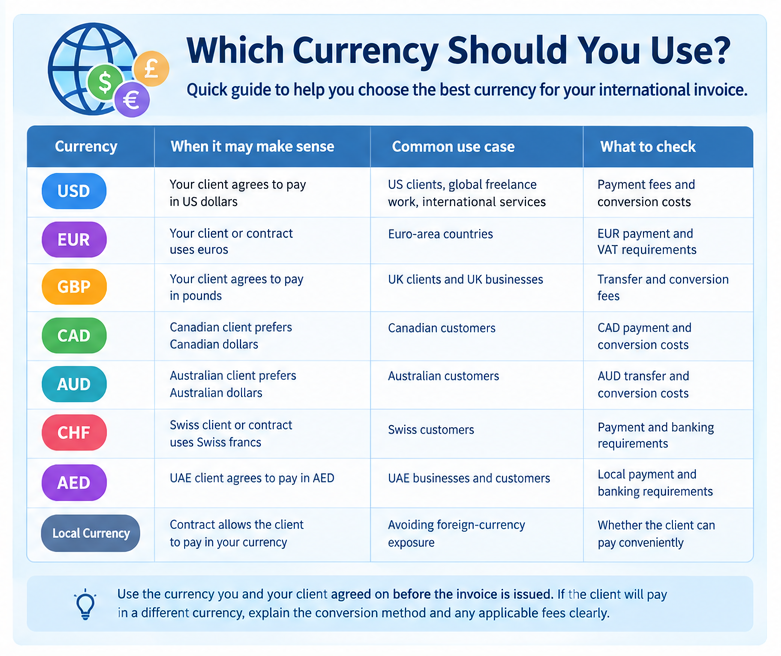
There isn’t one currency that works for every international client. The right choice depends on your agreement with the client, your business location, the client’s location, payment costs, accounting requirements, and currency risk.
USD
USD is widely used for international business transactions and is common in freelance and online services. You may choose USD when:
- Your client prefers USD
- Your contract is priced in USD
- Your customers are spread across different countries
- Your business costs are easier to track in USD
For example, a software freelancer working with clients in the United States, Canada, and Europe may decide to price all services in USD.
EUR: EUR can make sense when you work regularly with clients in the euro area. It can also make accounting easier when your contract, proposal, and invoice all use EUR.
GBP: GBP is commonly used when billing UK clients who have agreed to pay in pounds. If your contract states GBP 2,000, don’t send an invoice showing USD 2,000. The currency is part of the agreed price.
Other Currencies: You can also invoice in CAD, AUD, CHF, AED, and many other currencies.
The key is consistency. Your proposal should state the currency. Your contract should use the same currency. Your invoice should match it. That removes one common source of payment disputes.
How to Show an Exchange Rate on an International Invoice
Exchange rates become relevant when the contract price and the payment account use different currencies. Suppose you agree to charge a client USD 1,000, but you normally keep your business records in another currency.
You may need to convert the USD amount for accounting purposes. The exact exchange rate used can vary by bank, payment provider, accounting system, and transaction date.
If you show a converted amount, clearly label it as an estimate or accounting conversion when appropriate. For example:
Invoice total: USD 1,000
Reference conversion: EUR 925
Exchange rate used: 1 USD = 0.925 EUR
The client should still know which amount they are contractually required to pay. Don’t casually change the invoice total because the exchange rate moved after you agreed on the price.
Which Exchange Rate Should You Use?
There isn’t one universal rule for every business and country. Your accounting method, contract, tax rules, payment provider, and local regulations can affect the appropriate treatment.
For tax reporting, use the method required by the relevant authority or your accountant. For customer communication, keep the original invoice currency clearly visible.
International Payment Terms Matter
Payment terms become more important when money crosses borders.
A domestic bank transfer may arrive quickly. An international transfer can involve additional processing time, intermediary banks, currency conversion, and fees. Your invoice should state the due date clearly. For example:
Payment Terms: Net 15
Payment Due: October 15, 2026
You can also state who is responsible for transfer fees if your contract allows this. For example:
International transfer fees charged by the sender’s bank are the client’s responsibility.
The exact wording should match your contract and local legal requirements. Don’t add a surprise fee to the invoice after the client has already agreed to the price.
What Bank Details Should You Put on an International Invoice?
If you accept bank transfers, your international invoice may need more information than a domestic invoice. Depending on the countries and banks involved, payment instructions can include:
- Account holder name
- Bank name
- Account number
- IBAN
- SWIFT/BIC code
- Routing number, where applicable
- Bank address, where required
- Currency of the receiving account
Don’t add every possible banking field automatically. Ask your bank which details an international sender needs.
What Is an IBAN?
IBAN stands for International Bank Account Number.
It identifies a specific bank account in countries that use the IBAN system.
What Is a SWIFT or BIC Code?
A SWIFT/BIC code identifies a bank for international transfers. The exact information required depends on the sending country, receiving country, banks involved, and payment method.
If you’re unsure, confirm your details with your bank before putting them on an international invoice. One incorrect digit can delay a payment.
How International Freelancers Can Get Paid
Freelancers often work with clients from several countries at the same time.
A designer might invoice a US client in USD, a UK agency in GBP, and a European customer in EUR during the same month.
That can create extra administration. Keep each invoice clear and separate. Your payment method might include:
- Bank transfer
- Wise
- PayPal
- Stripe
- Card payment
- Another international payment service
Compare the fees, supported currencies, withdrawal options, settlement time, and account requirements before choosing a payment method.
Don’t assume the cheapest advertised fee is your total cost. Currency conversion can create another charge.
Tax and VAT on International Invoices
Tax treatment can become complicated when the seller and customer live in different countries. The correct treatment can depend on:
- Your country
- Client’s country
- Whether the client is a business or consumer
- Type of service or product
- Customer’s VAT or tax status
- Place-of-supply rules
- Local registration requirements
- Import or export rules
Some business-to-business transactions can involve reverse-charge VAT treatment. Other transactions may have different rules.
Don’t copy tax wording from another company’s invoice without checking whether it applies to your transaction.
If you’re unsure, ask a qualified accountant or tax professional who understands cross-border transactions. Your invoice should show the applicable tax information clearly when required.
How to Invoice a US Client From Another Country
Suppose you’re a freelancer outside the United States and a US company hires you for a project. Before invoicing, agree on:
- Project price
- Currency
- Payment method
- Payment due date
- Required business information
- Any tax documents the client requests
If the agreed price is USD 2,000, your invoice can show:
Subtotal: USD 2,000
Tax: As applicable
Total Due: USD 2,000
The exact tax treatment depends on the service, location, business structure, and applicable rules.
Don’t assume that a US client automatically means US sales tax applies.
How to Invoice a UK Client From Another Country
For a UK client, confirm whether they need:
- Company name
- Billing address
- VAT number
- Purchase order number
- Invoice number
- Payment terms
- Bank information
If you agreed on GBP, keep the invoice in GBP.
For example: Total Due: GBP 1,250
If your own bank account uses another currency, your payment provider may convert the funds when you receive them.
Check the provider’s exchange rate and fees before deciding how you want to receive payment.
How to Invoice European Clients
If you’re billing a business in Europe, first identify the client’s country and whether the customer is a business or consumer. For EU-related transactions, VAT treatment can depend on the specific transaction and place-of-supply rules.
A business may ask for a VAT number or other tax information. If VAT applies, show the relevant tax amount and required information on the invoice.
If a reverse-charge rule applies, use the wording and invoice information required for your situation. Because European tax rules differ by transaction, country, and customer type, verify the details before sending the invoice.
Common International Invoicing Mistakes
Small invoice mistakes can create long email chains. Here are some of the most common problems.
1. Leaving the Currency Unclear: Writing “$2,000” without identifying the currency can cause confusion. Use USD 2,000 when USD is the agreed currency.
2. Using the Wrong Exchange Rate: Don’t invent an exchange rate. State the original invoice currency and use an appropriate conversion method for accounting or tax purposes.
3. Missing Payment Instructions: A client shouldn’t have to email you asking, “Where should I send the money?” Give clear payment instructions.
4. Incorrect Bank Details: Check every digit before sending the invoice.
5. Adding Unexpected Fees: If payment fees or transfer charges matter, discuss them before the transaction.
6. Copying Tax Information From Another Invoice: Tax treatment can change based on the customer, country, and service.
7. Mixing Currencies: Avoid showing one amount in USD, another in EUR, and the final total in GBP without clearly explaining the calculation.
8. Forgetting the Due Date: A client should know exactly when payment is expected.
9. Using an Unclear Invoice Description: “Consulting – $3,000” gives less context than a specific description of the service and billing period.
10. Sending the Invoice Before Agreeing on Currency: This can create unnecessary payment discussions. Agree on the currency early.
International Invoice Example
Here’s a simple example for a freelance web developer billing a US company: INVOICE
Invoice Number: INV-2026-104
Invoice Date: September 26, 2026
Due Date: October 11, 2026
Currency: USD
From:
ABC Web Studio
Karachi, Pakistan
Bill To:
Example Business LLC
New York, USA
| Service | Qty | Rate | Amount |
|---|---|---|---|
| Website development | 1 | USD 1,800 | USD 1,800 |
| Website testing | 1 | USD 300 | USD 300 |
| Total Due | USD 2,100 |
Payment Terms: Net 15
Payment Method: International bank transfer
Bank Details:
Account Name: ABC Web Studio
Bank: Example Bank
IBAN: [Insert verified details]
SWIFT/BIC: [Insert verified details]
The example is intentionally simple. Your actual invoice should include the tax and business information required for your transaction.
Create an International Invoice Online
You don’t need to build an international invoice from scratch every time. An online invoice generator can save time when you regularly bill customers in different currencies.
With Invoice Generator Pro, you can create a professional invoice, select the required currency, add your client information, list products or services, and prepare the invoice for delivery.
A simple workflow is:
- Open the invoice generator.
- Add your business information.
- Add the international client’s billing information.
- Select the agreed currency.
- Add products or services.
- Enter prices and quantities.
- Add payment terms.
- Add payment instructions.
- Check the total.
- Download or print the invoice.
The important part isn’t making the invoice complicated. It’s making sure the client can understand exactly what they owe and how to pay it.
International Invoice Checklist
Before sending an invoice to a foreign client, run through this list:
Client’s legal name is correct
Client billing address is correct
Your business details are correct
Invoice number is unique
Invoice date is correct
Due date is clear
Currency is clearly identified
Services or products are described
Quantity and rates are correct
Total is correct
Tax information is correct
VAT information is included where required
Payment method is clear
Bank details are correct
IBAN is correct where applicable
SWIFT/BIC is correct where applicable
Payment fees are addressed
Required purchase order number is included
PDF has been checked before sending
That final review takes a few minutes. Fixing an international payment mistake can take much longer.
Frequently Asked Questions
1. What is an international invoice?
An international invoice is an invoice sent to a customer or business in another country. It contains normal billing information plus details that may be needed for cross-border payments, foreign currency, tax, and international bank transfers.
2. How do I invoice an international client?
Confirm the client’s billing information, agree on the currency and payment terms, create the invoice, add payment instructions, include required tax information, check the bank details, and send the invoice.
3. What currency should I use for an international invoice?
Use the currency agreed with the client in the contract, proposal, or payment terms. USD, EUR, and GBP are common choices, but the appropriate currency depends on your business arrangement.
4. Can I invoice an international client in USD?
Yes, when the client agrees to pay in USD and your transaction permits it. Clearly write USD on the invoice so the client knows the exact currency.
5. Can I invoice clients in EUR or GBP?
Yes. You can invoice in EUR, GBP, or another supported currency when that currency is part of your agreed payment terms.
6. Should I invoice a foreign client in their local currency?
Not necessarily. The currency should be based on your agreement with the client and practical payment considerations. A foreign client may agree to pay in USD even when USD isn’t their domestic currency.
7. How do I calculate an exchange rate on an invoice?
If a conversion is required, use an appropriate exchange rate based on your contract, accounting method, payment provider, or applicable tax rules. Clearly identify the original invoice currency.
8. Should I show the exchange rate on an international invoice?
You can show it when a conversion is relevant or useful. If the client only needs to pay USD 1,000, keep USD 1,000 clearly identified as the amount due.
9. What payment details should an international invoice include?
Depending on the payment method, you may need your account name, bank name, account number, IBAN, SWIFT/BIC code, routing information, or payment-service details.
10. Do international invoices need an IBAN?
Not always. IBAN requirements depend on the countries and banks involved. Confirm the required information with your bank or payment provider.
11. What is a SWIFT code on an invoice?
A SWIFT or BIC code identifies a bank for international transfers. Include it when your bank requires it for the payment method being used.
12. Who pays international transfer fees?
This should be agreed before payment. Your contract or payment terms can state how transfer charges are handled, subject to applicable rules.
13. Do international invoices need VAT?
It depends on the transaction. VAT treatment can vary based on the countries involved, customer type, service, and applicable tax rules.
14. What is a reverse-charge invoice?
A reverse-charge invoice is used in certain transactions where the customer accounts for VAT instead of the seller. Whether reverse charge applies depends on the specific transaction and applicable tax rules.
15. Can freelancers invoice international clients?
Yes. Freelancers commonly work with customers in other countries. They should keep their invoices clear and check the tax and payment requirements that apply to their business.
16. How do I invoice a US client from another country?
Agree on the project price, USD or another currency, payment method, due date, and required client information. Then create the invoice with clear payment instructions and any required tax information.
17. How do I invoice a UK client from another country?
Confirm the client’s legal and billing details, agree on GBP or another currency, include the required payment information, and check whether VAT or other tax information applies.
18. Can I use PayPal or Wise for international invoice payments?
You can list a payment service you actually use and that supports your transaction. Check its current fees, supported currencies, account requirements, and withdrawal options before relying on it.
19. Can I create an international invoice as a small business?
Yes. A small business can create an international invoice with the same basic billing information used for domestic invoices, plus any foreign currency, payment, tax, and banking details required for the transaction.
20. What information should an international invoice contain?
At minimum, include your business details, client details, invoice number, invoice date, description of goods or services, amount, currency, payment terms, due date, and payment instructions. Add tax, VAT, banking, and other information when required.
Wrapping Up
International clients can bring new business opportunities, but your invoicing process needs to keep up with cross-border payments.
Agree on the currency before you start. Put the currency clearly on the invoice. Check exchange-rate treatment when a conversion is needed. Give the client accurate payment instructions and verify your bank details before sending anything.
Tax and VAT can require more care, especially when the buyer and seller are in different countries. If you’re unsure about the rules for a particular transaction, get advice from a qualified tax professional.
For routine freelance and small-business billing, the process can stay simple.
Choose the agreed currency, create a clear invoice, provide accurate payment details, check the numbers, and send it on time.
If you regularly invoice international clients, using a free online invoice generator can also make the process faster and reduce repetitive manual work.
References
The following official and industry sources were used to support information about international invoicing, foreign currency, exchange rates, VAT, reverse-charge rules, and international payment details:
- U.S. Internal Revenue Service (IRS) – Foreign Currency and Currency Exchange Rates
Guidance on converting foreign-currency amounts for U.S. tax purposes and using appropriate exchange rates.
IRS: Foreign Currency and Currency Exchange Rates - U.S. Internal Revenue Service (IRS) – Yearly Average Currency Exchange Rates
Information about foreign-currency exchange rates and their use for tax reporting.
IRS: Yearly Average Currency Exchange Rates - European Commission – VAT: Place of Taxation
Official information about the place of taxation for services, including distinctions between B2B and B2C transactions.
European Commission: Place of Taxation - European Commission – VAT Invoicing
Official guidance on information that may need to appear on VAT invoices, including reverse-charge references.
European Commission: Invoicing - GOV.UK / HM Revenue & Customs – Foreign Currency Transactions and VAT
Guidance on invoicing in foreign currencies and converting transactions into pounds sterling for UK VAT purposes.
GOV.UK: Transactions in Foreign Currencies and VAT - GOV.UK / HM Revenue & Customs – Place of Supply of Services
Guidance on determining where services are supplied and when reverse-charge rules may apply.
GOV.UK: Place of Supply of Services - SWIFT – Business Identifier Code (BIC)
Official information about BIC codes and their use for identifying financial institutions in international transactions.
SWIFT: Business Identifier Code (BIC)
Note: International tax, VAT, exchange-rate, and invoicing requirements can vary by country, transaction type, and customer status. Always verify the rules that apply to your specific transaction with the relevant tax authority or a qualified professional.

Akbar Ali is the Founder of InvoiceGeneratorPro.io, a platform dedicated to helping freelancers, small businesses, startups, agencies, and entrepreneurs create professional invoices quickly and efficiently. With years of experience in digital business, SEO content strategy, and online entrepreneurship, he focuses on developing practical tools and educational resources that simplify invoicing, payment management, and financial documentation.As a business writer and digital entrepreneur, Akbar creates in-depth guides, industry insights, and actionable content covering invoicing, freelancing, accounting basics, business finance, taxation, productivity, and payment solutions. His goal is to make complex financial processes easy to understand while helping professionals save time and present their businesses more professionally.Through InvoiceGeneratorPro.io, he continues to build reliable, user-friendly solutions that empower businesses worldwide to streamline their billing workflows and improve financial organization.
Akbar Ali