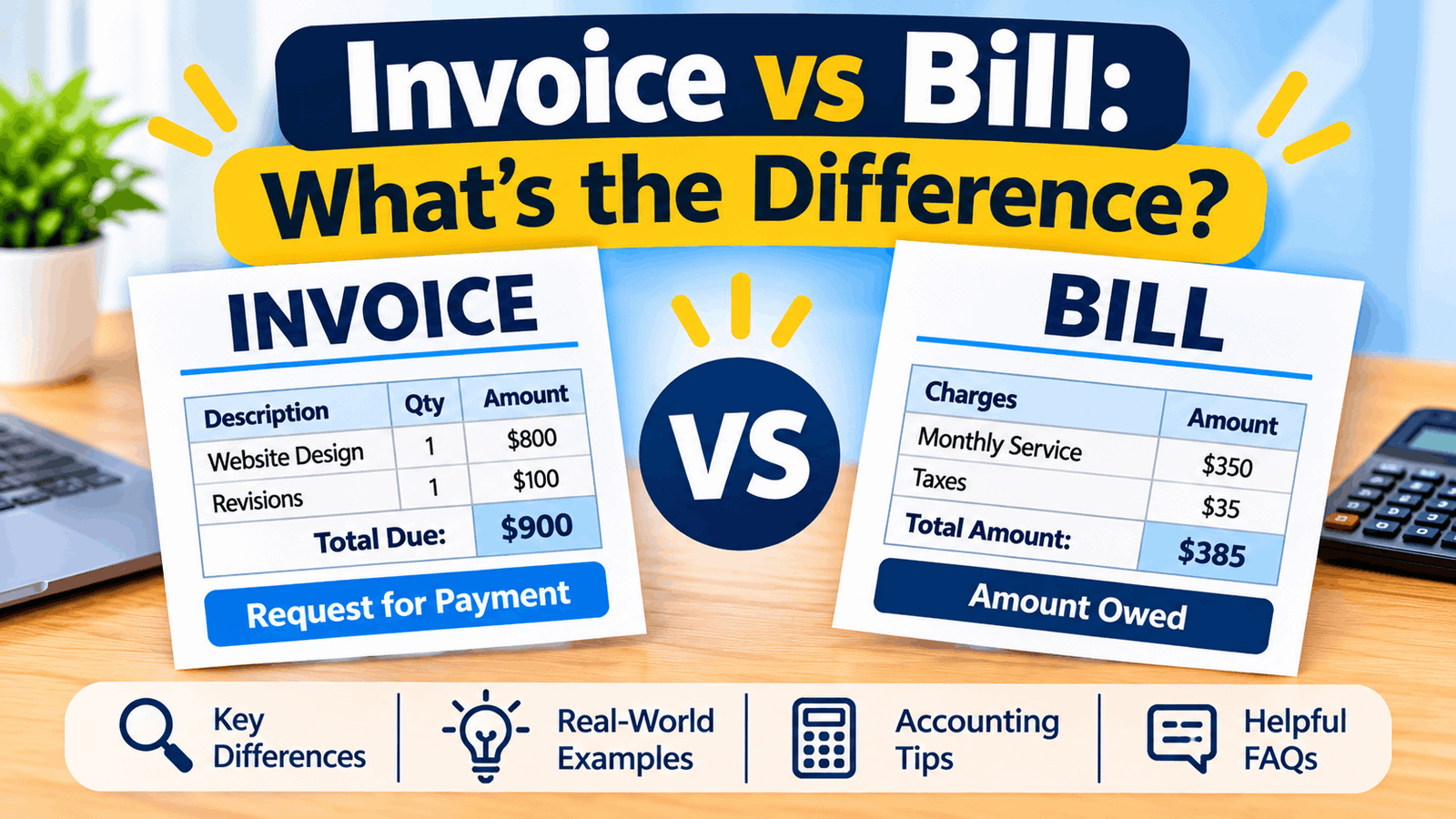
When managing business transactions, you will regularly encounter two familiar terms: invoice and bill. They are often used interchangeably, but their meaning can change depending on whether you are the person providing goods or services or the person receiving them.
For example, a freelance designer may send a client an invoice for completed work. The client may refer to that same document as a bill because it represents an amount they need to pay.
So, is an invoice the same as a bill? What is the difference between an invoice and a bill in accounting? And when should a business use each term?
The main distinction is perspective: a seller generally sends an invoice to request payment, while a buyer generally refers to the amount owed to a supplier as a bill. However, everyday business usage varies, and the terms are not always treated as separate document types.
This guide explains the difference between an invoice and a bill, how each is used in business and accounting, practical examples, and how to manage these documents accurately.
What Is an Invoice?
An invoice is a commercial document that a seller, freelancer, contractor, or service provider sends to a customer to request payment for products delivered or services provided. It describes what the customer purchased, how much they owe, and when payment is expected.
An invoice also creates a written record of the transaction. Both the seller and customer can use it to track the amount charged, payment terms, and outstanding balance.
For example, imagine a freelance web designer completes a website project for a small business. The designer sends an invoice showing:
- Website design services: $800
- Additional revisions: $100
- Total amount due: $900
- Payment terms: Net 15
- Due date: December 15
The customer uses this document to understand the charges and arrange payment. The designer uses a copy to track the amount owed by the customer.
What Information Does an Invoice Include?
A professional invoice should contain enough information for the customer to understand the transaction and make the payment.
Common invoice details include:
| Invoice element | Purpose |
|---|---|
| Business name and contact details | Identifies the seller |
| Customer information | Identifies the buyer |
| Invoice number | Helps track and organize invoices |
| Invoice date | Shows when the invoice was issued |
| Description of products or services | Explains what was provided |
| Quantity and unit price | Shows how charges are calculated |
| Subtotal | Displays the amount before applicable taxes or adjustments |
| Taxes and discounts | Shows relevant additions or deductions |
| Total amount due | States the amount payable |
| Payment terms | Explains when payment is expected |
| Payment instructions | Tells the customer how to pay |
Not every invoice needs exactly the same fields. Requirements can vary by industry, transaction, contract, and applicable tax rules.
Why Do Businesses Send Invoices?
Businesses use invoices for several practical reasons:
- Requesting payment: An invoice formally communicates the amount a customer is expected to pay.
- Explaining charges: Itemized descriptions help customers understand the products or services they purchased.
- Tracking income: Businesses can monitor issued invoices and outstanding customer balances.
- Maintaining transaction records: Invoices support bookkeeping and financial reporting.
- Managing payment deadlines: Due dates and payment terms help both parties understand when payment is expected.
- Resolving disputes: An itemized invoice can help clarify disagreements about prices, quantities, or completed work.
For freelancers and small businesses, consistent invoicing is particularly useful because it creates a documented process for requesting and tracking payments.
What Is a Bill?
A bill is a document or statement that tells a person or business how much they owe for products, services, or other charges.
In business-to-business transactions, a buyer often calls an invoice received from a supplier a bill. The supplier sends the document, but the receiving business records and manages it as an amount it needs to pay.
Bills are also common in everyday transactions. Electricity bills, internet bills, water bills, restaurant bills, and telephone bills all communicate amounts owed.
For example, a small marketing agency receives a $350 bill from a software provider for its monthly subscription. The agency must review the charge, confirm it is correct, and arrange payment before the deadline.
What Information Does a Bill Include?
The information depends on the type of bill and the organization issuing it. A supplier bill may include:
- Supplier’s business name and contact information
- Customer or account information
- Document or reference number
- Billing date
- Description of products or services
- Amount charged
- Applicable taxes or fees
- Outstanding balance
- Payment due date
- Payment instructions
A utility bill may contain additional details, such as an account number, service address, meter readings, billing period, previous balance, and current charges.
Why Do Businesses Receive Bills?
Businesses receive bills to manage their expenses and financial obligations.
Common reasons include:
- Paying suppliers: Bills tell businesses how much they owe vendors for goods and services.
- Managing expenses: They help identify costs associated with running the business.
- Tracking outstanding payments: Businesses can monitor unpaid amounts and upcoming due dates.
- Maintaining financial records: Bills and supporting documents help substantiate business expenses.
- Preventing late payments: A clear payment deadline helps businesses plan cash flow.
- Checking supplier charges: Businesses can compare bills against purchase orders, contracts, delivery records, or service agreements.
A business should not automatically pay every bill it receives. It should first check that the supplier, amount, products or services, and payment instructions are correct.
Invoice vs Bill: Key Differences
The main difference between an invoice and a bill is generally the perspective from which the transaction is described.
An invoice is commonly discussed from the seller’s perspective, while a bill is commonly discussed from the buyer’s perspective. In many transactions, both terms refer to the same payment request.
| Comparison | Invoice | Bill |
|---|---|---|
| Meaning | A document requesting payment | A document or notice showing an amount owed |
| Common perspective | Seller or service provider | Buyer or customer |
| Issued by | Seller, freelancer, contractor, or supplier | Business, vendor, service provider, or merchant |
| Received by | Customer or buyer | Customer or business responsible for payment |
| Main purpose | Request and document payment | Communicate an amount payable |
| Business use | Sales and accounts receivable | Purchases and accounts payable |
| Payment details | Commonly includes terms and due date | Usually includes amount due and payment deadline |
| Example | A designer sends a client a $900 invoice | The client records the $900 charge as a bill to pay |
Important: This table describes common business usage, not a universal legal distinction. A supplier’s invoice may be called a bill by the customer, and some organizations use the words differently.
Is an Invoice the Same as a Bill?
In many everyday business situations, yes. The same document can be an invoice from the seller’s perspective and a bill from the buyer’s perspective.
Consider this transaction:
- A supplier delivers office furniture worth $1,200 to a company.
- The supplier sends an invoice requesting payment within 30 days.
- The company receives the document and records the $1,200 obligation as a bill to pay.
The supplier calls it an invoice because it is requesting payment. The customer calls it a bill because it represents money owed.
The document has not changed. Only the perspective and accounting workflow have changed.
Invoice vs Bill in Accounting
Understanding the difference between an invoice and a bill is especially important for bookkeeping and financial management.
Businesses generally organize sales-related amounts they expect to collect separately from purchase-related amounts they need to pay.
Accounts Receivable: Invoices Sent to Customers
Accounts receivable (AR) represents amounts customers owe a business for goods or services provided on credit.
When a business issues an invoice and records the transaction under accrual accounting, it generally recognizes revenue when the applicable revenue-recognition requirements are met and records a corresponding receivable.
For example:
A marketing agency completes a project worth $2,000 and invoices its customer with payment due in 15 days.
The agency may record:
- Accounts receivable: $2,000
- Revenue: $2,000
When the customer pays, the agency records the cash received and reduces the outstanding accounts receivable balance.
The exact accounting entries depend on the transaction and the accounting method being used.
Accounts Payable: Bills Received from Suppliers
Accounts payable (AP) represents amounts a business owes suppliers or vendors for goods and services received but not yet paid.
For example:
A retail store purchases $1,500 worth of inventory from a supplier on credit. The supplier sends an invoice with payment due in 30 days.
The retail store may record:
- Inventory: $1,500
- Accounts payable: $1,500
When the store pays the supplier, it records the payment and reduces the accounts payable balance.
The debit side of the entry may be inventory, an operating expense, an asset, or another appropriate account. It should not automatically be treated as an ordinary expense because the accounting classification depends on what the business purchased.
Accounts Receivable vs Accounts Payable
| Feature | Accounts Receivable | Accounts Payable |
|---|---|---|
| Represents | Money customers owe your business | Money your business owes others |
| Related documents | Sales invoices | Supplier invoices or bills |
| Financial category | Asset | Liability |
| Business perspective | Amount to collect | Amount to pay |
| Main responsibility | Follow up on customer payments | Schedule and make supplier payments |
This distinction helps businesses understand their cash flow. Accounts receivable shows expected incoming payments, while accounts payable shows outstanding financial obligations.
Practical Examples of an Invoice vs a Bill
The following examples show how the terms are used in real business situations. The amounts are illustrative.
Example 1: Freelancer Sending an Invoice
A freelance graphic designer completes a logo design project for a client.
The designer prepares an invoice:
| Description | Amount |
|---|---|
| Logo design | $300 |
| Brand color variations | $75 |
| Subtotal | $375 |
| Total due | $375 |
The designer sends the invoice to the client with payment due in 7 days.
From the designer’s perspective, this is an invoice because it requests payment for completed work.
From the client’s perspective, it is a bill to pay.
Example 2: A Restaurant Bill
A customer visits a restaurant and orders food and drinks.
The final bill looks like this:
| Item | Amount |
|---|---|
| Main course | $24.00 |
| Dessert | $8.00 |
| Drinks | $6.00 |
| Subtotal | $38.00 |
| Tax (illustrative) | $3.04 |
| Total | $41.04 |
The restaurant presents the bill to the customer before payment.
In this situation, the word “bill” is more common in everyday conversation. The customer pays the amount and may receive a receipt or other proof of payment.
Example 3: A Business Receiving a Supplier Invoice
A construction company purchases building materials worth $4,500 from a supplier.
The supplier sends an invoice with payment due in 30 days.
The supplier records the sale as a transaction involving customer payment due. The construction company records the document as a supplier bill or payable.
The company should verify the materials, quantities, agreed prices, and payment terms before approving the payment.
Example 4: A Monthly Electricity Bill
A small business receives an electricity bill for $180.
The document includes:
- Customer account number
- Billing period
- Previous balance
- Current electricity charges
- Applicable taxes or fees
- Total amount due
- Payment deadline
The business records the electricity cost in its accounting system and schedules payment.
This is a familiar example of a bill because the service provider communicates the amount the customer owes for the billing period.
Invoice vs Receipt: What Is the Difference?
An invoice and a receipt serve different purposes.
An invoice requests payment, while a receipt confirms that payment has been made.
For example, a contractor completes a repair job and sends a customer an invoice for $600. After receiving the full payment, the contractor provides a receipt or another suitable payment confirmation.
| Feature | Invoice | Receipt |
|---|---|---|
| Main purpose | Request payment | Confirm payment |
| Usually issued | Before payment or when payment is due | After payment |
| Shows amount owed | Yes | Shows amount paid |
| Payment status | May be unpaid, partially paid, or paid | Records a payment received |
| Common use | Billing customers | Providing proof of payment |
An invoice marked “Paid” can also help document a completed transaction. However, businesses should maintain adequate payment records, especially when the invoice alone does not show how or when the money was received.
For accounting and tax recordkeeping, the IRS identifies invoices, receipts, paid bills, deposit slips, and other supporting documents as useful business records.
Invoice vs Purchase Order: What Is the Difference?
An invoice and a purchase order (PO) are also different documents.
A purchase order is generally created by the buyer to communicate an order to a supplier. An invoice is generally issued by the seller to request payment for the products or services supplied.
For example:
- A restaurant needs new kitchen equipment.
- The restaurant creates a purchase order for the equipment.
- The supplier accepts the order and delivers the products.
- The supplier sends an invoice requesting payment.
- The restaurant checks the invoice against the purchase order and delivery information before paying.
| Feature | Purchase Order | Invoice |
|---|---|---|
| Created by | Buyer | Seller |
| Main purpose | Request or authorize a purchase | Request payment |
| Timing | Usually before delivery | Usually during or after the agreed billing event |
| Contains | Ordered items, quantities, prices, terms | Supplied items or services, charges, payment details |
| Main business function | Purchasing control | Billing and payment collection |
Businesses may use purchase orders to control spending and check supplier invoices against what was ordered and received.
What Happens When an Invoice or Bill Is Not Paid?
An unpaid invoice or bill represents an outstanding payment obligation, but the consequences depend on the agreement, applicable law, and type of transaction.
When a Customer Does Not Pay an Invoice
A seller may:
- Send a payment reminder before or after the due date.
- Contact the customer to confirm whether there is a payment problem or dispute.
- Send a formal overdue notice.
- Apply late fees or interest only when permitted by the agreement and applicable law.
- Consider collection or legal options when appropriate.
A business should keep copies of the original invoice, communications, contract, and payment records.
When a Business Does Not Pay a Supplier Bill
A supplier may send reminders, place the account on hold, enforce contractual payment terms, or pursue collection options.
The buyer should not ignore an incorrect bill. It should contact the supplier, explain the discrepancy, and preserve supporting documents.
Practical tip: Always make payment terms clear before beginning work or placing an order. A written agreement can help prevent disagreements about due dates, late fees, deposits, and payment responsibilities.
How to Organize Invoices and Bills for Better Bookkeeping
Creating and receiving invoices and bills is only one part of managing business finances. You also need a consistent system for storing documents, tracking payment status, and reviewing outstanding amounts.
Here are practical steps businesses can follow.
1. Use Unique Invoice Numbers
Assign a unique reference number to each invoice. This makes it easier to locate documents, communicate with customers, and avoid duplicate records.
For example:
- INV-2026-001
- INV-2026-002
- INV-2026-003
Choose a numbering method that is consistent and easy to maintain.
2. Separate Sales Invoices From Supplier Bills
Maintain separate records for money customers owe you and money you owe suppliers.
This helps prevent confusion between accounts receivable and accounts payable.
3. Record Payment Status
Use clear payment statuses such as:
- Draft: The invoice is being prepared.
- Sent: The invoice has been delivered to the customer.
- Unpaid: Payment has not been received.
- Partially paid: Some, but not all, of the amount has been paid.
- Paid: The full amount has been received.
- Overdue: The payment deadline has passed and an amount remains outstanding.
A status should reflect the actual payment record, not simply the date a document was created.
4. Keep Supporting Documents
Save relevant invoices, bills, receipts, purchase orders, bank records, and payment confirmations.
The IRS explains that supporting documents help substantiate business transactions and entries in accounting records. It also recommends keeping records organized and secure.
5. Review Outstanding Payments Regularly
Review accounts receivable to identify customers with overdue invoices. Review accounts payable to identify supplier bills approaching their due dates.
A weekly review can help small businesses plan cash flow and follow up before payment issues become more serious.
6. Use a Consistent Digital Filing System
A simple folder structure can make document management easier:
- Sales Invoices
- Supplier Bills
- Paid Invoices
- Payment Receipts
- Purchase Orders
- Monthly Statements
You can organize files by year, month, customer, or supplier. The best structure is one your business can follow consistently.
Common Mistakes Businesses Make With Invoices and Bills
Even a small documentation mistake can create confusion between customers, suppliers, and accounting teams.
Avoid these common problems:
Treating Every Invoice as Proof of Payment
An invoice generally requests payment; it does not automatically prove that payment was received. Keep payment confirmations and receipts where appropriate.
Confusing Accounts Payable With Accounts Receivable
Accounts receivable is money owed to your business. Accounts payable is money your business owes. Mixing them up can lead to inaccurate financial records.
Forgetting Payment Terms
An invoice should clearly communicate the agreed payment deadline. Vague payment terms can cause unnecessary disputes.
Not Checking Supplier Bills
Before paying a supplier, verify the charges against the relevant order, contract, delivery record, or service agreement.
Using Duplicate Invoice Numbers
Duplicate reference numbers make transactions harder to track and can create bookkeeping problems. Use a consistent numbering system.
Failing to Keep Supporting Documents
Deleting or losing invoices, bills, receipts, and payment records can make it difficult to explain business transactions later.
Frequently Asked Questions About Invoice vs Bill
1. What is the main difference between an invoice and a bill?
An invoice is commonly used by a seller to request payment from a customer. A bill is commonly used by a buyer to describe an amount owed. In many transactions, both terms refer to the same document.
2. Is an invoice the same as a bill?
Often, yes. A supplier may send an invoice, while the customer refers to that document as a bill. The difference is usually the perspective and business context rather than the document itself.
3. Is an invoice legally different from a bill in the United States?
There is no single universal distinction that applies to every US business transaction. The terms are often used interchangeably, and their meaning depends on the transaction, industry, contract, and applicable rules. Businesses should focus on the document’s contents and legal obligations rather than relying on its title alone.
4. Is an invoice issued before or after payment?
An invoice is commonly issued before payment when a customer owes money. However, timing depends on the agreement. Some businesses invoice in advance, request deposits, bill at milestones, or issue invoices after delivery.
5. Can an invoice be called a bill?
Yes. A customer may call a supplier’s invoice a bill because it represents an amount they need to pay.
6. What is an unpaid invoice called?
An unpaid invoice is commonly described as an outstanding invoice. If its payment deadline has passed, it may be called an overdue invoice.
7. What is the difference between accounts payable and accounts receivable?
Accounts payable represents money a business owes suppliers and other creditors. Accounts receivable represents money customers owe the business.
8. Is a bill an expense?
A bill may relate to a business expense, but not every bill should automatically be recorded as an expense. For example, a bill for inventory or equipment may need to be recorded differently depending on the accounting treatment.
9. Does an invoice prove that payment has been made?
No. An invoice generally requests payment. A receipt, bank record, payment confirmation, or other suitable evidence can help establish that payment was made.
10. Can a business issue an invoice without a purchase order?
Yes. Many freelancers and small businesses issue invoices without purchase orders. However, some customers require a purchase order number before accepting or processing an invoice.
11. What is the difference between a bill and a receipt?
A bill communicates an amount owed. A receipt confirms that a payment was received. They serve different purposes in a transaction.
12. What happens if a customer disputes an invoice?
The customer should contact the seller, identify the disputed charge, and provide relevant supporting information. The seller should review the agreement, work performed, products supplied, and payment history before correcting or explaining the invoice.
13. Should small businesses keep copies of invoices and bills?
Yes. Organized records help businesses track income, expenses, payments, and outstanding obligations. They can also support bookkeeping and tax reporting.
14. What payment terms should an invoice include?
Common payment terms include Due on Receipt, Net 7, Net 15, Net 30, and Net 60. The appropriate terms depend on the agreement between the seller and customer. The invoice should state the actual due date or explain how it is calculated.
15. Can a paid invoice replace a receipt?
A paid invoice can provide useful transaction information, particularly when it records the payment date and amount. However, a separate receipt or payment confirmation may provide clearer evidence of payment. Businesses should retain whatever supporting records are appropriate for the transaction.
Final Thoughts: Invoice vs Bill
The difference between an invoice and a bill is mainly about perspective and business usage.
A seller generally sends an invoice to request payment for products or services. A buyer generally refers to the amount owed to a supplier as a bill. In many cases, the same document can be described by either term.
For business owners, freelancers, contractors, and accounting teams, understanding the distinction helps make billing, payment tracking, and bookkeeping more organized.
More importantly, businesses should maintain accurate records, use clear payment terms, verify supplier charges, and keep suitable proof of payments. These practices matter far more than whether a document is titled “invoice” or “bill.”

Akbar Ali is the Founder of InvoiceGeneratorPro.io, a platform dedicated to helping freelancers, small businesses, startups, agencies, and entrepreneurs create professional invoices quickly and efficiently. With years of experience in digital business, SEO content strategy, and online entrepreneurship, he focuses on developing practical tools and educational resources that simplify invoicing, payment management, and financial documentation. As a business writer and digital entrepreneur, Akbar creates in-depth guides, industry insights, and actionable content covering invoicing, freelancing, accounting basics, business finance, taxation, productivity, and payment solutions. His goal is to make complex financial processes easy to understand while helping professionals save time and present their businesses more professionally. Through InvoiceGeneratorPro.io, he continues to build reliable, user-friendly solutions that empower businesses worldwide to streamline their billing workflows and improve financial organization.
Akbar Ali