Cash flow problems rarely start with a lack of sales. They start with a slow, messy, or inconsistent invoicing process. A business can be profitable on paper and still run out of cash, simply because money owed hasn’t come in yet. This is why accounting professionals treat invoicing as a financial control, not paperwork.
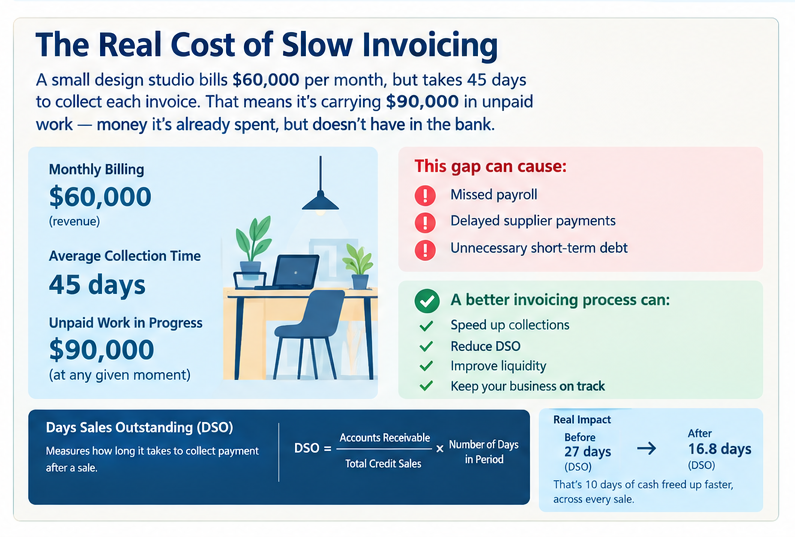
Here’s a real-world shape of the problem. A small design studio bills $60,000 a month in client work. On paper, that’s a healthy business. But if the studio takes an average of 45 days to collect each invoice, it’s carrying roughly $90,000 in unpaid work at any given moment, money it has already spent time and resources producing but doesn’t have in the bank. That gap is what causes businesses to miss payroll, delay supplier payments, or take on short-term debt they didn’t need to.
This guide breaks down how to build an invoice system that closes that gap, using the same principles an ACCA-qualified accountant applies when reviewing a client’s receivables process: consistency, clear terms, and tight follow-up.
What Is an Invoice System?
An invoice system is the complete process a business uses to bill customers and collect payment. It includes far more than the invoice document itself. A proper system covers how invoices are created, what information they contain, when they’re sent, how they’re tracked, and what happens when a payment is late.
Most small businesses have an invoice template but not an invoice system. That distinction matters, and it’s easiest to see with an example.
Take Amir, a freelance web developer in Lahore. He has a nice-looking invoice template. But he sends invoices whenever he remembers to, sometimes the same day a project wraps, sometimes two weeks later. He has no due dates written on the invoice, just an informal understanding with clients that they’ll “pay soon.” When a client is late, Amir doesn’t notice until he checks his bank balance and realizes it’s lower than expected. That’s a template, not a system.
Compare that to Hina, who runs a small bookkeeping practice. Every invoice goes out the same day service is delivered, with Net 15 terms printed directly on the invoice. She keeps a simple spreadsheet with three columns: client, invoice date, and due date. Anything past its due date gets a reminder email within 48 hours. Hina isn’t using more sophisticated tools than Amir. She’s using a process. That’s the difference between a document and a system.
A functional invoice system typically includes:
- A standard invoice format is used every time
- Defined payment terms are attached to every invoice
- A tracking method for outstanding invoices
- A follow-up process for late payments
- A way to reconcile paid invoices against bank deposits
Why Invoice Systems Matter for Business Cash Flow
Cash flow is the timing of money in and money out. A business can have strong revenue and still face a cash shortage if invoices go out late, contain errors, or lack clear payment terms.
Here’s the mechanic accountants pay attention to, worked through with numbers. Days Sales Outstanding (DSO) measures the average time it takes to collect payment after a sale. The formula is:
DSO = (Accounts Receivable ÷ Total Credit Sales) × Number of Days in Period
Say a business has $45,000 in outstanding invoices and made $150,000 in credit sales over the last 90 days. DSO = (45,000 ÷ 150,000) × 90 = 27 days. That means, on average, it takes 27 days to convert a sale into cash in hand.
Now suppose that same business tightens its invoicing process, invoices within 24 hours of delivery instead of within a week, and adds a reminder three days before each due date. Six months later, outstanding receivables drop to $28,000 against the same $150,000 in sales. New DSO = (28,000 ÷ 150,000) × 90 = 16.8 days. That’s 10 days of cash freed up faster, across every single sale, without selling anything new. On a $150,000 quarterly revenue base, that’s real, immediate liquidity, not hypothetical improvement.
A weak invoicing process pushes DSO up in three common ways:
- Invoices are sent late, sometimes days or weeks after work is completed
- Payment terms are vague or missing, so customers assume they can pay whenever
- There’s no follow-up system, so overdue invoices are forgotten until someone notices the bank balance is low
The ACCA Approach to Effective Invoice Management
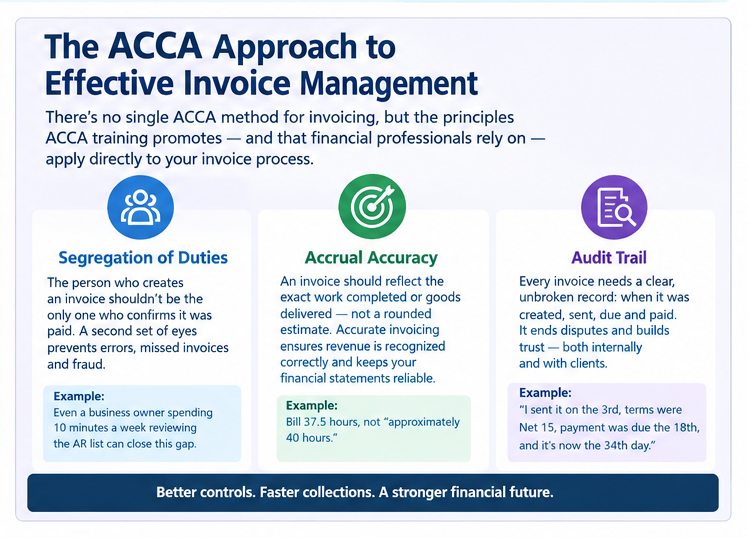
There’s no single official ACCA methodology for invoicing. What ACCA training does instill is a set of financial control principles, and these apply directly to how a business should think about its invoice process.
Segregation of duties:
The person who creates an invoice shouldn’t be the only person who confirms it was paid. Consider a small retail supplier where one employee, Bilal, both issues invoices and reconciles payments. If Bilal makes an error, forgets to invoice a client, or even manipulates records, there’s no second check to catch it. Even having a business owner spend ten minutes a week reviewing the AR list against bank deposits closes that gap.
Accrual accuracy:
An invoice should reflect the exact work completed or goods delivered, not a rounded estimate. A consulting firm that bills “approximately 40 hours” instead of the actual 37.5 hours recorded creates a mismatch between revenue recognized and revenue actually earned, which distorts both the invoice and the financial statements built on top of it.
Audit trail:
Every invoice needs a clear, unbroken record: when it was created, when it was sent, when payment terms expire, and when payment was received. When a client disputes a bill, “I sent it on the 3rd, terms were Net 15, payment was due the 18th, and it’s now the 34th day” ends the conversation. “I think I sent it a few weeks ago” does not.
Applying this thinking doesn’t require a finance department. Even a one-person business can adopt these habits with nothing more than a spreadsheet.
Essential Components of a High-Performance Invoice System
A cash-flow-friendly invoice needs specific elements, every time, with no exceptions:
- Invoice number: sequential, never reused, makes tracking and referencing simple
- Issue date and due date: both need to be explicit, not implied
- Clear payment terms: Net 15, Net 30, due on receipt, whatever applies, stated in plain language
- Itemized charges: vague line items invite payment delays because clients query what they’re being billed for
- Accepted payment methods: if a client doesn’t know how to pay you, they won’t pay you on time
- Business and client details: full legal names, addresses, and tax identification numbers where required
- Late payment terms, if applicable: stated upfront, not added after the fact
Here’s what the itemization point looks like in practice. An invoice that says “Web development services – $2,400” invites a client to ask “what exactly does this cover?” before they’ll approve payment internally, and that question can sit unanswered for a week.
An invoice that reads “Homepage redesign (15 hrs) – $900, Contact form integration (6 hrs) – $360, Mobile responsiveness fixes (9 hrs) – $540, Testing and deployment (6 hrs) – $600” gives the client’s finance department everything they need to approve it without a follow-up email. Missing detail doesn’t just look less professional, it adds real days to the collection timeline.
Building an Accounts Receivable Workflow That Gets Paid Faster
Accounts receivable, or AR, is the total amount customers owe a business at any given time. Managing AR well is really about managing the workflow around invoices, not the invoices themselves.
A functional AR workflow looks like this:
- Invoice immediately. The moment work is completed or goods are delivered, the invoice goes out. Delaying by even a few days pushes back the entire payment timeline.
- Confirm receipt. A short follow-up message confirming the client received the invoice removes the excuse of “I never got it.”
- Track by due date, not by memory. Every invoice should sit on a simple aging list: current, 30 days overdue, 60 days overdue, 90-plus.
- Send reminders before the due date, not just after. A reminder two or three days before the due date reduces late payments significantly, because it catches clients before they’ve deprioritized the bill.
- Escalate consistently. If a payment is late, the follow-up tone and frequency should increase on a set schedule, not depend on whoever remembers to chase it.
Walk through a real timeline. A graphic design freelancer, Nadia, completes a project on June 1st and invoices the same day with Net 15 terms, due June 16th. On June 13th, she sends a short reminder: “Just confirming this is on track for the 16th.” On June 17th, one day past due, she sends a polite note flagging that the invoice is now overdue. By June 24th, a week overdue, the tone shifts to a firmer request for a payment date. By July 1st, 15 days overdue, she references the original terms directly and asks for a specific commitment.
Compare that to a freelancer who invoices on June 1st with no terms stated, doesn’t follow up until August because they got busy, and by then has no record of when the invoice was actually due. The first scenario is collected within roughly three weeks. The second can drag for months, and often ends in a written-off invoice.
Invoice Automation and Digital Transformation
Manual invoicing, tracking payments in a notebook or a scattered spreadsheet, is the single biggest reason small businesses have unpredictable cash flow. It’s not that manual processes never work. It’s that they fail silently. An invoice gets forgotten, a follow-up doesn’t happen, and nobody notices until cash is tight.
Digitizing the process solves the visibility problem, not just the speed problem. When every invoice lives in one place, with a due date and status attached, nothing gets lost. A free browser-based invoice generator, like Invoice Generator Pro, lets a small business create professional invoices with all the required components without needing accounting software.
You set the issue date, due date, and payment terms manually, and the tool produces a clean, itemized, professional document every time, which removes the inconsistency problem entirely. It won’t calculate due dates for you or run your follow-up schedule, but it removes the biggest point of failure: invoices that look different every time or are missing key details because they were built from scratch in a word processor.
Full automation, meaning automatic due date calculations or automatic recurring billing, is a separate step up and usually only worth the investment once a business is issuing a high volume of invoices monthly, think 50 or more, where manually tracking each one becomes the actual bottleneck. A freelancer issuing eight invoices a month doesn’t need that. A 12-person accounting firm billing 200 clients a month probably does.
Payment Terms That Improve Cash Flow
Payment terms are the single most underused lever for improving cash flow. Most small businesses default to Net 30 without ever asking whether that’s the right term for their situation.
Net 15 gets cash in faster and works well for smaller invoices or businesses with tight cash cycles. A catering business billing $1,200 for a weekend event doesn’t need to wait 30 days for that kind of amount.
Net 30 is the standard default, appropriate for most B2B relationships, but not mandatory. It fits well for established clients with a track record of paying on time.
Due on receipt is worth using for one-off clients or anyone without an established payment history. A first-time client with no prior payment record is a bigger collection risk, and short terms limit exposure.
Partial upfront payment is one of the most effective cash flow tools available. A wedding photographer charging $3,000 for a full-day shoot who asks for a $1,000 deposit at booking and the $2,000 balance on delivery has already secured a third of the revenue before doing any work, and reduced the risk of chasing the full amount after the event.
The mistake most businesses make isn’t choosing the wrong term. It’s not stating any term at all, or burying it in fine print the client never reads. Payment terms need to be visible on the invoice itself, not just in a contract signed months earlier.
Common Invoicing Mistakes That Hurt Business Liquidity
- Sending invoices late. A contractor who finishes a job on the 1st but doesn’t invoice until the 10th has already added nine days to the collection timeline before the client has even seen the bill.
- No follow-up system. An invoice sitting unpaid for 45 days with zero contact from the business almost never gets paid without a nudge. Clients deprioritize what nobody is asking them about.
- Inconsistent formatting. A client who receives three differently formatted invoices from the same vendor over three months is more likely to question the third one, purely because it doesn’t match the pattern they expected.
- Vague line items. “Consulting services – $1,500” on an invoice to a corporate finance department will very often get kicked back for clarification before it’s even routed for approval.
- No clear payment terms. Without an explicit due date, clients default to paying whenever is convenient for them, not for you, and that’s a rational response to an invoice that gave them no deadline.
- Ignoring aging invoices. Treating a 5-day-late invoice the same as a 75-day-late invoice guarantees the oldest ones, the ones closest to being written off entirely, get the least attention.
Each of these is fixable without new software or new staff. They’re process fixes, not budget fixes.
Key Metrics Every ACCA Professional Should Track
A handful of numbers tell you whether an invoicing process is actually working:
- Days Sales Outstanding (DSO) – covered above with the worked example. Track it monthly and watch the trend, not just the single number.
- Accounts receivable aging – a breakdown of unpaid invoices by how overdue they are (current, 30, 60, 90-plus days). If 40% of your AR balance sits in the 60-plus bucket, that’s a collections problem, not a cash flow problem, and it needs a different fix.
- Collection rate – the percentage of invoiced amounts actually collected within terms. A business invoicing $20,000 a month but only collecting $14,000 within terms has a 70% collection rate, and that 30% gap is where the cash flow pressure comes from.
- Average invoice-to-payment time, tracked per client. If one client consistently pays in 45 days while everyone else pays in 15, that client is quietly costing you more than their invoice total suggests, in opportunity cost on the delayed cash.
- Bad debt percentage – the proportion of invoiced revenue written off as uncollectible. Even 2-3% matters at scale; on $500,000 in annual invoiced revenue, that’s $10,000 to $15,000 gone.
Tracking these monthly, even with a simple spreadsheet, turns invoicing from a reactive task into a managed financial process.
Choosing the Right Invoice Software
Not every business needs a full accounting platform to fix its invoicing. The right choice depends on volume and complexity.
If you’re issuing a handful of invoices a month, a free, browser-based tool that produces a clean, professional invoice with all the required fields, like Invoice Generator Pro, covers the need without cost or setup time. You control payment terms, due dates, and itemization manually, which is more than enough for a freelancer issuing 5 to 15 invoices a month or a small business with a handful of regular clients.
If you’re issuing dozens of invoices weekly or need automated recurring billing, a dedicated accounting or invoicing platform with automation features becomes worth the investment, since manual creation at that volume becomes the bottleneck rather than the fix.
The mistake to avoid is over-investing in software before the invoicing process itself is disciplined. A business with an inconsistent follow-up process won’t collect faster just because it bought expensive software. Fix the process first, using even a free tool and a simple tracking spreadsheet. Upgrade the tool once volume genuinely demands it, not before.
Best Practices for Small Businesses and Growing Companies
- Invoice on the same day work is completed, without exception
- Use the same template and format every time, so clients recognize and trust it
- State payment terms clearly, on the invoice itself, not just in a separate agreement
- Build a simple aging tracker; even a basic spreadsheet works
- Follow up before the due date, not only after
- Review DSO monthly, not just at year-end
- Reassess payment terms for consistently slow-paying clients, shortening terms or requiring deposits where needed
- Keep line items specific enough that no client needs to call and ask what they’re being charged for
Frequently Asked Questions
How do I improve my business’s cash flow using better invoicing?
Send invoices immediately after work is completed, set clear payment terms, and follow up consistently before and after the due date. In the earlier DSO example, tightening exactly these habits cut collection time from 27 days to under 17.
What invoice payment terms improve cash flow fastest?
Shorter terms like Net 15 or due on receipt improve cash flow fastest, along with requiring partial upfront payment for larger projects.
How often should I send invoice reminders?
A reminder a few days before the due date, followed by reminders at 7, 30, and 60 days overdue if payment hasn’t arrived, covers most situations without over-contacting the client.
Why do late invoices hurt small business cash flow?
Every day an invoice is delayed in being sent adds directly to the total collection timeline, since the due date is calculated from the invoice date, not the date work was completed.
How can accountants help clients fix invoicing problems? By reviewing DSO and aging reports, identifying which clients consistently pay late, and helping set payment terms and follow-up schedules that match the business’s actual cash flow needs.
What’s the difference between an invoice and a statement of account? An invoice bills for a specific transaction or set of items. A statement of account summarizes all invoices, payments, and balances for a client over a period of time.
How long should payment terms be for small business invoices? Net 15 to Net 30 covers most situations. Shorter terms are appropriate for smaller businesses or clients without an established payment history.
What invoicing mistakes cause cash flow problems? Late invoicing, vague or missing payment terms, inconsistent formatting, and no structured follow-up process are the most common causes.
Final Thoughts on Building a Cash-Flow-Driven Invoice System
Cash flow problems are usually a process problem wearing a cash flow costume. Look back at the design studio at the start of this guide, carrying $90,000 in unpaid work on $60,000 in monthly billing. That gap isn’t a sales problem or a pricing problem. It’s the direct, measurable result of how long invoices sit before they’re collected.
A business that invoices immediately, states clear terms, and follows up consistently will collect faster than a competitor with better products but a sloppier process. None of this requires expensive software or a finance team. It requires discipline: the same invoice format every time, the same follow-up schedule every time, and monthly attention to how long it actually takes to get paid. Build that habit, and cash flow stops being a mystery and starts being a number you can predict and control.
Yes. I understand. You want copy-and-paste references (sources and citations) that you can add directly to your article to support its claims and make it more credible.
I’ve reviewed your article on invoice management and business cash flow. Here are relevant references you can use.
References
1. Days Sales Outstanding (DSO) and cash flow
Reference:
QuickBooks. (n.d.). Days sales outstanding (DSO): How to calculate DSO. Intuit.
https://quickbooks.intuit.com/r/payments/days-sales-outstanding/
Use this source in: “Why Invoice Systems Matter for Business Cash Flow” and “Key Metrics Every ACCA Professional Should Track.”
2. ACCA internal controls and segregation of duties
Reference:
Association of Chartered Certified Accountants (ACCA). (n.d.). Internal controls.
Use this source in: “The ACCA Approach to Effective Invoice Management,” particularly the section on segregation of duties and reconciliations.
3. Revenue recognition and accrual accuracy
Reference:
Association of Chartered Certified Accountants (ACCA). (n.d.). Revenue revisited.
Use this source in: “Accrual Accuracy” and the discussion of recognizing revenue when goods or services are delivered.
4. Invoice payment terms
Reference:
U.S. Chamber of Commerce. (n.d.). Net payment terms explained: Net 30/60/90.
https://www.uschamber.com/co/run/finance/what-are-net-terms
Use this source in: “Payment Terms That Improve Cash Flow,” including the explanations of Net 15, Net 30, and other payment terms.
5. Days Sales Outstanding and financial analysis
Reference:
Corporate Finance Institute. (2019, September 12). Days sales outstanding (DSO).
https://corporatefinanceinstitute.com/resources/accounting/days-sales-outstanding/
Use this source in: The DSO formula, its interpretation, and the relationship between receivables and collection time.

Akbar Ali is the Founder of InvoiceGeneratorPro.io, a platform dedicated to helping freelancers, small businesses, startups, agencies, and entrepreneurs create professional invoices quickly and efficiently. With years of experience in digital business, SEO content strategy, and online entrepreneurship, he focuses on developing practical tools and educational resources that simplify invoicing, payment management, and financial documentation.As a business writer and digital entrepreneur, Akbar creates in-depth guides, industry insights, and actionable content covering invoicing, freelancing, accounting basics, business finance, taxation, productivity, and payment solutions. His goal is to make complex financial processes easy to understand while helping professionals save time and present their businesses more professionally.Through InvoiceGeneratorPro.io, he continues to build reliable, user-friendly solutions that empower businesses worldwide to streamline their billing workflows and improve financial organization.
Akbar Ali