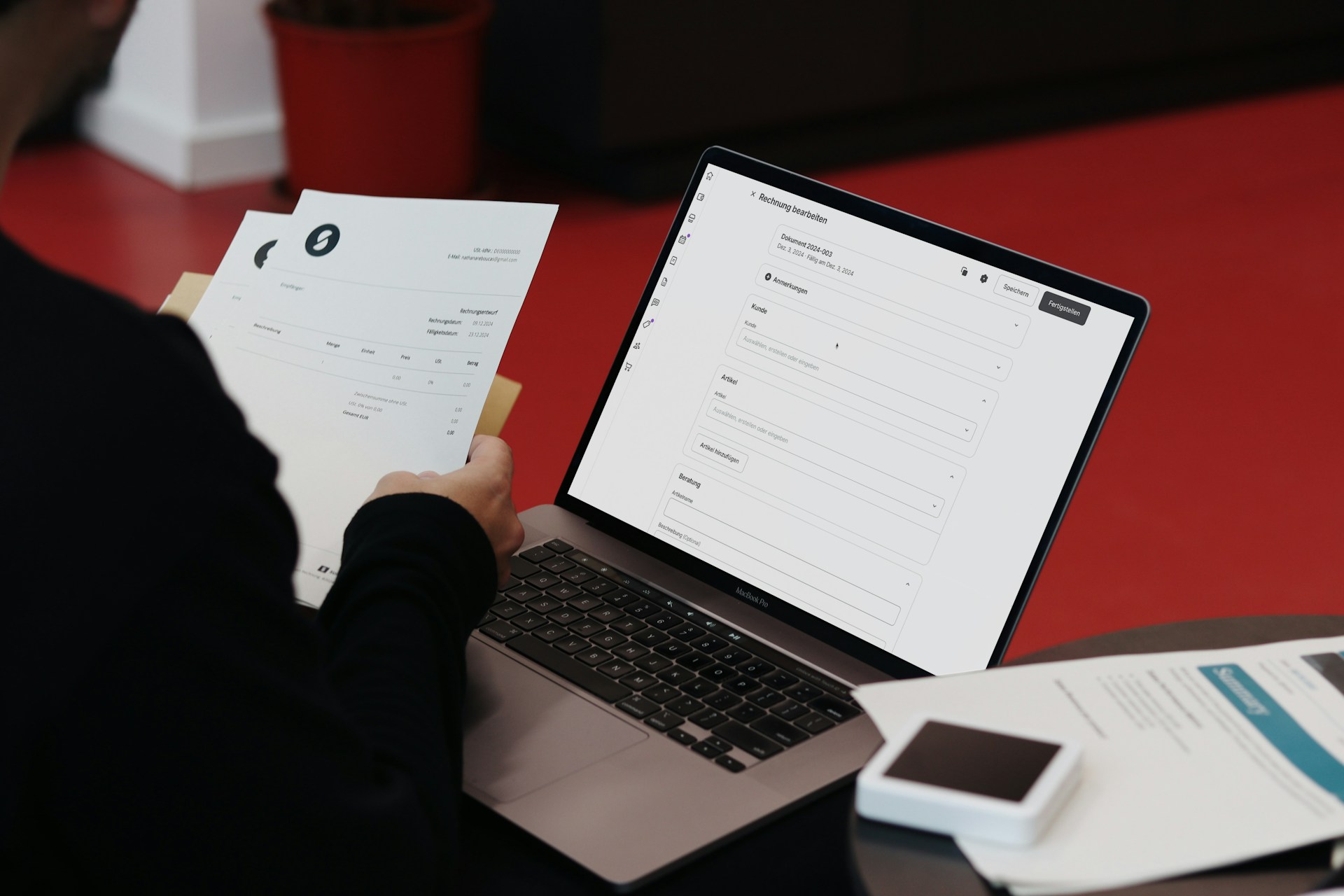
Electronic invoicing is no longer limited to large corporations or specialist accounting departments. Governments around the world are increasingly moving from paper invoices and ordinary PDF attachments toward structured electronic invoices, tax-authority reporting, digital clearance systems, and connected invoicing networks.
The important point is that e-invoicing does not mean simply emailing a PDF invoice.
A traditional PDF may be easy for a person to read, but a structured e-invoice is designed so that accounting software, business systems, and in some countries tax authorities can automatically process the underlying invoice data.
This difference matters because e-invoicing rules are becoming increasingly specific. Some countries require businesses to send invoices through government platforms. Others use accredited service providers or interoperability networks such as Peppol. Some require electronic reporting in addition to e-invoicing.
This guide explains how e-invoicing works, how major countries are approaching it in 2026, and what international businesses should consider before sending invoices across borders.
Last updated: September 2026
Important: E-invoicing regulations change frequently. This article is an informational guide, not tax or legal advice. Businesses should verify the current requirements with the relevant tax authority before relying on them for compliance.
What Is E-Invoicing?
An electronic invoice, or e-invoice, is an invoice exchanged in a structured electronic format that allows the information to be processed automatically. This is different from simply creating an invoice as a PDF and emailing it.
A PDF can contain all the information of an invoice, but the information may still need to be manually entered or extracted by accounting software. A structured e-invoice contains data in a machine-readable format. Common technologies and standards include:
- XML
- UBL
- CII
- Peppol BIS Billing
- APIs
- government-specific invoice schemas
The exact format depends on the country and system involved.
The European Union describes an e-invoice as an invoice issued, sent, and received in a structured way that allows automatic electronic processing.
PDF invoice vs structured e-invoice
| Feature | Traditional PDF invoice | Structured e-invoice |
|---|---|---|
| Human readable | Yes | Usually |
| Machine-readable data | Limited | Yes |
| Automatic processing | Limited | Designed for it |
| Can be emailed | Yes | Sometimes, but transmission method may be regulated |
| Tax-authority integration | Usually not directly | Often possible or required |
| XML/UBL data | Usually absent | Common |
| Government clearance | Usually unavailable | Required in some countries |
| Suitable for every mandate | No | Depends on local requirements |
Therefore, businesses should not assume that a PDF invoice automatically satisfies an e-invoicing mandate.
Why Are Governments Introducing E-Invoicing?
Governments have several reasons for moving toward electronic invoicing.
1. Better tax reporting: Structured invoice data can make it easier for tax authorities to identify transactions and compare reported sales with tax returns.
2. Reduced manual processing: Electronic invoice data can move directly between business systems without employees repeatedly entering information.
3. Faster transaction processing: Automated invoice exchange can reduce delays caused by manual data entry, scanning, and document handling.
4. Better audit trails: Digital systems can provide more consistent records of when invoices were issued, received, validated, or reported.
5. Reduced tax leakage and fraud: Some governments use e-invoicing and real-time or near-real-time reporting to improve VAT and GST administration.
6. Greater interoperability: Standards such as Peppol are designed to allow different business systems and service providers to exchange structured documents.
How E-Invoicing Systems Work
Not every country uses the same model. Understanding the different models is more useful than simply memorizing country names.
1. Clearance Model
Under a clearance model, invoice information is submitted to or validated through a government-controlled system before, during, or closely around the invoice transaction.
Brazil is a well-known example of a country with long-established electronic tax document systems.
2. Continuous Transaction Controls
Continuous Transaction Controls, often abbreviated as CTC, refer to systems where governments receive transaction information electronically with a high degree of automation.
The exact implementation varies by country.
Some systems validate invoices directly, while others focus on rapid reporting.
3. Post-Audit Model
In a post-audit model, businesses issue invoices and maintain records, while tax authorities obtain information later through tax reporting, audits, or other mechanisms.
4. Network-Based Model
Some countries use an interoperability network rather than requiring every business to connect directly to the tax authority.
Peppol is an important example.
Businesses can exchange structured documents through participating service providers while following common technical standards.
5. Hybrid Models
Some jurisdictions combine several approaches.
For example, a country may require structured invoices for domestic B2B transactions while using separate e-reporting rules for other transactions.
This is why simply asking whether a country “has e-invoicing” is not enough.
You also need to know:
- Who must comply?
- Which transactions are covered?
- Which invoice format is required?
- How must the invoice be transmitted?
- Does the government validate it?
- Must transaction data be reported separately?
- What are the implementation dates?
Global E-Invoicing Requirements at a Glance
| Country/Region | Main system or framework | 2026 situation |
|---|---|---|
| France | Accredited platforms + e-invoicing/e-reporting | Major rollout begins September 2026 |
| Germany | Structured B2B e-invoices | Receiving required; issuing transition period |
| Poland | KSeF | Mandatory rollout in phases during 2026 |
| Italy | SDI | Established mandatory electronic invoicing system |
| Malaysia | MyInvois | Phased rollout reaches smaller businesses |
| Singapore | InvoiceNow | GST-related reporting rollout expanding |
| Saudi Arabia | ZATCA/Fatoora | Generation and integration phases |
| UAE | National e-invoicing system | Pilot and phased implementation |
| Brazil | NF-e and other electronic tax documents | Mature electronic tax-document environment |
| United States | No nationwide B2B mandate | Adoption remains decentralized |
| United Kingdom | Mostly voluntary B2B | Government consultation and adoption efforts continue |
The table is a high-level summary. Specific obligations depend on business size, transaction type, tax status, sector, and local rules.
Europe: E-Invoicing Is Moving Into a New Phase
Europe is one of the most important regions for businesses following e-invoicing developments.
The European Union has already established electronic invoicing standards for public procurement, while individual member states have introduced or are introducing their own B2B and tax-reporting requirements.
The EU’s wider VAT reforms are also increasing the importance of digital reporting and electronic invoicing.
France
France is implementing one of the most significant e-invoicing reforms in Europe.
From 1 September 2026, large companies and intermediate-sized enterprises must issue electronic invoices under the new system, while all businesses subject to French VAT must be capable of receiving electronic invoices.
Small and medium-sized businesses and micro-enterprises receive additional time for mandatory electronic invoice issuance, with the next major deadline on 1 September 2027.
The French system also includes electronic reporting, known as e-reporting, for certain transactions that fall outside domestic B2B e-invoicing.
Businesses must work with an approved platform in the system.
This makes France an important example of why businesses should distinguish between:
- e-invoicing
- e-reporting
- receiving requirements
- issuing requirements
These are related but not identical obligations.
Germany
Germany introduced a new B2B e-invoicing framework beginning in 2025.
Domestic businesses must be able to receive e-invoices, while transitional arrangements allow certain businesses to continue using other invoice formats for a limited period.
The transition depends partly on the issuer’s previous-year turnover.
The practical lesson for businesses operating in Germany is simple: being able to receive and process structured e-invoices is increasingly important even where the issuing obligation is still in a transition period.
Poland
Poland’s KSeF, or National e-Invoicing System, is one of Europe’s major centralized e-invoicing systems. The mandatory rollout begins in phases. Under the current schedule, the main obligation starts on:
- 1 February 2026 for taxpayers above the specified 2024 sales threshold
- 1 April 2026 for other taxpayers covered by the obligation, subject to specified exceptions
KSeF also functions as the system through which businesses receive invoices.
Businesses operating in Poland therefore need to consider not only invoice design but also system integration and access to the national platform.
Italy
Italy’s Sistema di Interscambio (SDI) remains one of the best-known examples of a government-connected electronic invoicing system.
Invoices subject to the Italian electronic invoicing rules are transmitted through the SDI infrastructure.
Italy’s experience is important because it demonstrates how electronic invoicing can become integrated into ordinary business and tax administration rather than remaining an optional accounting feature.
Romania
Romania’s RO e-Factura system has become an important part of the country’s digital tax administration.
Businesses subject to the applicable rules need to consider electronic invoice submission, validation, and retention requirements.
Because Romanian requirements have evolved over time, businesses should check the current ANAF rules for their transaction type rather than relying on older descriptions of the system.
Belgium
Belgium is expanding the use of structured electronic invoicing, with Peppol playing an important role in interoperability.
The broader European trend is toward invoices that accounting systems can process automatically rather than relying exclusively on PDFs exchanged by email.
Spain
Spain is developing stronger electronic invoicing and digital record requirements as part of its tax-compliance framework.
Businesses should distinguish between:
- electronic invoice requirements
- certified invoicing software requirements
- VAT reporting
- transaction-record requirements
These are related areas but should not be treated as one single requirement.
Portugal
Portugal has long used digital invoice and reporting mechanisms, including requirements involving invoice data and accounting information.
Businesses operating there should verify current requirements for invoice fields, QR codes, reporting, and SAF-T-related obligations.
Latin America: A Major E-Invoicing Region
Latin America has been one of the world’s most advanced regions for electronic tax invoicing.
Countries such as Brazil, Mexico, Chile, Argentina, and Colombia have developed sophisticated electronic tax-document systems.
Brazil
Brazil’s NF-e, or Nota Fiscal Eletrônica, is a major component of the country’s electronic tax-document infrastructure.
Brazil also operates different electronic document systems for different types of transactions and services.
The country’s system is closely connected with tax administration and invoice authorization.
Brazil is also going through major tax-reform-related changes in 2026, meaning businesses need to monitor updated electronic document requirements rather than relying on older NF-e guidance alone.
Mexico
Mexico’s CFDI system is a central part of electronic invoicing.
Invoices generally require digital certification through the authorized infrastructure.
Businesses dealing with Mexico should pay attention to:
- CFDI versions
- digital certification
- required invoice fields
- tax information
- cancellation rules
- sector-specific requirements
Chile
Chile was an early adopter of electronic invoicing and operates an established digital tax-document environment through the country’s tax authority.
Electronic documents are integrated into the country’s tax administration.
Argentina
Argentina uses electronic invoicing and authorization mechanisms for applicable taxpayers.
Requirements can vary according to taxpayer status, transaction type, and the relevant invoice category.
Businesses should verify current requirements with Argentina’s tax authority because electronic invoicing rules and procedures can change.
Colombia
Colombia’s DIAN electronic invoicing system requires applicable businesses to issue and validate electronic invoices according to the country’s technical and tax rules.
The system includes electronic invoice validation and related electronic documents.
Asia-Pacific: Rapid Expansion of Digital Invoicing
Asia-Pacific contains some of the most rapidly evolving e-invoicing programs.
India
India’s GST e-invoicing system requires eligible taxpayers to report applicable invoices through the government’s Invoice Registration Portal.
The system generates an Invoice Reference Number and QR-related information for applicable transactions.
Eligibility depends on the applicable turnover and other rules, so businesses should verify the current threshold and exemptions rather than relying on older articles.
India’s model demonstrates how e-invoicing can be integrated directly with GST compliance.
Singapore
Singapore’s InvoiceNow network is based on the Peppol standard.
The system allows businesses to send and receive invoices digitally through an interoperable network.
Singapore is also progressively introducing mandatory InvoiceNow requirements for GST-registered businesses.
The government announced in 2026 that the GST InvoiceNow requirement would be progressively extended, with implementation for all GST-registered businesses scheduled between April 2028 and April 2031.
This makes Singapore a particularly important example of a country combining:
- Peppol
- structured invoices
- digital business networks
- tax-authority reporting
Malaysia
Malaysia’s MyInvois system is being implemented in phases based on annual turnover or sales.
The current timeline includes:
- More than RM100 million: 1 August 2024
- More than RM25 million to RM100 million: 1 January 2025
- More than RM5 million to RM25 million: 1 July 2025
- Up to RM5 million: 1 January 2026
Taxpayers with annual sales below RM3 million are currently exempt under the published implementation framework.
Malaysia’s system uses electronic submission and validation through the tax administration infrastructure.
Indonesia
Indonesia uses electronic tax invoicing through its e-Faktur framework.
Businesses subject to the relevant VAT rules should monitor current Directorate General of Taxes requirements for invoice generation, tax documentation, and electronic submission.
Vietnam
Vietnam has implemented electronic invoicing as part of its modernization of tax administration.
Businesses should verify the current requirements for electronic invoice issuance, invoice data, and applicable tax-authority systems.
Thailand
Thailand supports electronic tax invoices and electronic receipts through its tax administration framework.
Businesses considering electronic invoicing should check whether their transaction type and taxpayer status fall under the relevant e-Tax Invoice requirements.
South Korea
South Korea has a mature electronic tax invoice environment.
Electronic tax invoices are integrated into tax reporting and business accounting processes, making digital invoicing a normal part of compliance for many businesses.
Japan
Japan introduced its Qualified Invoice System in October 2023.
The system is closely connected with consumption-tax treatment and input-tax-credit requirements.
Businesses dealing with Japan should distinguish between the Qualified Invoice System and broader concepts of electronic invoicing.
A qualified invoice does not automatically mean that every invoice must be exchanged through a government e-invoicing network.
Middle East: E-Invoicing Is Becoming More Structured
The Middle East is another region where businesses need to pay attention to rapidly evolving digital tax systems.
Saudi Arabia
Saudi Arabia’s e-invoicing system is operated by the Zakat, Tax and Customs Authority (ZATCA).
The system has two major implementation phases:
Phase 1 — Generation
Phase 1 became mandatory on 4 December 2021.
Taxpayers subject to the rules must generate and store compliant electronic invoices.
Phase 2 — Integration
Phase 2 began on 1 January 2023 and has been introduced in waves.
The integration phase involves connecting taxpayers’ systems with ZATCA according to the applicable technical requirements and implementation schedule.
Saudi Arabia’s requirements include structured invoice data and technical controls, so a simple PDF invoice should not be confused with a compliant ZATCA e-invoice.
United Arab Emirates
The UAE is introducing a national electronic invoicing system based on the OpenPeppol framework.
The UAE Ministry of Finance states that an e-invoice is structured invoice data exchanged electronically between supplier and buyer and reported electronically to the Federal Tax Authority.
A PDF, Word document, image, scanned document, or ordinary email attachment is not considered an e-invoice under the UAE framework. The implementation is phased. The pilot began in July 2026.
Under the published schedule, businesses with annual revenue of at least AED 50 million have an implementation date of 1 January 2027, while businesses below that threshold have an implementation date of 1 July 2027. The deadline for appointing an Accredited Service Provider for businesses above AED 50 million was subsequently extended to 30 October 2026.
This is a good example of why businesses should always check the latest government announcement rather than relying on an old blog post.
Egypt
Egypt operates a nationwide electronic invoicing system as part of its tax digitization program.
Applicable businesses need to follow the Egyptian Tax Authority’s current requirements for electronic invoices, registration, submission, and technical integration.
Africa: Digital Tax Invoicing Is Expanding
African countries are adopting different approaches to electronic tax reporting and digital invoicing. The pace and scope vary considerably.
Kenya
Kenya has expanded electronic tax invoicing through its digital tax administration systems. Businesses should check the current Kenya Revenue Authority requirements for electronic tax invoices, tax compliance, and applicable systems.
Nigeria
Nigeria continues to develop digital tax administration and electronic invoicing capabilities.
Because implementation can differ by taxpayer category and tax framework, businesses should verify current requirements with the relevant Nigerian tax authority before relying on general e-invoicing guidance.
South Africa
South Africa’s invoicing environment remains more decentralized than countries with mandatory centralized clearance systems.
Businesses should distinguish between ordinary invoice requirements, VAT documentation, electronic document exchange, and any sector-specific digital reporting obligations.
North America: A Different Approach
North America has generally taken a less centralized approach to B2B e-invoicing than countries such as Brazil, Mexico, Saudi Arabia, or Poland.
United States
The United States does not currently have a single nationwide B2B e-invoicing mandate comparable to some European and Latin American systems.
Businesses commonly use:
- accounting software
- electronic billing platforms
- accounts payable networks
- EDI
- PDF invoices
- automated invoice exchange
Government procurement can have its own electronic invoicing requirements.
The important point is that the United States should not be treated as one nationwide government-clearance e-invoicing system.
Canada
Canada also has a more decentralized environment.
Businesses may use electronic invoicing and digital procurement systems, while specific government or procurement requirements can apply to particular transactions.
For international companies, Canada therefore requires a different compliance approach from countries using centralized tax invoice clearance.
United Kingdom
The United Kingdom currently has a largely voluntary B2B e-invoicing environment.
Businesses can choose to use e-invoicing systems, while specific requirements exist in some public-sector contexts.
The UK government has also been examining ways to encourage wider electronic invoicing adoption.
For businesses operating internationally, this means that UK e-invoicing should not be treated in the same way as mandatory clearance systems in countries such as Italy or Brazil.
Why One Global Invoice Format Does Not Work Everywhere
One of the biggest challenges for international businesses is that different countries can require different:
- invoice formats
- tax identifiers
- VAT/GST fields
- invoice numbering rules
- reporting deadlines
- digital signatures
- QR codes
- APIs
- government platforms
- service providers
- document standards
- retention periods
A company selling to customers in five countries may therefore need to support five different compliance environments. This is one reason structured standards and interoperability networks are becoming increasingly important.
What Is Peppol?
Peppol is an important part of the global e-invoicing discussion, but it is often misunderstood. Peppol is not simply a government tax system.
It provides specifications and infrastructure that help organizations exchange electronic business documents through an interoperable network.
One important specification is Peppol BIS Billing.
Businesses can use compatible service providers, commonly known as Peppol Access Points, to exchange structured invoices.
This approach can reduce the need for every company to build a separate connection to every trading partner. Several governments use or are adopting Peppol-based approaches as part of their digital invoicing strategies.
The UAE, for example, has explicitly based its national e-invoicing system on OpenPeppol.
UBL, XML, and Structured Invoice Data
A major difference between an ordinary PDF invoice and a structured e-invoice is the underlying data. A structured invoice can contain machine-readable fields such as:
- supplier name
- supplier tax number
- buyer name
- buyer tax number
- invoice number
- invoice date
- currency
- product or service description
- quantity
- unit price
- tax rate
- tax amount
- total amount
- payment information
XML is commonly used to represent structured invoice data. UBL is another important standard used for structured business documents. The exact format required depends on the jurisdiction.
Therefore, businesses should never assume that generating an XML file automatically makes an invoice compliant. The XML must follow the applicable country’s technical specification.
Common E-Invoicing Mistakes
Mistake 1: Assuming a PDF is an e-invoice
A PDF is a document format. It is not automatically a structured e-invoice.
Mistake 2: Using an old compliance guide
E-invoicing regulations change.
A guide published several years ago may contain outdated thresholds or deadlines.
Mistake 3: Ignoring the buyer’s country
A business may follow its own country’s invoicing rules but still need to consider the customer’s country, transaction location, VAT treatment, or procurement requirements.
Mistake 4: Focusing only on invoice design
Compliance is not only about how an invoice looks.
It may involve:
- data structure
- transmission
- validation
- authentication
- reporting
- archiving
- APIs
- tax identifiers
Mistake 5: Assuming Peppol means universal compliance
Peppol can provide interoperability, but using Peppol does not automatically satisfy every country’s tax requirements.
Businesses still need to follow local rules.
Mistake 6: Ignoring credit notes
Many electronic invoicing systems also regulate credit notes and debit notes.
A business should understand how corrections, cancellations, refunds, and adjustments must be handled.
Mistake 7: Treating all customers the same
B2B, B2C, B2G, domestic, and international transactions can have different requirements.
How International Businesses Can Prepare
If your business invoices customers in multiple countries, use a structured process.
Step 1: Identify where you have tax obligations
List the countries where your business:
- sells products
- provides services
- has VAT/GST registration
- has a permanent establishment
- sells to government entities
- has recurring B2B customers
Step 2: Determine whether e-invoicing is mandatory
Do not stop at “Does this country have e-invoicing?”
Check whether the mandate applies to your:
- business size
- industry
- tax status
- transaction type
- customer type
Step 3: Identify the required format
Check whether the jurisdiction requires:
- XML
- UBL
- CII
- Peppol BIS
- government-specific XML
- another structured format
Step 4: Identify the transmission method
Determine whether invoices must be sent through:
- a government portal
- an accredited service provider
- Peppol
- API
- approved accounting software
- another network
Step 5: Check reporting requirements
Some systems require more than sending the invoice to the customer.
You may also need to transmit transaction or payment information to a tax authority.
Step 6: Prepare your accounting software
Your system should be capable of handling the relevant:
- tax identifiers
- invoice fields
- currencies
- tax rates
- invoice statuses
- credit notes
- structured data
- reporting requirements
Step 7: Keep records
Understand how long invoices and related transaction data must be retained under the applicable tax rules.
Step 8: Recheck the rules regularly
This is critical.
A compliance system that was correct in 2025 may require changes in 2026 or 2027.
International E-Invoicing Compliance Checklist
Before sending an invoice to an international customer, ask:
Do I know which country’s invoicing rules apply?
Is e-invoicing mandatory for this transaction?
Is the transaction B2B, B2C, or B2G?
Does the customer require a structured e-invoice?
Is PDF sufficient?
Is XML, UBL, CII, or another format required?
Is Peppol used?
Is a government platform required?
Do I need an accredited service provider?
Is tax-authority reporting required?
Does the invoice require a VAT/GST number?
Does it require a QR code?
Are there special invoice-numbering rules?
Are credit notes subject to separate requirements?
How long must records be retained?
Have I checked the latest official guidance?
What This Means for Freelancers and Small Businesses
Not every freelancer or small business needs a sophisticated government-integrated e-invoicing system. The correct approach depends on where the business operates, who its customers are, and which tax rules apply.
For a freelancer sending a normal commercial invoice to a foreign client, a professionally structured invoice may be enough if no mandatory electronic invoicing rule applies to that transaction.
However, the situation can change when the freelancer:
- becomes VAT/GST registered
- crosses a local turnover threshold
- sells to a government organization
- operates in a country with mandatory e-invoicing
- sells through a marketplace with special tax requirements
- begins invoicing domestic businesses subject to a mandate
The key is to avoid assuming that one invoice format works for every country.
Why Invoice Software Matters
Modern invoicing software can help businesses organize invoice data, currencies, tax fields, customer information, and payment records.
However, businesses should distinguish between a general invoice generator and a country-specific government-compliant e-invoicing solution.
A basic invoice generator may help create a professional invoice, but it does not automatically connect to every government platform or satisfy every national e-invoicing mandate.
For businesses operating under a mandatory electronic invoicing system, the software must support the specific technical and transmission requirements of that jurisdiction.
For ordinary commercial invoicing where no structured e-invoice mandate applies, a professional invoice generator can still be useful for creating clear invoices with:
- business information
- customer information
- invoice numbers
- dates
- line items
- quantities
- prices
- taxes
- totals
- currencies
- payment details
Create a professional invoice with Invoice Generator Pro
The Future of Global E-Invoicing
The direction of travel is clear: governments and businesses are moving toward more structured financial data.
But there will not necessarily be one universal global e-invoicing system.
Instead, businesses are likely to continue dealing with a mixture of:
- government platforms
- accredited service providers
- Peppol networks
- APIs
- XML standards
- national invoice schemas
- tax reporting systems
The European Union’s digital VAT reforms are also pushing electronic invoicing and digital reporting higher on the policy agenda.
For international businesses, the biggest challenge will not simply be creating an invoice. It will be creating and transmitting the right invoice data through the right system for the right transaction.
Final Takeaway
Global e-invoicing is not one single technology or one worldwide rule.
Italy’s SDI, Poland’s KSeF, Saudi Arabia’s ZATCA system, Malaysia’s MyInvois, Singapore’s InvoiceNow network, Brazil’s electronic tax documents, France’s accredited-platform model, and the UAE’s emerging Peppol-based system all demonstrate different approaches to digital invoicing.
That means businesses should stop thinking about e-invoicing as simply “sending invoices electronically.”
The more important questions are:
What data is required?
Which format is required?
Who must receive the invoice?
Does a tax authority need the data?
Which platform or network must be used?
When does the obligation apply?
For companies working across borders, building an invoicing workflow that can adapt to different tax jurisdictions is becoming increasingly important.
And for any business affected by a mandatory e-invoicing regime, the safest approach is to verify the latest requirements directly with the relevant tax authority before relying on a generic invoice template or PDF generator.
Sources and Official References
The information in this guide should be checked against the latest official documentation because e-invoicing rules and implementation schedules can change.
Key official sources include:
- European Union — Your Europe: eInvoicing
- EUR-Lex — EU VAT and electronic invoicing legislation
- France — Direction générale des Finances publiques (impots.gouv.fr)
- Germany — Federal Ministry of Finance (Bundesfinanzministerium)
- Poland — Krajowy System e-Faktur (KSeF)
- Saudi Arabia — Zakat, Tax and Customs Authority (ZATCA)
- United Arab Emirates — Ministry of Finance eInvoicing portal
- Singapore — Inland Revenue Authority of Singapore (IRAS)
- Malaysia — Inland Revenue Board of Malaysia (HASiL)
- Brazil — Receita Federal / Nota Fiscal Eletrônica
- United Kingdom — GOV.UK electronic invoicing guidance

Akbar Ali is the Founder of InvoiceGeneratorPro.io, a platform dedicated to helping freelancers, small businesses, startups, agencies, and entrepreneurs create professional invoices quickly and efficiently. With years of experience in digital business, SEO content strategy, and online entrepreneurship, he focuses on developing practical tools and educational resources that simplify invoicing, payment management, and financial documentation.As a business writer and digital entrepreneur, Akbar creates in-depth guides, industry insights, and actionable content covering invoicing, freelancing, accounting basics, business finance, taxation, productivity, and payment solutions. His goal is to make complex financial processes easy to understand while helping professionals save time and present their businesses more professionally.Through InvoiceGeneratorPro.io, he continues to build reliable, user-friendly solutions that empower businesses worldwide to streamline their billing workflows and improve financial organization.
Akbar Ali