
Getting a client to sign a contract feels good. Getting the work finished feels even better. Then comes the part many freelancers and small business owners dread: waiting for the invoice to be paid.
You check your bank account. Nothing. A few days pass. Still nothing.
Then you open your accounting software and see the same unpaid invoice sitting in your accounts receivable.
Late payments can create serious cash flow problems, especially for small businesses. You may have completed the work weeks ago, yet the money you earned still isn’t available to pay suppliers, staff, rent, software bills, or your own expenses.
The good news is that better small business invoicing can reduce many common payment delays.
You can set clearer payment terms, make invoices easier to pay, send reminders at the right time, and create a consistent follow-up process. None of these steps guarantees that every client will pay immediately, but they can remove many of the reasons invoices sit unpaid.
Here are 11 practical strategies you can use to get clients to pay invoices faster.
Why Do Clients Pay Invoices Late?
There isn’t always one reason for a late payment.
Sometimes the client simply forgets. Sometimes the invoice goes to the wrong person. A missing purchase order can delay approval. An unclear invoice can send it back to your accounts team. A client may also have their own cash flow problems.
Common causes include:
- Unclear payment terms
- Missing invoice details
- Incorrect billing information
- No easy payment method
- Invoices sent to the wrong contact
- Slow internal approval processes
- No payment reminders
- Disagreements about the work
- Client cash flow problems
- Invoices being sent weeks after the work is finished
You can’t control every reason for late payments. You can control how you create, send, and follow up on your invoices.
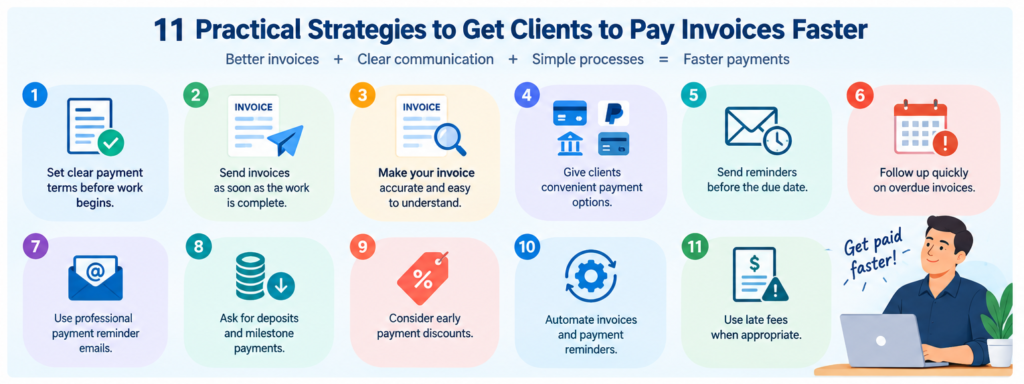
1. Set Clear Payment Terms Before Starting Work
Payment expectations should be discussed before the project begins. If a client doesn’t know when payment is due, you have created room for confusion. Your contract or agreement should state the payment schedule, due date, accepted payment methods, deposit requirements, and any applicable late payment terms.
For example, you might use:
- Due on receipt
- Net 7
- Net 15
- Net 30
- 50% deposit and 50% on completion
- Monthly milestone payments
For smaller freelance projects, a short payment period may make sense. Larger business projects may require a longer approval process.
The important part is that both sides understand the agreement before work starts.
Your invoice should repeat the agreed payment terms. Don’t make the client search through an old email to find out when the money is due.
Put the Due Date in a Visible Place
A client shouldn’t have to study the invoice to find the payment deadline. Include:
Invoice Date: September 17, 2026
Due Date: October 2, 2026
Payment Terms: Net 15
Clear information reduces unnecessary back-and-forth.
2. Send the Invoice as Soon as the Work Is Complete
If you finish a project on Friday and wait until the following Friday to send the invoice, you’ve already lost seven days.
Send the invoice promptly.
This is one of the simplest ways to improve invoice payment times.
For freelancers, this could mean sending the invoice immediately after delivering the final files. For agencies, it could mean invoicing when a project milestone is approved. For service businesses, it may mean sending an invoice after each completed service.
The sooner the invoice reaches the client, the sooner the payment process can begin.
This is also where an online invoice generator can save time. You can prepare a professional invoice quickly instead of rebuilding the same document from scratch every time.
3. Make Your Invoice Accurate and Easy to Understand
A confusing invoice can delay payment. Check the basics before sending it:
- Client name
- Business name
- Billing address
- Invoice number
- Invoice date
- Due date
- Description of products or services
- Quantity
- Price
- Taxes, where applicable
- Total amount
- Payment instructions
- Payment terms
- Contact information
An invoice with a wrong company name or missing purchase order number may be rejected by the client’s accounts department.
The same thing happens when the invoice total doesn’t match the agreed quote. A professional invoice should answer three basic questions quickly:
- What am I paying for?
- How much do I owe?
- When do I need to pay?
If those answers are obvious, the client has fewer reasons to contact you before making payment.
4. Give Clients Convenient Payment Options
Payment friction can slow down an invoice. If you only accept bank transfers but your client normally pays suppliers through another method, they may postpone the payment until they have time to deal with it.
Where practical, give clients several payment options. Depending on your location and business type, these might include:
- Bank transfer
- Credit or debit card
- PayPal
- Payment links
- Online payment services
- Local digital payment methods
Your invoice should clearly explain how the client can pay.
If you use an invoice generator or invoicing software that supports payment links, place the payment option where the client can find it quickly.
The easier the payment process is, the fewer steps stand between the client and the completed payment.
5. Send a Payment Reminder Before the Due Date
You don’t have to wait until an invoice becomes overdue before contacting the client. A friendly reminder a few days before the due date can prevent forgotten invoices.
For example:
Hi Sarah,
Just a quick reminder that invoice #1048 is due on September 22. Please let me know if you need any additional information for processing the payment.
Thanks.
That’s enough.
You don’t need a long email.
For recurring clients, you can create a standard payment reminder email and adjust the invoice number and due date each time.
A reminder before the deadline also gives the client an opportunity to tell you about a problem while there’s still time to fix it.
6. Follow Up Quickly When an Invoice Becomes Overdue
Once the due date passes, don’t leave the invoice sitting untouched for another month. Follow up.
Your first overdue invoice reminder can remain polite and professional.
For example:
Hi James,
I’m following up on invoice #1082, which was due on September 15. I wanted to check whether the payment has been scheduled. Please let me know if you need the invoice resent or require any additional details.
Thank you.
This approach gives the client an easy way to explain a delay.
Maybe the invoice went to the wrong department. Maybe their accounting team needs a document. Maybe payment was already sent and hasn’t reached your account yet.
You won’t know until you ask.
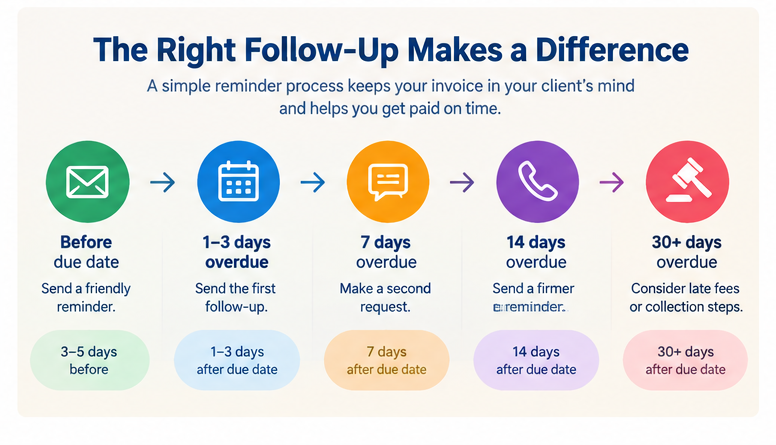
Create a Consistent Follow-Up Schedule
Don’t rely on memory. For example:
Before due date: Friendly reminder
1 to 3 days overdue: First follow-up
7 days overdue: Second follow-up
14 days overdue: Firmer payment request
30+ days overdue: Formal collection step, depending on your contract and local law
Your exact schedule should match your business and client agreements.
7. Use Professional Payment Reminder Emails
Your payment reminder should be clear, specific, and easy to act on. Include:
- Invoice number
- Original invoice date
- Due date
- Amount due
- Payment instructions
- A request for a payment update
Avoid emotional language. You don’t need to write:
“I’ve been waiting forever and really need this money.”
Write:
“Invoice #1082 for $1,250 was due on September 15. Please confirm the expected payment date.”
That is much easier for a business contact to process.
Keep the Subject Line Specific
Useful subject lines include:
- Payment Reminder: Invoice #1082
- Invoice #1082 Due September 15
- Overdue Invoice #1082
- Payment Follow-Up for Invoice #1082
The client should understand the purpose of the email before opening it.
8. Ask for Deposits and Milestone Payments
Large projects can create a long wait between starting the work and receiving money. A deposit reduces that gap.
For example, a web designer might require 30% before work starts, 40% after the first milestone, and 30% before final delivery.
A contractor might use progress payments tied to specific stages of a project. A freelancer might request 50% upfront and 50% when the work is completed. The right structure depends on your industry, project size, client relationship, and contract.
Milestone payments also give both sides clearer payment points. Instead of one large invoice at the end, the client pays according to agreed stages. For small businesses, this can make cash flow easier to manage.
9. Consider an Early Payment Discount
An early payment discount can encourage clients to pay before the normal due date. For example:
2% discount if paid within 10 days, otherwise Net 30.
This is commonly expressed as 2/10 Net 30.
Before using an early payment discount, calculate the cost. If a client pays 20 days early but you give away 2% of the invoice, decide whether the earlier cash is worth that reduction. For some businesses, faster access to cash can be useful. For others, the discount may cost more than the benefit. Don’t offer a discount automatically. Run the numbers first.
10. Automate Invoices and Payment Reminders
Manual invoicing becomes harder as your client list grows.
You may remember to create invoices but forget to send reminders. Or you may send a reminder to one client and miss another.
Invoice automation can reduce these mistakes. Depending on the system you use, you may be able to:
- Create invoices from saved information
- Send recurring invoices
- Track invoice status
- Schedule payment reminders
- Record payments
- Identify overdue invoices
- Track outstanding accounts receivable
Tools such as QuickBooks and FreshBooks include invoicing and accounting features, while simpler invoice generators can work well for businesses that mainly need to create professional invoices quickly.
The right tool depends on how complex your business is.
A freelancer with ten invoices a month may need something very different from an agency managing hundreds of invoices.
Track Your Outstanding Invoices
At minimum, you should know:
Paid: Payment received
Pending: Invoice sent but not yet due
Overdue: Due date has passed
Disputed: Client has raised a billing issue
This gives you a clear view of which invoices need attention.
11. Use Late Fees When Appropriate
Late fees can encourage timely payments, but they need to be handled carefully.
If you plan to charge a late fee, include the terms in your agreement and invoice before the payment becomes overdue.
For example: A 1.5% monthly late fee applies to unpaid balances after the due date.
The exact fee you can legally charge depends on your contract and local laws. Some industries and jurisdictions have specific restrictions.
Don’t suddenly add a fee that the client never agreed to. If a client has a genuine billing dispute, resolve that issue first. Charging a late fee while the amount itself is being disputed can make the situation worse.
What Should You Do When a Client Still Doesn’t Pay?
Sometimes you’ve done everything correctly and the invoice still remains unpaid. At this point, stop sending vague reminders. Ask for a specific payment date.
For example:
“Please confirm whether payment will be made by September 25.”
A specific question requires a specific response.
If the client says they can’t pay the full amount, you may discuss a payment plan if that makes financial sense for your business.
For a serious unpaid invoice, review your contract and consider formal collection options that are appropriate for your location and situation.
Keep records of:
- The signed agreement
- Original invoice
- Work delivered
- Emails
- Payment reminders
- Client responses
- Any agreed payment plans
Good documentation matters when a payment dispute becomes serious.
A Simple Invoice Payment Workflow for Small Businesses
You don’t need a complicated process.
A basic workflow can look like this:
Step 1: Agree on payment terms before work begins.
Step 2: Collect the correct billing details.
Step 3: Complete the work or reach the agreed milestone.
Step 4: Send a professional invoice immediately.
Step 5: Confirm that the client received it.
Step 6: Send a reminder before the due date.
Step 7: Follow up shortly after the due date if payment hasn’t arrived.
Step 8: Continue according to your payment collection policy.
Step 9: Escalate serious overdue accounts according to your contract and applicable law.
This process makes small business invoicing more predictable.
How a Better Invoice Can Improve Payment Speed
Your invoice won’t force a client to pay. It can remove unnecessary delays. A good invoice gives the client the information their accounting team needs. It identifies the amount due, payment deadline, services provided, and payment method.
That matters when several people are involved in approving a payment.
For example, suppose you send an invoice with no purchase order number. The client’s finance department may send it back to the person who hired you. That person may contact you three days later. You correct the invoice. The finance team processes it during its next payment cycle.
A tiny invoice error can turn into a week-long delay. Accurate invoicing prevents that chain of events.
Should You Send an Invoice Before or After the Work?
It depends on the agreement. For projects that require upfront costs, a deposit invoice may be appropriate. For milestone-based projects, invoice after each approved milestone. For recurring services, use a regular billing schedule. For completed one-time services, send the invoice as soon as the service is finished.
The important point is to agree on the process before the work starts. That prevents awkward conversations later.
Frequently Asked Questions About Faster Invoice Payments
1. How can I get clients to pay invoices faster?
Set clear payment terms, send invoices promptly, provide convenient payment options, and follow up before and after the due date. A consistent invoice payment process reduces avoidable delays.
2. How do I politely ask a client to pay an invoice?
Mention the invoice number, amount, and due date. Ask whether payment has been scheduled and whether the client needs any additional information.
3. When should I send an invoice reminder?
A reminder a few days before the due date can prevent forgotten payments. Send another reminder soon after the invoice becomes overdue.
4. How long should I wait before following up on an unpaid invoice?
You can follow up shortly after the due date. For important or large invoices, don’t wait several weeks before contacting the client.
5. What should I include in a payment reminder email?
Include the invoice number, amount due, original due date, payment instructions, and a clear request for a payment update.
6. What are good payment terms for small businesses?
Common terms include due on receipt, Net 7, Net 15, and Net 30. The right term depends on your industry, clients, project size, and agreement.
7. Should freelancers ask for a deposit?
A deposit can reduce the financial risk of starting a project. The percentage should reflect the project size, expected costs, and agreement with the client.
8. Can early payment discounts help businesses get paid faster?
They can encourage earlier payments. However, calculate the cost of the discount before using one.
9. Should I charge a late payment fee?
A late fee can encourage timely payment when it is included in the agreement and allowed under applicable law. Make the terms clear before the invoice becomes overdue.
10. What is an overdue invoice?
An overdue invoice is an invoice whose payment due date has passed without the full amount being paid.
11. What is an outstanding invoice?
An outstanding invoice is an invoice that remains unpaid. It may still be within its payment period or already overdue.
12. How can invoice automation reduce late payments?
Automated systems can send invoices and scheduled reminders without relying on someone to remember each step manually.
13. What payment methods should I put on an invoice?
Use payment methods your clients can access easily, such as bank transfer, card payments, payment links, or relevant online payment services.
14. What should I do if a client disputes an invoice?
Ask the client to explain the disputed amount or service. Check the contract, quote, work records, and invoice, then resolve the specific issue.
15. How many times should I remind a client about an unpaid invoice?
There is no universal number. A practical process can include a pre-due reminder, an early overdue reminder, and a firmer follow-up if payment remains outstanding.
16. How can small businesses improve cash flow from invoices?
Invoice promptly, use suitable payment terms, collect deposits where appropriate, monitor accounts receivable, and follow up on overdue invoices consistently.
17. Is Net 30 a good payment term?
Net 30 gives the client 30 days to pay. It may work well for established business relationships, but smaller businesses should consider whether waiting 30 days fits their cash flow.
18. Can a professional invoice make clients pay faster?
A professional invoice can reduce confusion and billing errors. It cannot guarantee faster payment, but clear information can reduce avoidable processing delays.
19. How can I track unpaid invoices?
You can track invoice status using accounting software, invoicing software, or a simple spreadsheet. At minimum, record the invoice number, client, amount, due date, and payment status.
20. What is the best way to prevent late invoice payments?
Start before the invoice is created. Agree on payment terms, collect accurate billing information, invoice promptly, make payment easy, and create a regular reminder process.
Final Thoughts
Getting clients to pay invoices faster starts before an invoice becomes overdue.
Clear payment terms reduce confusion. Prompt invoicing starts the payment clock sooner. Accurate invoices reduce processing problems. Payment reminders keep invoices visible. Deposits and milestone payments can reduce long waits on large projects.
For many small businesses and freelancers, the biggest improvement comes from consistency.
Create the invoice. Send it on time. Make payment easy. Track the due date. Follow up when necessary.
Your clients may still pay according to their own schedules, and some will always need a reminder. A clear small business invoicing process gives you a better way to manage those situations and protect your cash flow.
If you regularly create invoices, use an online invoice generator to create professional invoices quickly and keep your billing process consistent.

Akbar Ali is the Founder of InvoiceGeneratorPro.io, a platform dedicated to helping freelancers, small businesses, startups, agencies, and entrepreneurs create professional invoices quickly and efficiently. With years of experience in digital business, SEO content strategy, and online entrepreneurship, he focuses on developing practical tools and educational resources that simplify invoicing, payment management, and financial documentation.As a business writer and digital entrepreneur, Akbar creates in-depth guides, industry insights, and actionable content covering invoicing, freelancing, accounting basics, business finance, taxation, productivity, and payment solutions. His goal is to make complex financial processes easy to understand while helping professionals save time and present their businesses more professionally.Through InvoiceGeneratorPro.io, he continues to build reliable, user-friendly solutions that empower businesses worldwide to streamline their billing workflows and improve financial organization.
Akbar Ali