
Getting your first freelance client feels great. Getting paid feels even better.
Then the client says, “Please send me an invoice.”
That can create a surprisingly awkward moment if you work independently and haven’t registered an LLC, corporation, or other formal company.
You may wonder:
- Can I invoice without a company?
- Do I need a business registration number?
- Can I use my personal name?
- Do I need a business bank account?
- What happens if the client is in another country?
- Does sending an invoice create a tax obligation?
The good news is that these questions can be separated.
An invoice is a payment document. Company registration is a legal and administrative matter. They can be connected, but they aren’t automatically the same thing.
The exact rules depend on your country, state, province, industry, and type of work. So this guide explains the general process and then points out where local rules can change the answer.
For U.S. freelancers, the IRS treats many people who work independently as self-employed or independent contractors. The IRS also expects self-employed people to keep records of business income and expenses. (IRS)
Can You Invoice Without a Registered Company?
In many situations, yes, you can send a freelance invoice as an individual.
A freelancer may work under their own legal name without creating an LLC or corporation. The invoice can identify the freelancer, the client, the services provided, the amount due, and the payment terms. The exact registration requirement depends on local law.
That distinction matters because freelancers often mix up three separate things:
- Creating an invoice
- Registering a business
- Reporting freelance income and paying taxes
These are different compliance questions.
For example, a person may be able to send an invoice under their own name while still having tax obligations or local licensing requirements.
In the United States, the IRS describes independent contractors as self-employed when they are in business for themselves. The tax treatment depends on the facts of the working relationship, not simply on whether someone created an LLC. (IRS) So don’t treat the absence of an LLC as proof that you have no tax or registration obligations.
What Does a Freelancer Invoice Need?
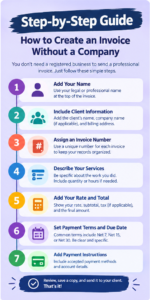
A freelance invoice doesn’t need to look complicated. For a typical service invoice, include:
- Your full legal or professional name
- Your contact information
- Client name
- Client business information, if applicable
- Invoice number
- Invoice date
- Payment due date
- Description of your services
- Quantity or hours, where relevant
- Rate
- Subtotal
- Applicable taxes
- Total amount due
- Payment instructions
- Payment methods
- Optional notes or terms
Here’s a simple example.
Freelancer: Ahmed Khan
Client: Bright Media LLC
Invoice: INV-2026-014
Date: September 21, 2026
Due: October 5, 2026
Service: Website landing page design
Quantity: 1
Rate: $450
Total: $450
Payment: Bank transfer or PayPal. That’s a legitimate-looking freelance invoice without inventing a company structure you don’t have.
How to Create a Freelancer Invoice Without a Company
You can create an invoice manually, use a document template, or use an online invoice generator. Here’s the practical process.
1. Put your name at the top
If you don’t have a registered company, your personal legal name can identify you.
For example:
Muhammad Ali
Freelance Graphic Designer
Email: example@email.com
Don’t create a fake company name and make it look like a registered corporation.
If you regularly use a separate trading or professional name, check whether your location requires that name to be registered.
2. Add the client’s details
Ask the client for the exact billing information they want on the invoice.
This can include:
- Client name
- Company name
- Billing address
- Purchase order number
- Tax information, where applicable
Large companies can have strict accounts-payable rules. Your invoice may be correct, but payment can still be delayed if you leave out a purchase order or billing reference.
3. Give the invoice a unique number
Use a simple sequence. Examples:
- INV-001
- INV-002
- INV-003
Or:
- 2026-001
- 2026-002
- 2026-003
Don’t reuse invoice numbers. A consistent numbering system makes it easier to match payments to invoices and maintain your records.
4. Describe the freelance work
Avoid vague descriptions such as:
Design work
Give the client enough information to understand what they’re paying for.
For example:
Logo design, two initial concepts, one revision, final PNG and SVG files.
For hourly work:
Website development, 12 hours at $40/hour.
A clear service description can reduce disputes later.
5. Add your rate and total
If you charge by project, show the project price. If you charge hourly, show:
12 hours × $40 = $480
If you charge a daily rate, show:
3 days × $300 = $900
The client should be able to understand how you calculated the invoice without sending you another email.
6. Set payment terms
Common payment terms include:
- Due on receipt
- Net 7
- Net 15
- Net 30
If your client agrees to payment within 15 days, put that agreement on the invoice.
For example: Payment due within 15 days of invoice date. Don’t put “Net 30” on an invoice when you’ve already agreed to 7 days with the client.
7. Add payment instructions
Tell the client exactly how to pay. You might accept:
- Bank transfer
- PayPal
- Stripe
- Wise
- Card payment
- Other approved payment methods
If you use a payment link, make sure it leads to the correct account.
Should You Use Your Personal Name or a Business Name?
This depends on how you’re operating. If you work under your own legal name, using your personal name is often the simplest approach. For example:
Sara Ahmed
Freelance Copywriter
You can still describe your profession below your name.
If you operate under a separate business or trading name, local rules may require registration before you use that name commercially.
This is where invoice without a business name becomes a useful option for early-stage freelancers.
Don’t put “LLC,” “Ltd,” “Inc.,” or another legal designation after your name unless you actually have that legal structure. A professional invoice doesn’t need a fancy company identity to look credible.
Do You Need a Business Registration Number?
There isn’t one worldwide rule.
Some jurisdictions require freelancers or sole traders to register once they reach certain conditions. Others allow individuals to conduct certain types of freelance work under their personal name without forming a separate company.
The same applies to:
- Business licenses
- Tax identification numbers
- VAT registration
- Sales tax registration
- Local permits
Your location matters. For U.S. freelancers, federal tax treatment is separate from forming an LLC. The IRS provides guidance for self-employed individuals and independent contractors, including income reporting and recordkeeping. (IRS)
So the phrase “I don’t have a company” doesn’t mean “I don’t have tax responsibilities.” That’s an important distinction.
What About Taxes on a Freelancer Invoice?
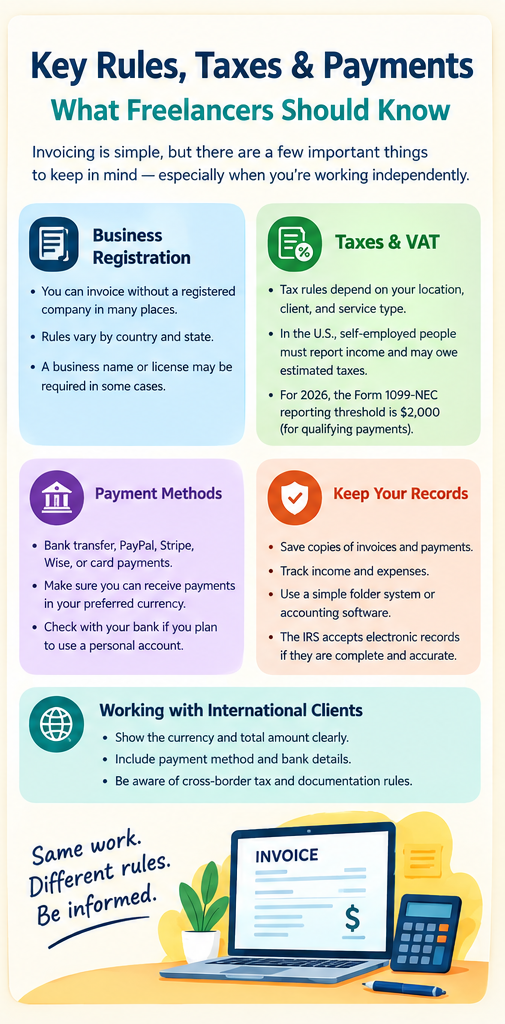
This is one area where you should slow down. Don’t automatically add sales tax or VAT to every freelance invoice.
Tax treatment depends on factors such as:
- Your country
- State or province
- Client location
- Type of service
- Your registration status
- Revenue level
- Applicable tax rules
For example, VAT rules can differ significantly from U.S. sales-tax rules.
If you’re unsure, check your local tax authority or ask a qualified accountant.
For U.S. freelancers, the IRS says gig workers who earn self-employment income must report that income, and self-employed individuals may have estimated-tax obligations. (IRS) The invoice itself doesn’t erase those obligations.
U.S. Freelancers: Keep Your Invoice Records
If your target market includes U.S. freelancers, this section deserves attention. The IRS lists invoices, receipts, deposit information, payment records, and other documents as supporting records for business income and expenses. (IRS)
That means your invoice folder shouldn’t become a digital junk drawer.
Keep records of:
- Invoices you issued
- Payments you received
- Business expenses
- Payment processor statements
- Bank records
- Receipts
- Tax forms
- Refunds and adjustments
Electronic records can work too. The IRS says electronic accounting or financial systems can be used if they provide complete and accurate records that can be accessed when needed. (IRS) A simple folder structure can work:
Freelance Business → 2026 → Invoices → Paid
and
Freelance Business → 2026 → Expenses
Simple systems tend to survive busy months.
What About Form 1099-NEC?
Freelancers sometimes think an invoice and Form 1099-NEC are the same document. They’re not.
In the United States, Form 1099-NEC is an information return used by certain businesses to report payments for services to nonemployees. The payer’s reporting obligation depends on the applicable rules and threshold. (IRS)
For payments made in 2026, the IRS currently states a $2,000 reporting threshold for the relevant Form 1099-NEC payments. (IRS)
Your client may have reporting obligations even though you send your own invoice. Don’t treat the invoice as a substitute for tax forms.
Can You Invoice a Company as an Individual?
Yes, this can happen in freelance work. A company may hire an individual freelancer for:
- Writing
- Graphic design
- Programming
- Consulting
- Photography
- Video editing
- Marketing
- Translation
- Accounting services
- Web development
The company may ask for additional information before paying you. For a U.S. client, that can include a Form W-9 when the circumstances require it. The IRS says Form W-9 is used to request the payee’s correct name and taxpayer identification number. (IRS)
So don’t panic when a corporate client asks for tax documentation. An invoice and a tax form can serve different purposes.
How to Invoice International Clients
International freelancing adds a few extra details. Suppose you’re a freelancer in Pakistan working with a U.S. client. Your invoice could show:
Freelancer: Your legal name
Client: U.S. company name
Service: Website development
Currency: USD
Amount: $750
Payment method: Bank transfer or supported payment platform
Due date: October 15, 2026
You should also check the rules that apply in your own country.
For international invoices, make the following details obvious:
- Currency
- Total amount
- Payment method
- Bank or payment details
- Invoice number
- Client information
- Service description
- Tax information where required
Currency conversion can create confusion, especially when your client pays in USD but your local accounts are maintained in another currency. Keep the amount and currency clear.
Can You Use a Personal Bank Account?
This depends on your bank and local rules.
Some freelancers receive payments into personal accounts while operating individually. Some banks require a business account for commercial activity.
Your bank’s account terms matter. If you’re receiving frequent business payments, talk to your bank before assuming your personal account is suitable.
You should also keep enough records to distinguish freelance income from unrelated personal transactions. The IRS recommends recordkeeping that clearly shows business income and expenses. (IRS)
How to Handle Deposits and Milestone Payments
Freelancers don’t always need to wait until a project is finished to invoice. For a $2,000 website project, you might agree to:
- 50% deposit: $1,000
- 50% final payment: $1,000
Your first invoice can clearly state:
Website project deposit, 50% of agreed project fee: $1,000
The second invoice can reference the remaining balance. For larger projects, milestone invoices can reduce the amount of unpaid work you carry. Put the payment schedule in writing before you begin.
What Should You Avoid on a Freelance Invoice?
A few mistakes can create unnecessary payment problems.
Using fake company information: Don’t invent a registration number, tax ID, or corporate status.
Missing the client’s billing requirements: Ask whether the client needs a purchase order, billing address, tax details, or specific invoice format.
Using vague service descriptions: “Freelance work” doesn’t tell the client much.
Forgetting the due date: A client shouldn’t have to email you to ask when payment is due.
Reusing invoice numbers: Keep numbering consistent.
Mixing currencies: State the currency clearly.
Adding taxes without checking the rules: Tax requirements vary by location and service.
Losing your records: Keep invoices and payment records organized.
The IRS specifically identifies invoices and other supporting documents as records that can support business income and tax reporting. (IRS)
A Simple Freelancer Invoice Example
Here is a practical format you can copy into an invoice:
INVOICE
From:
John Smith
Freelance Web Developer
john@example.com
Bill To:
ABC Marketing LLC
billing@example.com
Invoice Number: INV-2026-021
Invoice Date: September 21, 2026
Due Date: October 5, 2026
| Service | Qty | Rate | Amount |
|---|---|---|---|
| Website development | 10 hours | $50 | $500 |
| Website maintenance | 1 | $100 | $100 |
Subtotal: $600
Tax: As applicable
Total Due: $600
Payment terms: Payment due within 14 days.
Payment method: Bank transfer / PayPal
This format works for many ordinary freelance service arrangements. Your local tax and invoicing rules may require additional information.
Create Your Invoice in Minutes
You don’t need complicated accounting software for every freelance project.
For a simple service invoice, an online freelancer invoice generator can save time and keep the basic fields consistent. A freelancer can enter:
- Personal or business information
- Client details
- Services
- Rates
- Invoice number
- Payment terms
- Payment instructions
Then review the invoice before sending it.
For occasional freelance work, a free invoice generator for freelancers can be enough. If you manage dozens of clients, recurring invoices, expenses, tax reports, and accounts receivable, dedicated accounting software may make more sense.
Tools such as QuickBooks or FreshBooks can fit larger bookkeeping workflows, while a simple invoice generator can be faster for one-off invoices.
For a basic freelance invoice, you can also use Invoice Generator Pro to create and download an invoice without building the document from scratch.
What Happens After You Send the Invoice?
Sending an invoice is only half the billing process. Track:
Sent → Viewed → Due → Paid
If the due date passes, send a polite payment reminder.
For example:
Hi Sarah, I’m following up on invoice INV-2026-021, which was due on October 5. Could you please confirm when payment is scheduled?
Keep the message short.
A late payment doesn’t always mean the client is avoiding you. Sometimes the invoice went to the wrong person, the accounts team needs a missing reference, or the payment was approved but hasn’t been released. A clear invoice gives everyone less room for confusion.
Final Checklist for Freelancers Without a Company
Before sending your next invoice, check:
Your legal or professional name is correct
Client information is correct
Invoice number is unique
Invoice date is included
Due date is clear
Services are described clearly
Rates are correct
Total is correct
Currency is stated
Applicable tax is handled correctly
Payment instructions are included
Your contact information is correct
You saved a copy
You can match the invoice to the eventual payment
That’s enough for many straightforward freelance invoices.
Your lack of a registered company doesn’t automatically prevent you from presenting a professional invoice. The part that requires more care is your local business, tax, licensing, and registration rules.
Keep those questions separate from the invoice itself, keep good records, and don’t claim a legal status you don’t have.
Frequently Asked Questions
1. Can I invoice clients without registering a company?
In many situations, an individual freelancer can invoice under their own name. Whether you must register as a business depends on your location, activity, income, and local rules.
2. Can I send an invoice as an individual freelancer?
Yes, many freelancers invoice clients using their personal legal name. The invoice should accurately identify who provided the service.
3. Do freelancers need a registered business to invoice clients?
There isn’t one worldwide rule. Some freelancers can work under their personal names, while local laws may require registration, licensing, or tax registration under certain conditions.
4. Can I invoice a company without an LLC?
In the United States, an LLC isn’t automatically required for every independent contractor relationship. Tax and business requirements are separate questions. The IRS recognizes self-employed individuals and independent contractors. (IRS)
5. What should a freelancer put on an invoice?
Include your name and contact information, client details, invoice number, date, service description, amount, currency, due date, payment terms, and payment instructions.
6. Can I use my personal name on a freelance invoice?
Yes, if you are operating under your personal legal name and local rules permit that arrangement.
7. Do I need a business address on my freelance invoice?
The answer depends on your local requirements and the client’s billing policy. If a physical business address isn’t required, you may be able to use another permitted contact address.
8. Do I need a tax ID to invoice a client?
Not every invoice requires a tax ID. Some clients or tax systems may require taxpayer identification information separately.
9. Can I invoice an international client without a registered company?
This may be possible for individual freelancers, depending on the laws where you live and the client’s requirements. Check both your local tax rules and any documents the client requests.
10. Can I invoice a U.S. client from another country?
International freelancers can work with U.S. clients, but cross-border tax and documentation rules can apply. The client may request tax forms or other information depending on the relationship and circumstances.
11. Can I invoice using my personal bank account?
Some individual freelancers do this, but bank terms and local rules vary. Check your bank’s conditions before using a personal account for regular business payments.
12. Do freelance invoices need to be signed?
A signature isn’t universally required on every freelance invoice. Your contract and local rules may create additional requirements.
13. Can I create a freelance invoice for free?
Yes. You can create an invoice using a document template or a free online invoice generator.
14. Should I put my business name on a freelance invoice?
Use the name under which you legally operate. If you use a separate trade or business name, check whether local registration rules apply.
15. Do freelancers need a business license to invoice?
Some freelancers may need a license depending on their location, profession, and activities. An invoice itself doesn’t determine whether a license is required.
16. Should freelancers charge sales tax or VAT?
Only when the applicable tax rules require it. Tax treatment depends on location, registration status, service type, and other factors.
17. How long should a freelancer give a client to pay?
Common payment terms include due on receipt, Net 7, Net 15, and Net 30. Choose terms before starting the project and put the agreed deadline on the invoice.
18. Can freelancers invoice before completing the work?
Yes, if the client agreement allows deposits, upfront payments, or milestone billing.
19. Do I need to keep copies of my freelance invoices?
You should keep organized records of invoices and payments. For U.S. taxpayers, the IRS specifically identifies invoices and other documents as supporting records for business income and tax reporting. (IRS)
20. Does sending an invoice mean I have no tax obligations?
No. An invoice is a billing document. Tax obligations depend on your income, location, business activity, and applicable law. For U.S. self-employed workers, the IRS requires reporting of applicable self-employment income and provides separate rules for estimated taxes and recordkeeping. (IRS)
A final practical point
If you’re a freelancer who hasn’t registered a company yet, don’t invent a company identity simply because your client asks for an invoice.
Use accurate information. Describe your services clearly. Set a payment deadline. Keep your records. Then check the business and tax rules that apply where you live.
For U.S. freelancers, the IRS resources on independent contractors, self-employment, and recordkeeping are the right place to verify federal requirements. (IRS)
For everyone else, your national tax authority and local business-registration office should take priority over generic advice from an invoice template website.
References and Sources
- Internal Revenue Service (IRS). Independent Contractor (Self-Employed) or Employee?
The IRS explains how independent contractors and employees are classified and provides guidance on self-employment.
https://www.irs.gov/businesses/small-businesses-self-employed/independent-contractor-self-employed-or-employee - Internal Revenue Service (IRS). Forms and Associated Taxes for Independent Contractors.
This resource explains Form W-9, Form 1099-NEC, taxpayer identification numbers, and reporting requirements for independent contractors.
https://www.irs.gov/businesses/small-businesses-self-employed/forms-and-associated-taxes-for-independent-contractors - Internal Revenue Service (IRS). What Kind of Records Should I Keep?
The IRS provides guidance on maintaining records that support business income and expenses, including invoices, receipts, and other financial documents.
https://www.irs.gov/businesses/small-businesses-self-employed/what-kind-of-records-should-i-keep - Internal Revenue Service (IRS). Recordkeeping.
This page explains how businesses can maintain records of income and expenses and discusses electronic recordkeeping.
https://www.irs.gov/businesses/small-businesses-self-employed/recordkeeping - Internal Revenue Service (IRS). Reporting Payments to Independent Contractors.
This resource explains when businesses may need to report payments to independent contractors using Form 1099-NEC.
https://www.irs.gov/businesses/small-businesses-self-employed/reporting-payments-to-independent-contractors - Internal Revenue Service (IRS). Am I Required to File a Form 1099 or Other Information Return?
The IRS provides current reporting thresholds and explains when businesses must file information returns. For payments made during 2026, the IRS states a $2,000 reporting threshold for qualifying Form 1099-NEC payments.
https://www.irs.gov/businesses/small-businesses-self-employed/am-i-required-to-file-a-form-1099-or-other-information-return - Internal Revenue Service (IRS). Form 1099-NEC and Independent Contractors.
This resource explains the difference between employee and independent-contractor classification and discusses Form 1099-NEC reporting.
https://www.irs.gov/faqs/small-business-self-employed-other-business/form-1099-nec-and-independent-contractors - Internal Revenue Service (IRS). 1099-MISC, Independent Contractors, and Self-Employed.
This resource explains how independent contractors generally report applicable self-employment income and when estimated tax payments may apply.
https://www.irs.gov/faqs/interest-dividends-other-types-of-income/1099-misc-independent-contractors-and-self-employed

Akbar Ali is the Founder of InvoiceGeneratorPro.io, a platform dedicated to helping freelancers, small businesses, startups, agencies, and entrepreneurs create professional invoices quickly and efficiently. With years of experience in digital business, SEO content strategy, and online entrepreneurship, he focuses on developing practical tools and educational resources that simplify invoicing, payment management, and financial documentation.As a business writer and digital entrepreneur, Akbar creates in-depth guides, industry insights, and actionable content covering invoicing, freelancing, accounting basics, business finance, taxation, productivity, and payment solutions. His goal is to make complex financial processes easy to understand while helping professionals save time and present their businesses more professionally.Through InvoiceGeneratorPro.io, he continues to build reliable, user-friendly solutions that empower businesses worldwide to streamline their billing workflows and improve financial organization.
Akbar Ali