Ask ten freelancers what frustrates them most about running their own business, and at least seven will say the same thing: clients who pay late. Not clients who refuse to pay. Clients who just… drift. Three weeks turn into six. Six turn into “let me check with accounting.” By the time the money lands, you’ve already forgotten which invoice it was for.
A lot of that drift starts with the payment terms line on the invoice itself. Most people copy whatever term they saw on a template once and never think about it again. That single line, the one that says “Net 30” or “Due on Receipt,” sets the entire timeline for when you get paid, and most invoices either get this wrong or skip it entirely.
This article breaks down what each common term actually means, who should use which one, and which term has the best track record for getting money in your account faster.
What “Payment Terms” Actually Means
Payment terms are the conditions attached to when and how an invoice gets paid. They cover the deadline (30 days, 60 days, or immediately), sometimes a discount for paying early, and occasionally with a penalty for paying late.
The phrase sounds like legal jargon, but it’s closer to a deadline you’re handing your client in writing. Without it, “payment due” is open to interpretation, and clients will interpret it in whatever way suits their own cash flow, not yours.
A clear payment term does two things at once. It tells the client exactly when the clock starts and stops, and it gives you a legitimate basis to follow up once that date passes. Vague invoices invite vague payment behavior.
Net 30: The Default Everyone Uses (Whether It Fits or Not)
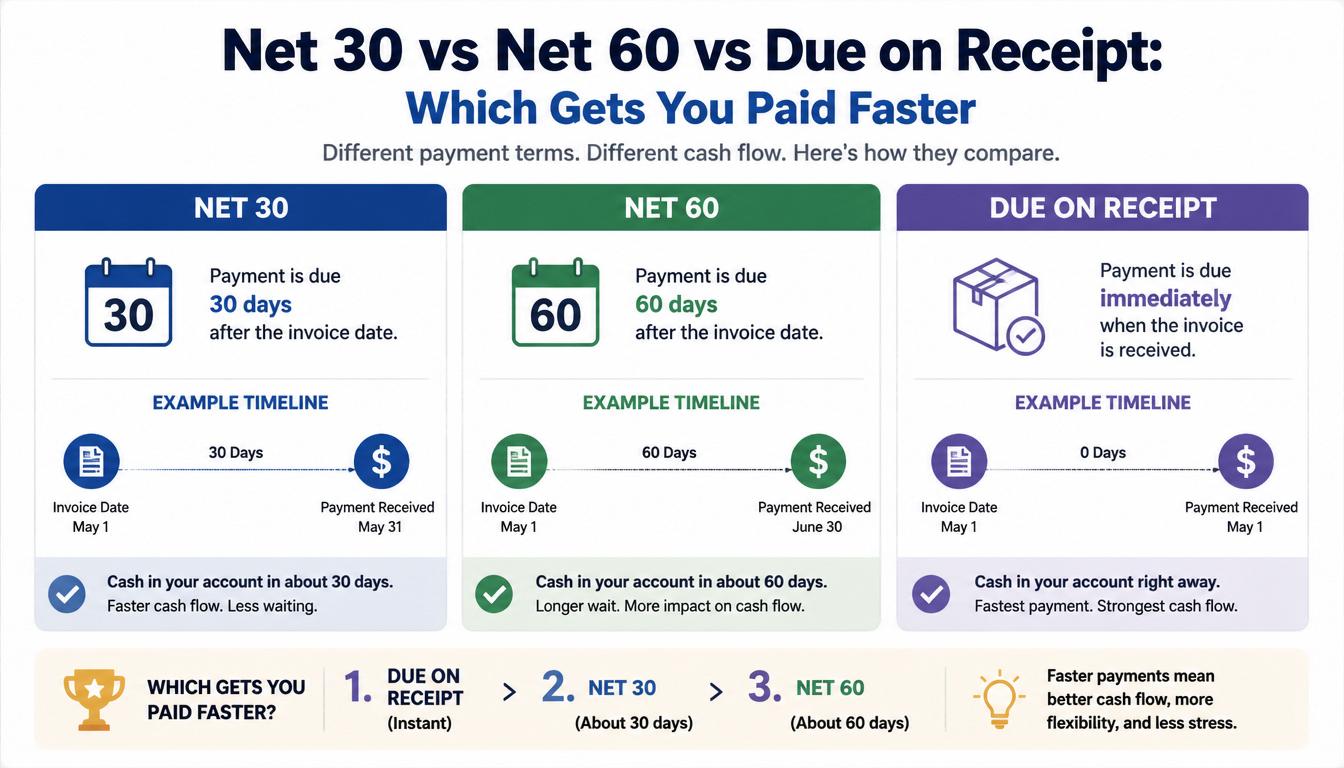
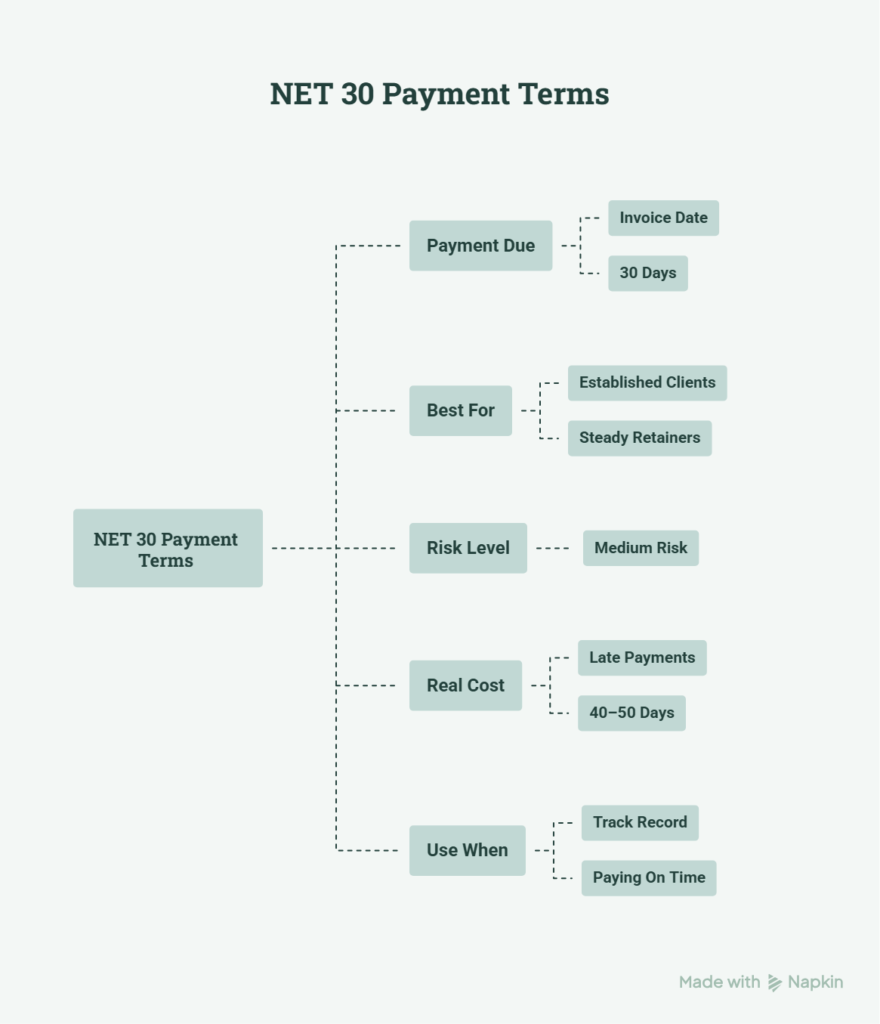
Net 30 means payment is due 30 days from the invoice date. It’s the most common term in business invoicing, largely because it’s the default setting in most accounting software and the one freelancers see first when they Google “standard invoice terms.”
Net 30 works reasonably well for established businesses with steady cash flow and clients who pay through structured accounts payable departments. Larger companies often run payment cycles in batches, so a 30-day window matches their internal process.
The problem: 30 days is a long time when you’re a solo freelancer or a small agency covering payroll, rent, and software subscriptions out of the same account.
A single Net 30 invoice that arrives 10 days late means you’re effectively waiting 40 days to get paid for work you already finished. Multiply that across five or six clients, and your cash flow planning falls apart fast.
Net 30 isn’t a bad choice. It’s just a default that got applied to a lot of businesses that didn’t need that much breathing room to give their clients.
Net 60: A Bigger Gap, A Bigger Risk
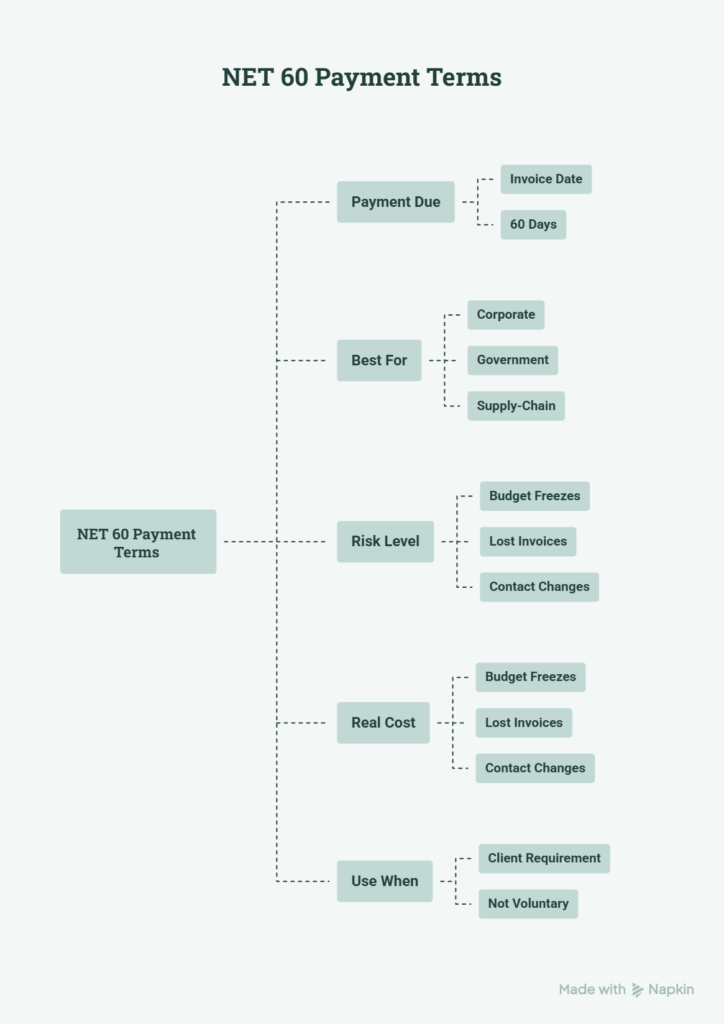
Net 60 gives the client 60 days to pay. You’ll see this most often in industries with long internal approval chains: government contracts, large corporations, and certain manufacturing and supply chain relationships.
If a client requires Net 60 and you have no leverage to negotiate, that’s a fact of doing business with them. But if you’re offering Net 60 voluntarily because it “feels professional” or because a template suggested it, stop. There’s no real upside to giving a client two months to pay you unless they’re explicitly requiring it.
Here’s the part that catches people off guard: Net 60 doesn’t just double your wait time compared to Net 30. It doubles your exposure to things going wrong. More time on the clock means more chances for a client’s accounting team to lose the invoice, more chances for a budget freeze to hit before payment clears, more chances for the relationship to change entirely (new manager, new vendor, new excuse).
Reserve Net 60 for situations where it’s a contractual requirement, not a courtesy.
Due on Receipt: Fast, But Not for Everyone
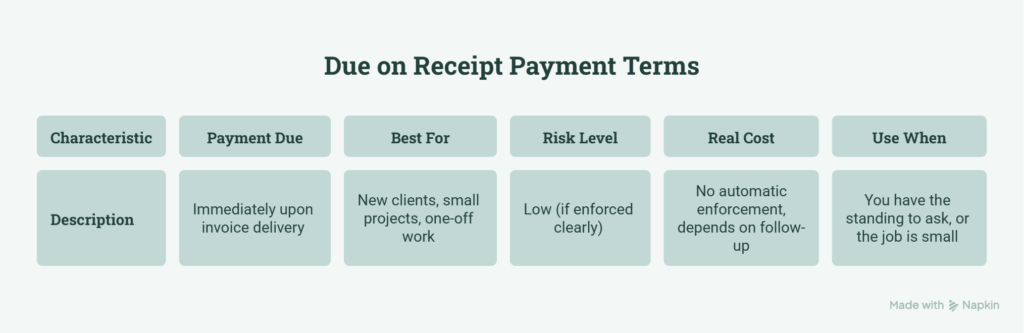
Due on Receipt means exactly what it says. Payment is expected the moment the client receives the invoice, no 30 or 60 day runway attached.
This term is common among freelancers, small service providers, and anyone doing one-off projects rather than ongoing retainer work. It removes the ambiguity entirely: there’s no “the 30 days haven’t started yet” excuse available to the client.
The catch is that Due on Receipt only works if you have the standing to ask for it. A first-time client with no track record of paying you on time has no incentive to treat “due on receipt” any differently than they’d treat Net 30, because there’s no enforcement built into the phrase itself. It’s a request, not a guarantee.
Due on Receipt tends to perform best in two scenarios: small transactions where the client expects to pay quickly anyway (think a quick design fix or a one-hour consulting call), and repeat clients who already trust you and pay promptly as a matter of habit.
Other Terms Worth Knowing
A few less common terms show up often enough that you should recognize them:
- 2/10 Net 30: Pay within 10 days and get a 2% discount; otherwise, the full amount is due in 30 days. This rewards fast payment without forcing it.
- 50% upfront, 50% on completion: common for larger projects where you need working capital before you start.
- Cash on Delivery (COD): payment due at the moment goods or services are delivered, more common in physical product businesses than service-based ones.
None of these is exotic. They’re just less automatic than Net 30, which is exactly why fewer people use them, and exactly why they sometimes work better.
Which Term Actually Gets You Paid Faster
Here’s the part most articles on this topic skip: the term itself matters less than how specific and enforceable it is.
Due on Receipt and short Net terms (Net 7, Net 15) consistently get paid faster than Net 30 or Net 60, for one straightforward reason: shorter windows give clients less room to deprioritize the payment. A 60-day window competes with a dozen other 60-day windows on someone’s desk. A 7-day window stands out because it’s due before the next billing cycle even starts.
That said, the term only works as fast as your follow-up. A Net 15 invoice with no reminder system behind it will still slip. A Net 30 invoice paired with a reminder at day 25 and a follow-up at day 31 often gets paid faster than a Net 15 invoice that nobody ever follows up on.
The honest answer: shorter terms plus consistent follow-up beats any single “magic” term. If you’re choosing between Net 30 and Due on Receipt for a new client, Due on Receipt with a polite, firm tone wins more often than people expect, especially for project-based work under a few thousand dollars.
How to Pick the Right Term for Your Business
A few practical guidelines, based on the type of work and client relationship:
New clients, project-based work:
Due on Receipt or Net 15. You haven’t built trust yet, so don’t extend more runway than you need to.
Ongoing retainer clients with a history of paying on time:
Net 30 is fine. You already know they pay, so the extra time doesn’t cost you much in practice.
Corporate or government clients with fixed AP cycles:
match their required term. You won’t win this negotiation, so don’t waste energy trying.
Large projects requiring upfront capital:
Split terms, such as 50% upfront and 50% on delivery, protect you from doing the work and chasing payment afterward.
The mistake most freelancers make is picking one term and using it for every client, regardless of risk level. Treat your payment terms the way you’d treat pricing: adjust it to the relationship, not a one-size template.
Making Clients Respect the Term You Set
A payment term on paper doesn’t enforce itself. A few things actually move the needle:
State the term clearly on the invoice itself, not buried in an email thread from three weeks ago. Add a specific due date, not just “Net 30,” so there’s zero math required on the client’s end.
Follow up before the deadline, not after. A short note a few days ahead (“just confirming this is on track for the 15th”) reads as organized, not pushy, and gives the client a chance to flag a problem early.
Consider a late fee clause for repeat offenders. Even a small percentage fee changes behavior, because it turns a vague inconvenience into a real cost.
Setting This Up Without the Manual Work
None of this requires a complicated system. It requires an invoice that states the term clearly, with a real due date the client can see at a glance, and looks professional enough that the client takes the deadline seriously.
That’s what Invoice Generator Pro gives you. You enter your issue date and your due date directly, so the deadline sits right on the invoice in plain sight instead of buried in an email thread. Add your line items, apply tax if you need it, and download a clean PDF in minutes, with no signup and no cost.
If you want to see the full set of fields available, including tax, multi-currency support, and logo upload, the professional invoice generator page walks through everything the tool can do before you create your first invoice.
Quick Recap
Net 30 is the default, not always the right choice. Net 60 should be reserved for clients who require it, not offered out of habit. Due on Receipt works well for new clients and smaller projects, provided you have the confidence to ask for it. Shorter terms paired with consistent follow-up beat any single term on its own.
Pick the term that matches the relationship, state it clearly, and follow up before the deadline rather than after. That combination gets invoices paid faster than any specific term by itself.
FAQS
What does “Net 30” mean on an invoice?
Net 30 means the client has 30 days from the invoice date to pay the full amount. It’s the most common payment term in business invoicing, but it’s a default, not a requirement, so you don’t have to use it just because it’s the standard option in most software.
Is Net 60 a bad payment term to offer clients?
Net 60 isn’t bad, but it should be reserved for clients who require it contractually, like corporate or government accounts with fixed payment cycles. Offering Net 60 voluntarily just to seem accommodating gives away two months of cash flow for no real benefit.
What does “Due on Receipt” mean, and is it realistic to ask for?
Due on Receipt means payment is expected immediately when the client gets the invoice. It works well for new clients, small projects, and anyone with a track record of paying you promptly. It’s less effective with first-time clients who have no existing trust in you, since the term alone doesn’t enforce itself.
Which payment term actually gets invoices paid fastest?
Shorter terms like Net 15 or Due on Receipt generally get paid faster than Net 30 or Net 60, because they give clients less room to deprioritize the invoice. That said, the term matters less than consistent follow-up. A Net 30 invoice with a reminder before the deadline often gets paid faster than a Net 15 invoice that nobody follows up on.
Can I use different payment terms for different clients?
Yes, and you should. Match the term to the relationship: shorter terms or Due on Receipt for new clients, Net 30 for trusted retainer clients, and whatever term a corporate or government client requires contractually. Using one fixed term for every client ignores the actual risk level of each relationship.
Does adding a late fee to my invoice actually help?
A late fee clause changes behavior for repeat late payers because it turns a vague inconvenience into a real cost. It won’t fix a client who’s genuinely unable to pay, but for clients who are just slow, it’s one of the more effective tools available.
How do I set a clear due date on my invoice?
State the exact due date on the invoice itself rather than just writing “Net 30,” since that removes any math the client has to do. Tools like Invoice Generator Pro let you enter your issue date and due date directly on a free, no-signup invoice template.

Akbar Ali is the Founder of InvoiceGeneratorPro.io, a platform dedicated to helping freelancers, small businesses, startups, agencies, and entrepreneurs create professional invoices quickly and efficiently. With years of experience in digital business, SEO content strategy, and online entrepreneurship, he focuses on developing practical tools and educational resources that simplify invoicing, payment management, and financial documentation.As a business writer and digital entrepreneur, Akbar creates in-depth guides, industry insights, and actionable content covering invoicing, freelancing, accounting basics, business finance, taxation, productivity, and payment solutions. His goal is to make complex financial processes easy to understand while helping professionals save time and present their businesses more professionally.Through InvoiceGeneratorPro.io, he continues to build reliable, user-friendly solutions that empower businesses worldwide to streamline their billing workflows and improve financial organization.
Akbar Ali