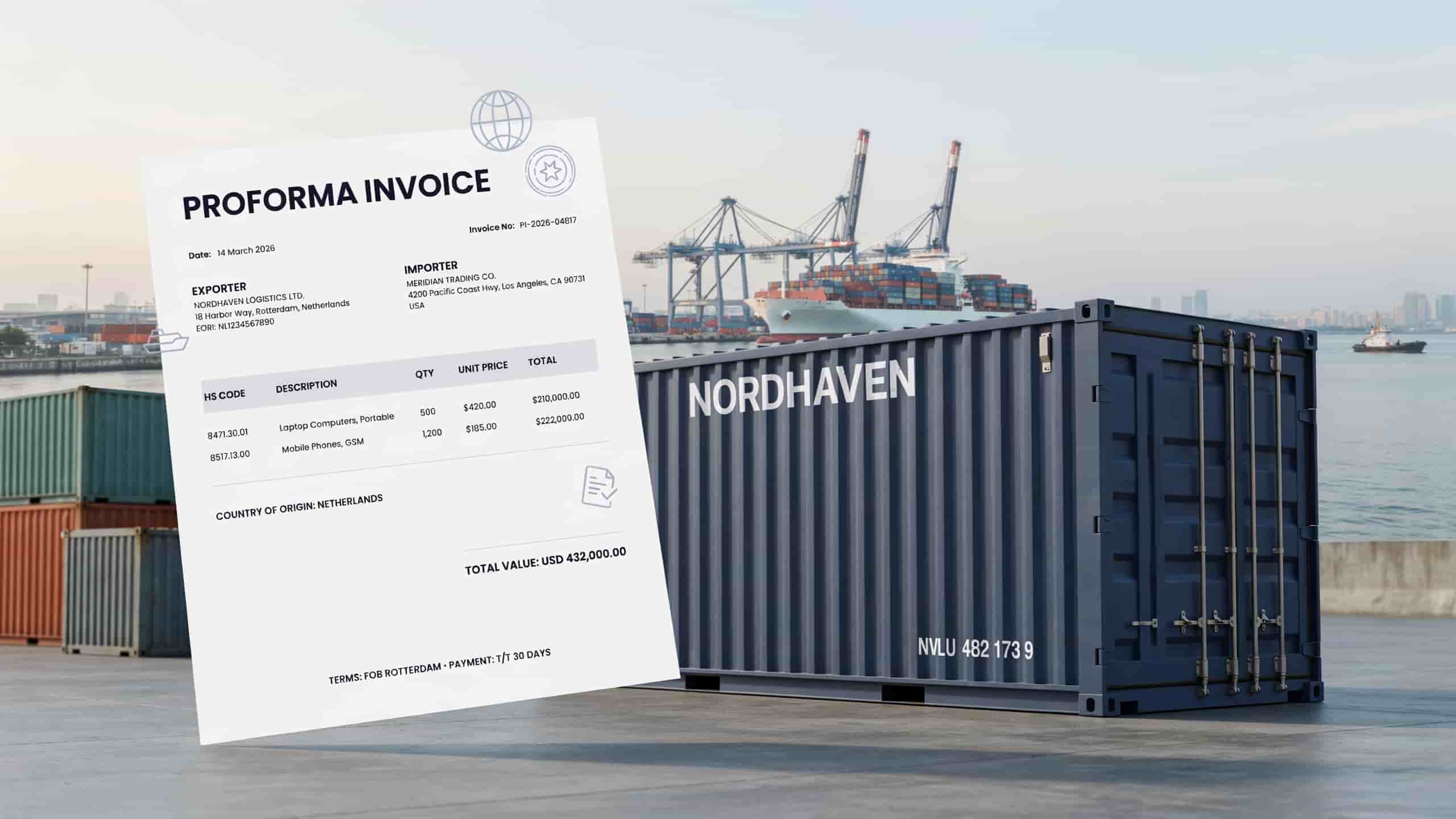
International shipping involves more paperwork than sending a package across town. When goods cross a border, customs authorities, carriers, buyers, and sellers may all need clear information about the shipment.
A proforma invoice for international shipping gives them that information before the final sale or shipment is completed. It describes the goods, their estimated value, the parties involved, and the terms of the shipment.
If you export products, sell goods overseas, send samples, or ship items for reasons other than a normal sale, knowing how to create an international proforma invoice can prevent delays and confusion.
The good news is that the process is fairly simple once you know what information belongs on the document.
What Is a Proforma Invoice for International Shipping?
A proforma invoice is a preliminary document that describes a planned transaction. It usually includes information about the seller, buyer, products, prices, shipping details, and terms of sale.
For international trade, the document can give customs authorities information about a shipment before the final commercial invoice is issued.
A proforma invoice can be used for several situations, including:
- Export shipments
- International sales
- Product samples
- Gifts or promotional goods
- Replacement products
- Temporary exports
- Goods sent for repair
- Shipments where the final sale price has not been confirmed
The exact requirements can vary by country, carrier, and shipment type. Some shipments may require a commercial invoice instead, especially when goods are being sold.
A proforma invoice should therefore contain accurate information even when the transaction is still being finalized.
Why Do You Need a Proforma Invoice for International Shipping?
International shipments can pass through customs before reaching the buyer. Customs authorities need information about the goods to assess the shipment and determine whether duties, taxes, permits, or other requirements apply.
A proforma invoice gives customs and shipping parties information such as:
- What the goods are
- How many items are being shipped
- What the goods are worth
- Where the goods were made
- Who is sending them
- Who is receiving them
- Why they are being exported
- How the shipment will be delivered
For example, suppose a small business in Pakistan sends handmade clothing samples to a potential buyer in the United States. The seller may not have completed a commercial sale yet, but the shipment still needs a clear description and declared value.
A properly prepared export proforma invoice gives the carrier and customs authorities useful information about the shipment.
Proforma Invoice vs. Commercial Invoice
These two documents are often confused because they contain many of the same details.
The main difference is their purpose.
A proforma invoice usually describes a proposed transaction or shipment before the final sale is completed. A commercial invoice is generally used as a formal document for a completed sale and is commonly used by customs to determine the value of imported goods.
Here is a simple comparison:
| Proforma Invoice | Commercial Invoice |
|---|---|
| Usually prepared before the transaction is finalized | Usually prepared for a completed sale |
| Can provide estimated transaction details | Contains final transaction details |
| Often used for quotations and customs information | Commonly used for customs clearance |
| May be changed before the final sale | Normally reflects the final sale |
| Can be used for samples or non-sale shipments | Mainly used for commercial transactions |
The exact customs requirements depend on the destination country and type of shipment.
For that reason, exporters should check the requirements of the destination country and their shipping carrier before sending the goods.
What Information Should a Proforma Invoice Include?
A good international proforma invoice should give enough information for someone unfamiliar with the shipment to understand what is being sent and why.
Here are the main sections to include.
1. Seller Information
Start with the exporter or seller’s details.
Include:
- Business name
- Full address
- Country
- Phone number
- Email address
- Tax or business identification number, when applicable
Use the same business information that appears on your other shipping or export documents.
2. Buyer Information
Add the buyer or importer information.
This normally includes:
- Customer or company name
- Billing address
- Delivery address
- Country
- Phone number
- Email address
If the buyer and consignee are different, identify both clearly.
3. Consignee and Shipping Details
The consignee is the party receiving the shipment.
Depending on the shipment, you may need:
- Consignee name
- Consignee address
- Shipping address
- Contact information
- Shipper information
- Carrier information
Clear shipping information reduces the chance of a package being held because the parties cannot be identified.
4. Proforma Invoice Number
Give the document a unique invoice number.
For example:
PI-2026-0047
A consistent numbering system makes it easier to find the document later.
You should also include the invoice date.
5. Description of Goods
This is one of the most important sections.
Avoid vague descriptions such as:
- Clothes
- Parts
- Samples
- Products
- Accessories
Instead, describe the goods clearly.
For example:
Men’s cotton T-shirts, short sleeve, 100% cotton
A customs officer should be able to understand what the shipment contains from the description.
6. Quantity and Unit of Measure
List how many items are being shipped.
For example:
| Description | Quantity | Unit |
|---|---|---|
| Cotton T-shirts | 50 | Pieces |
| Product brochures | 100 | Pieces |
Use a unit that makes sense for the product, such as pieces, kilograms, boxes, sets, meters, or liters.
7. Unit Price and Total Value
Enter the estimated or agreed value of each item and calculate the total.
For example:
50 T-shirts × $12 = $600
If multiple products are included, calculate each line separately.
The declared value should be reasonable and supported by your transaction or shipment records.
Do not enter an arbitrary amount simply to reduce potential customs duties. Incorrect declarations can cause serious problems with customs clearance.
8. Currency
Clearly state the currency used for the values.
Examples include:
- USD
- EUR
- GBP
- CAD
- AUD
- PKR
Writing $500 without identifying the currency can create unnecessary confusion. Using USD 500 is clearer.
9. HS Code
An HS code, or Harmonized System code, classifies goods for international trade.
Customs authorities use HS codes to identify products and determine applicable tariff treatment.
For example, two products may both be described generally as clothing, but their HS classifications can differ based on the type of garment, material, and other characteristics.
Use the correct HS code for the goods being shipped. If you aren’t sure about the classification, check the applicable customs tariff or ask a qualified customs broker.
A wrong HS code can cause delays, incorrect duty calculations, or additional questions from customs.
10. Country of Origin
State where the goods were manufactured or produced.
For example:
Country of Origin: Pakistan
The country of origin can affect customs treatment, trade agreements, duties, and import requirements.
Do not confuse the country of origin with the country from which the package is shipped. Those can be different.
Add the Reason for Export
The reason for export can be particularly useful when the shipment isn’t a normal commercial sale.
Examples include:
- Commercial sale
- Product sample
- Gift
- Warranty replacement
- Return
- Repair
- Temporary export
- Personal shipment
For example, if you send five product samples to a potential customer without charging them, writing “Product samples for evaluation” gives customs more context than simply writing “samples.”
Include Shipping and Delivery Terms
International transactions often use Incoterms, which define responsibilities between the seller and buyer.
Examples include:
- EXW
- FCA
- FOB
- CIF
- DAP
- DDP
The appropriate Incoterm depends on the agreement between the parties and the shipping arrangement.
Your proforma invoice can include the agreed Incoterm along with the named location.
For example:
Incoterm: DAP New York, USA
Do not select an Incoterm randomly. The term affects responsibilities for transportation, insurance, customs procedures, and costs.
Add Package and Weight Information
Shipping carriers and customs authorities may need physical shipment details.
Include, when applicable:
- Number of packages
- Net weight
- Gross weight
- Package dimensions
- Type of packaging
For example:
Packages: 3 cartons
Net weight: 42 kg
Gross weight: 46 kg
Net weight refers to the goods themselves. Gross weight includes the packaging.
Accurate measurements can also prevent unexpected shipping charges.
Include Payment Terms
If the proforma invoice relates to an expected sale, include the agreed payment terms.
Examples include:
- 100% payment in advance
- 50% deposit, 50% before shipment
- Net 30
- Letter of credit
- Bank transfer
- PayPal
For a quotation-style proforma invoice, the payment terms can help the buyer understand what is expected before the order is confirmed.
Include Shipping Costs When Relevant
If shipping, insurance, handling, or other charges are known, list them separately.
For example:
| Item | Amount |
|---|---|
| Products | USD 600 |
| Shipping | USD 80 |
| Insurance | USD 20 |
| Total | USD 700 |
Keep the calculations clear.
Whether shipping and insurance costs are included in the customs value can depend on the destination country’s rules and the applicable valuation method. Don’t assume that every country treats these charges the same way.
How to Make a Proforma Invoice Step by Step
Creating a proforma invoice for export doesn’t have to be complicated.
Follow these steps.
Step 1: Identify the Parties
Enter the seller, buyer, and consignee information. Check names and addresses carefully.
Step 2: Assign an Invoice Number
Give the proforma invoice a unique number and add the issue date.
Step 3: Describe the Goods
Write clear descriptions for every product.
Include the material, type, model, or other details that identify the goods.
Step 4: Add Quantity and Value
Enter the quantity, unit price, currency, and total value for each product.
Step 5: Add HS Codes
Enter the appropriate HS code for each product when required.
Step 6: Add Country of Origin
State where each product was manufactured or produced.
Step 7: Add Shipping Information
Enter package count, weight, dimensions, shipping method, and delivery details where applicable.
Step 8: Add Export Reason
State whether the shipment is a commercial sale, sample, gift, repair, replacement, return, or another type of export.
Step 9: Add Terms
Include payment terms, delivery terms, Incoterms, and other agreed conditions.
Step 10: Review Everything
Check the names, addresses, quantities, prices, currency, HS codes, weights, and shipment details.
One wrong number can create unnecessary questions during shipping.
Example of an International Proforma Invoice
Here is a simple example for a small export shipment.
PROFORMA INVOICE
Invoice No.: PI-2026-0047
Date: September 10, 2026
Exporter:
ABC Garments
Karachi, Pakistan
Importer:
XYZ Retail LLC
New York, USA
Consignee:
XYZ Retail LLC
New York, USA
| Description | Qty | Unit Price | Total |
|---|---|---|---|
| 100% Cotton T-Shirts | 50 pcs | USD 12 | USD 600 |
| Cotton Caps | 20 pcs | USD 5 | USD 100 |
Subtotal: USD 700
Shipping: USD 80
Total: USD 780
Country of Origin: Pakistan
HS Code: Applicable code for each product
Reason for Export: Commercial sale
Payment Terms: 100% advance payment
Incoterm: DAP New York, USA
Packages: 3 cartons
Net Weight: 42 kg
Gross Weight: 46 kg
This example gives the parties and customs authorities a clear description of the planned shipment.
The exact information required may differ depending on the destination country, product, carrier, and transaction.
Common Mistakes to Avoid
Small errors can cause big delays in international shipping.
Using vague product descriptions
“Clothing” doesn’t tell customs much.
Use a specific description that identifies the goods.
Entering an unrealistic value: The declared value should have a reasonable basis. An unusually low value can lead to questions, inspection, or additional documentation.
Forgetting the currency: Always identify whether the amount is in USD, EUR, GBP, or another currency.
Using the wrong HS code: Product classification can be complicated. Verify the code before submitting your shipping documents.
Leaving out the country of origin: Country of origin information can affect customs processing and duty calculations.
Mixing up net and gross weight: Net weight is the goods. Gross weight includes packaging.
Using inconsistent addresses: The buyer, consignee, and delivery address should be clearly identified.
Treating a proforma invoice as the final commercial invoice: A proforma invoice can describe a proposed transaction, but it doesn’t automatically replace the commercial invoice required for a completed sale.
Declaring the wrong reason for export: A product sample, gift, return, and commercial sale can have different customs treatment. State the reason accurately.
Do You Need a Proforma Invoice for Customs Clearance?
It depends on the shipment.
A customs authority or shipping carrier may request a proforma invoice for certain non-commercial shipments or transactions where the final commercial invoice isn’t available.
For commercial exports, a commercial invoice is often the main customs document.
Requirements vary by country and shipment type, so exporters should check the rules that apply to their goods and destination.
If a carrier gives you a specific invoice or customs form, follow its instructions rather than assuming a generic template will meet every requirement.
Can You Use a Proforma Invoice for Product Samples?
Yes, a proforma invoice can be used for many sample shipments.
Suppose a manufacturer sends ten samples to a prospective customer overseas. There may be no completed sale, but customs still needs to know what is inside the package.
The invoice could state:
Reason for export: Product samples for evaluation
The products should still have clear descriptions and reasonable declared values.
Avoid entering zero simply because the samples are free. Customs valuation rules may still require a declared value.
What Value Should You Put on a Proforma Invoice?
Use a reasonable value based on the goods and the purpose of the shipment.
The correct customs valuation method depends on the country and circumstances.
For a commercial transaction, the agreed price may be relevant. For samples, gifts, replacements, or other non-sale shipments, customs rules may require another method of determining value.
This is one area where guessing can cause problems.
If the shipment has a significant value or unusual circumstances, check the destination country’s customs requirements or speak with a customs professional.
Can You Create a Proforma Invoice Online?
Yes. You can create a proforma invoice using an online invoice generator, accounting software, spreadsheet, or document editor.
For occasional shipments, a simple template may be enough.
For businesses that send international shipments regularly, keeping a consistent format makes document preparation easier.
Whatever method you use, make sure the final document contains the information required for your shipment.
The software can calculate totals and format the document, but you are still responsible for the accuracy of the information you enter.
Proforma Invoice Checklist for International Shipping
Before giving the document to your carrier, review this checklist:
Seller/exporter information
Buyer/importer information
Consignee information
Invoice number
Invoice date
Detailed product descriptions
Quantity
Unit price
Total value
Currency
HS code
Country of origin
Reason for export
Payment terms
Incoterms, when applicable
Shipping method
Number of packages
Net weight
Gross weight
Package dimensions
Shipping and insurance costs, when applicable
Signature or declaration, if required
A final review takes a few minutes. Fixing a customs problem after a shipment has been held can take much longer.
Final Thoughts
A proforma invoice for international shipping gives customs authorities, carriers, buyers, and sellers a clear record of what a planned shipment contains.
The document should clearly identify the parties, describe the goods, state their value, and provide relevant customs and shipping information. Details such as the HS code, country of origin, declared value, package weight, Incoterms, and reason for export can matter depending on the shipment.
The biggest mistake is treating the document as a formality. International shipments depend on accurate information. A vague product description, incorrect value, or wrong classification can create delays that are frustrating for both the exporter and importer.
Create the invoice carefully, check the destination country’s requirements, and keep the information consistent with your other shipping documents.
That simple process can make international shipping much easier to manage.

Akbar Ali is the Founder of InvoiceGeneratorPro.io, a platform dedicated to helping freelancers, small businesses, startups, agencies, and entrepreneurs create professional invoices quickly and efficiently. With years of experience in digital business, SEO content strategy, and online entrepreneurship, he focuses on developing practical tools and educational resources that simplify invoicing, payment management, and financial documentation.As a business writer and digital entrepreneur, Akbar creates in-depth guides, industry insights, and actionable content covering invoicing, freelancing, accounting basics, business finance, taxation, productivity, and payment solutions. His goal is to make complex financial processes easy to understand while helping professionals save time and present their businesses more professionally.Through InvoiceGeneratorPro.io, he continues to build reliable, user-friendly solutions that empower businesses worldwide to streamline their billing workflows and improve financial organization.
Akbar Ali