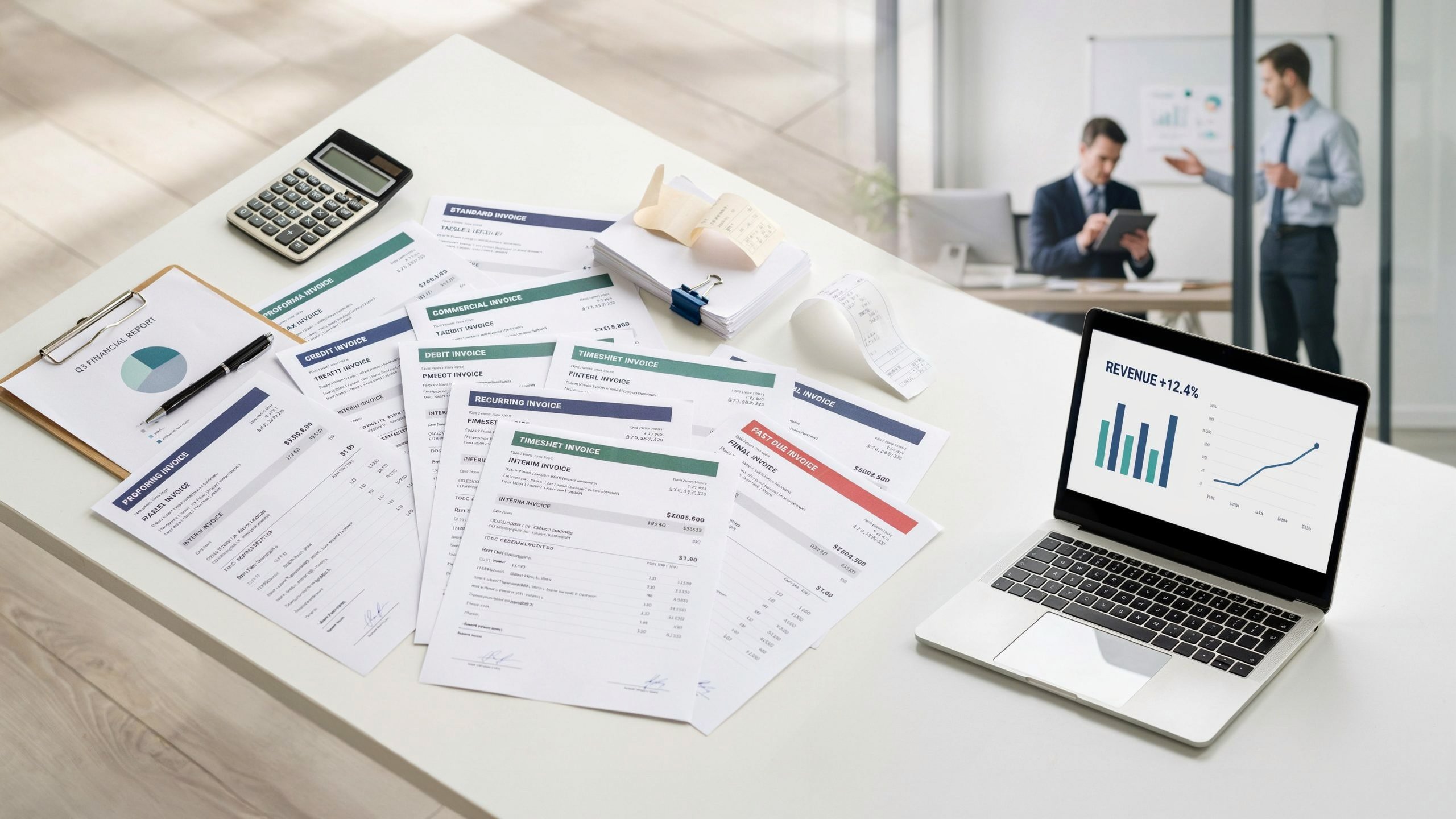
Running a business involves much more than selling products or completing projects. Every payment, refund, advance, and recurring subscription needs proper documentation. That documentation usually starts with an invoice.
Whether you’re a freelancer sending your first bill, a startup managing monthly subscriptions, or an accountant handling hundreds of transactions, knowing the types of invoices in accounting can save time, reduce payment disputes, and keep financial records accurate.
Many people think an invoice is simply a request for payment. In practice, businesses use several invoice formats depending on the transaction. A contractor requesting an advance payment uses a different invoice than an exporter shipping goods overseas. A SaaS company billing customers every month uses another format entirely.
Knowing when to issue each invoice keeps your bookkeeping organized, supports tax compliance, and improves cash flow.
This guide explains every major invoice type with practical examples, common use cases, accounting tips, and best practices. By the end, you’ll know which invoice fits each business situation and why it matters.
Quick Navigation
- What is an invoice in accounting?
- Why businesses use different invoice types
- Complete list of invoice types
- Types of invoices with examples
- Invoice vs purchase order vs receipt
- What is 3-way invoice matching?
- Types of invoices in accounts payable
- Types of invoices in India under GST
- Common invoice mistakes
- Best invoicing practices
- Frequently asked questions
What Is an Invoice in Accounting?
An invoice is a commercial document that records a sale of goods or services and requests payment from the buyer. It contains information about the seller, customer, products or services provided, prices, taxes, payment terms, due date, and total amount payable.
In accounting, an invoice creates a financial record. For the seller, it records revenue and an amount owed by the customer (accounts receivable). For the buyer, it records an expense or inventory purchase and an amount payable (accounts payable).
A standard invoice usually contains:
- Invoice number
- Invoice date
- Seller’s business information
- Customer information
- Description of products or services
- Quantity
- Unit price
- Applicable taxes
- Discounts
- Total amount due
- Payment terms
- Due date
- Accepted payment methods
Every business, regardless of size, benefits from issuing professional invoices. They reduce misunderstandings, provide proof of transactions, and simplify bookkeeping throughout the financial year.
Why Do Businesses Use Different Types of Invoices?
Businesses don’t bill every customer the same way.
A graphic designer charging for a completed logo project follows a different billing process than a construction company working on a twelve-month contract. An online retailer shipping products internationally needs customs documentation that a local consultant never uses.
Different invoice types exist because different transactions require different information.
Some invoices request payment before work begins. Others bill customers after project completion. Some correct previous invoices, while others repeat automatically every month.
Using the correct invoice type improves:
- Financial reporting
- Cash flow management
- Tax compliance
- Accounts receivable tracking
- Accounts payable processing
- Audit preparation
- Customer communication
Choosing the wrong invoice can create confusion, delay payments, or even lead to tax reporting problems.
How Many Types of Invoice Are There?
There isn’t one universal number.
Most accounting professionals regularly use 15 to 20 common invoice types, although specialized industries may use additional formats.
The most common invoice types include:
| Invoice Type | Main Purpose | Common Users |
|---|---|---|
| Sales Invoice | Bill, after selling goods or services | Most businesses |
| Proforma Invoice | Estimate before work begins | Exporters, freelancers |
| Commercial Invoice | International shipping | Export businesses |
| Tax Invoice | Tax reporting | GST/VAT-registered businesses |
| Credit Invoice | Reduce customer balance | Retailers, wholesalers |
| Debit Invoice | Increase customer balance | Service providers |
| Purchase Invoice | Record supplier purchases | Buyers |
| Interim Invoice | Partial project billing | Construction firms |
| Final Invoice | Final project payment | Agencies, consultants |
| Recurring Invoice | Automatic repeated billing | SaaS companies |
| Timesheet Invoice | Bill hourly work | Freelancers |
| Retainer Invoice | Advance monthly payment | Consultants |
| Expense Invoice | Reimburse expenses | Contractors |
| Collective Invoice | Combine multiple orders | Wholesale businesses |
| Overdue Invoice | Follow up on unpaid invoices | All businesses |
| Self-Billing Invoice | Customer creates invoice | Large organizations |
| E-Invoice | Electronic tax-compliant invoice | Many countries |
| Credit Note | Correct overpayments | Businesses issuing refunds |
| Debit Note | Correct underpayments | Suppliers |
Each serves a different accounting purpose and supports accurate financial records.
Understanding the Invoice Lifecycle
Every invoice follows a series of steps before payment reaches the business.
A typical invoice lifecycle includes:
- Customer places an order.
- Goods or services are delivered.
- The business creates an invoice.
- The invoice is sent to the customer.
- The customer verifies the invoice.
- Payment is approved.
- Payment is made.
- The invoice is marked as paid.
- Accounting records are updated.
Larger companies often include additional approval stages, purchase order verification, and invoice matching before releasing payment.
Where Do Invoices Fit in Accounting?
Invoices appear in two major accounting areas.
Accounts Receivable (AR):
Accounts receivable tracks the money customers owe your business.
When you send an invoice, the amount becomes an asset until payment arrives.
Example:
A freelance web developer completes a website for $2,500.
After sending the invoice:
- Revenue increases by $2,500.
- Accounts Receivable increases by $2,500.
Once the client pays, cash increases, and Accounts Receivable returns to zero.
Accounts Payable (AP)
Accounts payable records the invoices your business receives from suppliers.
Example:
A marketing agency buys software licenses worth $800.
The software vendor sends an invoice.
Until payment is made:
- The agency records an expense.
- Accounts Payable increases by $800.
When payment is made, Accounts Payable decreases, and cash decreases.
Understanding both sides of invoicing helps accountants maintain accurate financial statements and prevent duplicate or missing payments.
Why Accurate Invoices Matter
A well-prepared invoice does more than request payment.
It supports:
- Accurate bookkeeping
- Faster customer payments
- Tax reporting
- Audit documentation
- Financial forecasting
- Business cash flow
- Customer trust
- Legal protection during payment disputes
Businesses that use consistent invoice formats often spend less time correcting errors and following up on unpaid balances.
Next: Part 2 will cover the first group of invoice types in depth, including:
- Sales Invoice
- Proforma Invoice
- Commercial Invoice
- Tax Invoice
- Purchase Invoice
- Debit Invoice
- Credit Invoice
Each section will include:
- Definition
- When to use it
- Real business example
- Advantages
- Common mistakes
- Accounting treatment
- Professional invoice sample explanation
The Most Common Types of Invoice in Accounting (With Examples)
Understanding the purpose of each invoice type makes billing easier and keeps accounting records accurate. Some invoices request payment before work begins. Others confirm a completed sale or adjust an earlier transaction. Choosing the right invoice reduces confusion, speeds up payments, and supports tax compliance.
The following invoice types appear in almost every industry, from freelancing and consulting to manufacturing, retail, software, and international trade.
1. Sales Invoice
A sales invoice is the most common type of invoice in accounting. Businesses issue it after delivering goods or completing services. It tells the customer how much they owe and when payment is due.
For many companies, this is the standard invoice customers receive.
When Is a Sales Invoice Used?
A sales invoice is appropriate when:
- Products have been delivered.
- Services have been completed.
- Payment is due after delivery.
- A customer purchases on credit.
- A business wants an official record of the transaction.
Example
A digital marketing agency completes a three-month SEO campaign for a local restaurant.
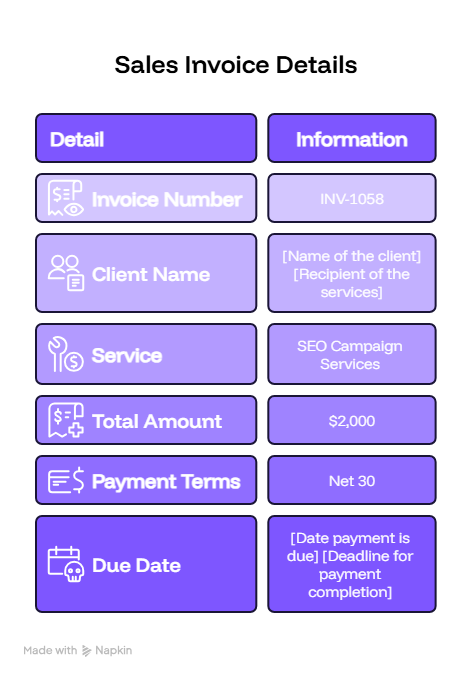
The restaurant pays within 30 days, and the invoice is marked as paid.
Accounting Treatment
For the seller:
- Debit: Accounts Receivable
- Credit: Sales Revenue
For the buyer:
- Debit: Marketing Expense
- Credit: Accounts Payable
Advantages
- Records revenue accurately.
- Improves payment tracking.
- Creates legal proof of the sale.
- Supports financial reporting.
- Common Mistakes
- Missing payment terms.
- Incorrect tax calculation.
- Duplicate invoice numbers.
- Wrong customer information.
2. Proforma Invoice
A proforma invoice is a preliminary invoice sent before goods or services are delivered. It estimates costs rather than requesting immediate payment.
Many people confuse a pro forma invoice with a standard invoice. The difference is simple.
A proforma invoice provides pricing details before the final sale. It does not record revenue in accounting books because the transaction has not been completed.
When Should You Use a Proforma Invoice?
Businesses often send a proforma invoice when:
- A customer requests a quotation.
- An advance payment is required.
- Products are manufactured after approval.
- International buyers need pricing before customs documentation.
- Freelancers want client approval before starting work.
Real Example: A freelance UI/UX designer receives an inquiry for a mobile app redesign. Before starting work, the designer sends a proforma invoice:
| Item | Amount |
|---|---|
| UI Design | $1,200 |
| UX Research | $600 |
| Prototype | $400 |
| Estimated Total | $2,200 |
After the client approves the proposal and pays the agreed advance, the designer begins the project. Once the work is complete, a final sales invoice replaces the proforma invoice.
Is a Proforma Invoice Legally Binding?
Usually, no. It explains expected costs but does not confirm that payment is due. The final invoice becomes the official accounting document.
Advantages
- Sets clear expectations.
- Reduces pricing disputes.
- Encourages faster client approval.
- Supports international trade.
Common Mistakes
- Treating it as a tax invoice.
- Recording it as revenue.
- Forgetting to issue the final invoice.
3. Commercial Invoice
A commercial invoice is required for international trade. Customs authorities use it to calculate import duties, taxes, and shipping documentation.
Without a properly prepared commercial invoice, shipments may face delays or additional inspections.
When Is It Used?
Businesses issue commercial invoices when:
- Exporting goods.
- Importing products.
- Shipping internationally.
- Completing customs declarations.
Example: A manufacturer in India exports machinery worth $18,000 to a customer in Germany.
The commercial invoice includes:
- Seller details
- Buyer details
- Product description
- HS Code
- Country of origin
- Quantity
- Unit price
- Shipping terms (Incoterms)
- Currency
- Total invoice value
Customs officials use this information to determine applicable duties and taxes.
Accounting Treatment
The commercial invoice records the sale just like a regular sales invoice, while also supporting customs clearance.
Advantages
- Required for international shipping.
- Simplifies customs processing.
- Documents for exported goods.
- Supports international tax reporting.
Common Mistakes
- Incorrect HS codes.
- Missing country of origin.
- Wrong currency.
- Incomplete shipping details.
4. Tax Invoice
A tax invoice includes tax information required by government authorities. Businesses registered for GST, VAT, or sales tax usually issue this invoice.
Tax invoices allow customers to claim eligible input tax credits where local tax laws permit.
When Should You Use It?
A tax invoice is appropriate when:
- Selling taxable goods.
- Providing taxable services.
- Charging GST or VAT.
- Reporting sales to tax authorities.
Example: A software company sells accounting software for $500. GST: 10%
| Description | Amount |
|---|---|
| Software License | $500 |
| GST | $50 |
| Total Due | $550 |
The invoice clearly separates the tax amount from the product price.
Information Included
- Tax Registration Number
- Tax Rate
- Tax Amount
- Invoice Date
- Customer Details
- Seller Details
- Total Amount
Advantages
- Meets legal tax requirements.
- Supports tax deductions.
- Improves accounting accuracy.
- Reduces compliance issues.
Common Mistakes
- Wrong tax percentage.
- Missing tax registration number.
- Incorrect taxable value.
- Combining taxable and non-taxable items without distinction.
5. Purchase Invoice
A purchase invoice is issued by a supplier to request payment from a buyer. From the buyer’s perspective, it records a business purchase and becomes part of the accounts payable process.
Every company receives purchase invoices from vendors.
Common Examples
- Office furniture
- Computer equipment
- Inventory purchases
- Raw materials
- Business software
- Internet services
Real Business Example:
A clothing retailer purchases inventory worth $6,800 from a wholesaler.
The wholesaler sends a purchase invoice.
The retailer records:
- Inventory increases.
- Accounts Payable increases.
When payment is made, Accounts Payable decreases.
Why Purchase Invoices Matter
Purchase invoices help businesses:
- Track expenses.
- Monitor supplier payments.
- Match invoices with purchase orders.
- Prepare financial statements.
Common Mistakes
- Paying duplicate invoices.
- Recording invoices twice.
- Missing supplier discounts.
- Ignoring payment deadlines.
6. Credit Invoice (Credit Note)
A credit invoice, often called a credit note, reduces the amount a customer owes after an invoice has already been issued.
Businesses issue credit invoices when:
- Products are returned.
- Customers receive refunds.
- Billing errors occur.
- Discounts are applied after invoicing.
- Damaged goods are replaced.
- Example
An electronics supplier invoices a retailer for $5,000.
Later, the retailer returns defective products worth $600.
The supplier issues a credit invoice for $600.
The customer’s outstanding balance becomes $4,400.
Accounting Treatment
Seller:
- Debit: Sales Returns
- Credit: Accounts Receivable
Buyer:
- Debit: Accounts Payable
- Credit: Purchase Returns
Advantages
- Corrects billing errors.
- Keeps accounting records accurate.
- Documents refunds.
- Improves customer trust.
Common Mistakes
- Forgetting to reference the original invoice.
- Incorrect refund amount.
- Missing tax adjustments.
7. Debit Invoice (Debit Note)
A debit invoice, also called a debit note, increases the amount a customer owes after the original invoice has been issued.
Businesses use debit invoices when additional charges become necessary.
Situations That Require a Debit Invoice
- Undercharged products.
- Extra services requested.
- Shipping costs added later.
- Price corrections.
- Tax adjustments.
Example:
A construction company invoices a client $12,000.
During the project, the client requests additional electrical work worth $1,500.
Instead of creating a completely new invoice, the contractor issues a debit invoice.
New balance:
Original Invoice: $12,000
Debit Invoice: $1,500
Total Due: $13,500
Accounting Treatment
Seller:
- Debit: Accounts Receivable
- Credit: Revenue
Buyer:
- Debit: Expense or Asset
- Credit: Accounts Payable
Advantages
- Corrects underbilling.
- Maintains clear accounting records.
- Documents additional charges.
- Keeps audit trails complete.
Common Mistakes
- Failing to explain the additional charge.
- Not linking the debit invoice to the original invoice.
- Applying incorrect tax rates.
Choosing the Right Invoice Type
Each invoice has a specific purpose. Using the correct one keeps your accounting records accurate and improves communication with customers and suppliers.
| Invoice Type | Primary Purpose | Typical Users |
|---|---|---|
| Sales Invoice | Request payment after delivery | Retailers, agencies, freelancers |
| Proforma Invoice | Provide a cost estimate before work begins | Freelancers, exporters, consultants |
| Commercial Invoice | Support international shipping and customs | Exporters and manufacturers |
| Tax Invoice | Record taxable sales | GST and VAT-registered businesses |
| Purchase Invoice | Document supplier purchases | Buyers and procurement teams |
| Credit Invoice | Reduce the customer’s balance | Retailers, wholesalers, service providers |
| Debit Invoice | Increase the customer’s balance | Contractors, consultants, suppliers |
These invoice types form the foundation of most accounting systems. Once you understand when and why each one is used, billing becomes more accurate, payments are easier to track, and financial records stay organized.
More Types of Invoice in Accounting (With Real Examples)
The invoice types covered so far appear in most businesses every day. The following invoices are equally important, especially for long-term projects, subscription businesses, consulting firms, agencies, contractors, and companies with recurring clients.
Using these invoice types correctly creates a clear payment history and reduces confusion for both buyers and sellers.
8. Recurring Invoice
A recurring invoice is issued automatically at regular intervals for products or services that customers purchase repeatedly.
Subscription businesses, managed service providers, gyms, web hosting companies, and software providers rely on recurring invoices to bill customers monthly, quarterly, or annually.
When Should You Use a Recurring Invoice?
Recurring invoices work well for:
- Monthly software subscriptions
- Website hosting
- SEO retainers
- Accounting services
- Office rent
- Internet services
- Maintenance contracts
- Membership fees
Example: A bookkeeping firm manages payroll for a small business.
Monthly fee: $450
Instead of creating a new invoice every month, the accounting software automatically sends a recurring invoice on the first day of each month.
The invoice includes:
- Service Period: July 1 to July 31
- Payroll Management
- Monthly Amount: $450
- Payment Due: Within 15 Days
Accounting Treatment
Each recurring invoice records:
Seller
- Debit: Accounts Receivable
- Credit: Service Revenue
Buyer
- Debit: Payroll Expense
- Credit: Accounts Payable
Benefits
- Saves administrative time.
- Creates predictable cash flow.
- Reduces missed invoices.
- Improves customer convenience.
Common Mistakes
- Forgetting to update pricing.
- Billing inactive customers.
- Sending duplicate recurring invoices.
- Using outdated payment information.
9. Interim Invoice
An interim invoice requests payment for a portion of a project before the entire job is complete.
Large projects often last several months. Waiting until the end can create cash flow problems for the business. Interim invoices spread payments throughout the project.
Industries That Use Interim Invoices
- Construction
- Architecture
- Engineering
- Interior design
- Software development
- Manufacturing
Example:
A construction company signs a contract worth $120,000.
Payment schedule:
- 20% before construction
- 40% after foundation
- 30% after roofing
- 10% after final inspection
Each milestone generates an interim invoice.
Benefits
- Improves cash flow.
- Reduces financial risk.
- Matches payments with project progress.
- Gives clients visibility into completed work.
Common Mistakes
- Unclear milestone descriptions.
- Billing ahead of completed work.
- Missing contract references.
- Incorrect percentage calculations.
10. Final Invoice
A final invoice is issued after all work has been completed. It requests the remaining balance after deposits or interim payments have been deducted.
This invoice officially closes the project.
Example
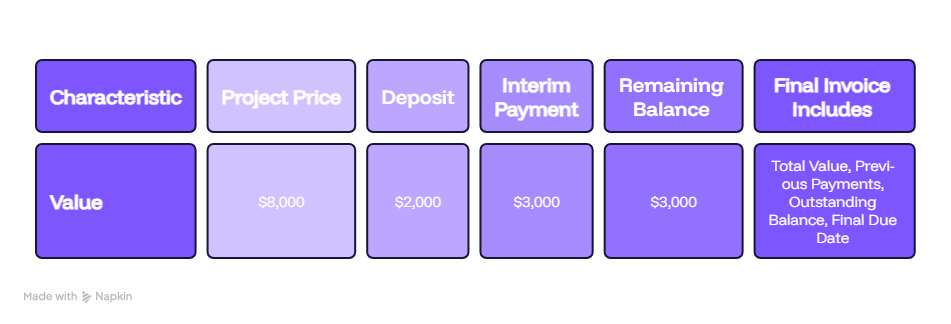
A web development agency builds an e-commerce website.
Project Price: $8,000
Payments already received:
- Deposit: $2,000
- Interim Payment: $3,000
Remaining Balance: $3,000
The final invoice includes:
- Total Project Value
- Previous Payments
- Outstanding Balance
- Final Due Date
Why It Matters
A final invoice confirms:
- Work is complete.
- Previous payments have been applied.
- The remaining balance is accurate.
- The contract is financially closed.
Common Mistakes
- Forgetting advance payments.
- Incorrect remaining balance.
- Missing project completion date.
11. Timesheet Invoice
A timesheet invoice bills clients based on hours worked rather than a fixed project price.
Freelancers, consultants, lawyers, virtual assistants, and software developers frequently use this invoice type.
Example: A freelance developer charges $60 per hour. Hours worked:
| Task | Hours |
|---|---|
| Website Updates | 8 |
| Bug Fixes | 6 |
| API Integration | 11 |
Total Hours: 25
Total Amount: 25 × $60 = $1,500
The invoice includes:
- Hourly Rate
- Hours Worked
- Task Description
- Total Hours
- Total Due
Benefits
- Transparent billing.
- Easy for clients to verify.
- Suitable for ongoing work.
Common Mistakes
- Rounded work hours.
- Missing work descriptions.
- Incorrect hourly rate.
12. Retainer Invoice
A retainer invoice requests payment before services are delivered over a specific period. Businesses that provide ongoing professional services often use retainers.
Common Users
- Lawyers
- Marketing agencies
- Business consultants
- Accountants
- Designers
- SEO specialists
Example: An SEO consultant signs a six-month agreement. Monthly Retainer: $900
At the beginning of each month, the consultant issues a retainer invoice requesting payment before work begins.
Services include:
- Technical SEO
- Keyword Research
- Monthly Reports
- Link Building Consultation
Benefits
- Predictable monthly income.
- Stronger client relationships.
- Easier budgeting.
Common Mistakes
- Unclear scope of work.
- No expiry period.
- Missing contract references.
13. Expense Invoice
An expense invoice requests reimbursement for costs paid on behalf of a client.
This invoice is common in consulting, construction, legal services, and project management.
Example: An interior designer purchases furniture samples during a client project.
Expenses:
| Item | Cost |
|---|---|
| Paint Samples | $65 |
| Flooring Sample | $120 |
| Courier Charges | $40 |
Total Expenses: $225
The expense invoice includes copies of receipts for verification.
Benefits
- Keeps project costs transparent.
- Separates service fees from expenses.
- Simplifies reimbursement.
Common Mistakes
- Missing receipts.
- Charging personal expenses.
- Duplicate reimbursements.
14. Collective Invoice
A collective invoice, sometimes called a consolidated invoice, combines several transactions into one invoice.
Businesses with frequent customer orders often use this format.
Example:
A wholesaler delivers products to the same retailer four times during one month. Instead of sending four invoices, the wholesaler sends one consolidated invoice listing all deliveries. This reduces paperwork and simplifies payment processing.
Benefits
- Fewer invoices to manage.
- Easier reconciliation.
- Lower administrative costs.
Common Mistakes
- Missing delivery references.
- Incorrect totals.
- Confusing payment dates.
15. Self-Billing Invoice
A self-billing invoice is created by the buyer instead of the supplier. Large organizations sometimes use self-billing agreements with trusted suppliers. The supplier approves the arrangement before transactions begin.
Example:
A supermarket purchases fresh produce from local farmers every day.
Rather than waiting for hundreds of supplier invoices, the supermarket generates invoices itself based on delivered quantities.
The supplier reviews and accepts the payment.
Benefits
- Faster payment processing.
- Fewer invoice disputes.
- Lower administrative work.
Common Mistakes
- No written agreement.
- Incorrect purchase quantities.
- Delayed supplier approval.
16. Overdue Invoice
An overdue invoice is an unpaid invoice that has passed its payment due date.
Businesses often send a reminder showing:
- Original invoice number
- Original amount
- Due date
- Days overdue
- Late payment fees (if applicable)
Example
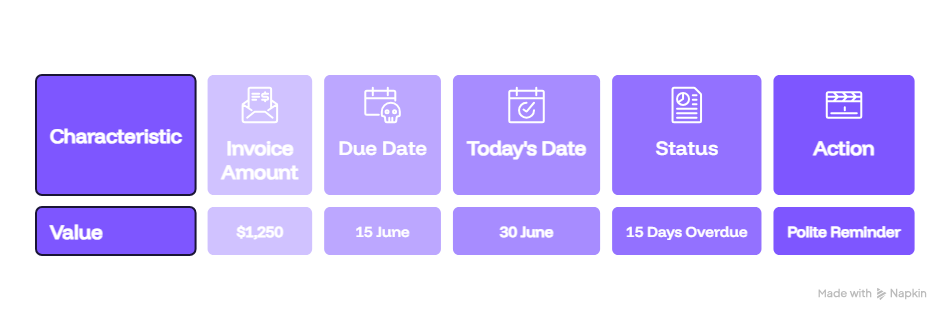
Invoice Amount: $1,250
Due Date: 15 June
Today’s Date: 30 June
Status: 15 Days Overdue
The business sends a polite reminder requesting immediate payment.
Best Practices
- Send reminders before the due date.
- Keep communication professional.
- Apply late fees only if agreed in advance.
Common Mistakes
- Waiting months before following up.
- Sending aggressive payment demands.
- Forgetting previous reminder history.
17. Electronic Invoice (E-Invoice)
An electronic invoice (e-invoice) is generated, transmitted, and stored digitally. Many governments now require electronic invoicing for tax reporting and fraud prevention. Unlike a PDF attached to an email, a true e-invoice uses structured digital data that accounting systems and tax authorities can process automatically.
Common Features
- Digital invoice number
- Electronic authentication
- Tax validation
- QR code (where required)
- Digital signature
- Automatic accounting integration
Example: A manufacturing company supplies goods to a retailer. Instead of printing paper invoices, its ERP system creates an e-invoice and submits it directly to the country’s tax portal before sending it to the customer.
Benefits
- Faster processing.
- Reduced paperwork.
- Better compliance.
- Easier record keeping.
- Lower administrative costs.
Common Mistakes
- Using the wrong tax format.
- Missing mandatory digital fields.
- Not keeping electronic records.
Comparison of Advanced Invoice Types
| Invoice Type | Purpose | Best For | Example |
|---|---|---|---|
| Recurring Invoice | Regular billing | SaaS, memberships, retainers | Monthly software subscription |
| Interim Invoice | Partial payment during a project | Construction, agencies | Foundation completed |
| Final Invoice | Remaining project balance | Contractors, consultants | Final project delivery |
| Timesheet Invoice | Bill by hours worked | Freelancers, lawyers | 25 hours of development |
| Retainer Invoice | Advance payment | Consultants, accountants | Monthly advisory services |
| Expense Invoice | Client reimbursement | Designers, contractors | Travel and material costs |
| Collective Invoice | Multiple transactions | Wholesalers | Monthly product deliveries |
| Self-Billing Invoice | Buyer creates invoice | Large retailers | Agricultural purchases |
| Overdue Invoice | Payment reminder | Every business | Invoice overdue by 15 days |
| E-Invoice | Digital tax-compliant invoice | Modern businesses | ERP-generated electronic invoice |
Which Invoice Type Should You Choose?
The right invoice depends on how your business operates.
- Retail stores usually issue sales invoices and tax invoices.
- Freelancers often rely on proforma, timesheet, retainer, and final invoices.
- Construction companies commonly use interim and final invoices tied to project milestones.
- Subscription businesses benefit from recurring invoices that automate monthly billing.
- Importers and exporters require commercial invoices to support customs clearance.
- Large organizations may use self-billing invoices to speed up supplier payments.
- Businesses working under digital tax systems increasingly issue e-invoices to meet legal requirements.
Using the appropriate invoice type improves payment accuracy, strengthens financial records, and makes both accounts receivable and accounts payable easier to manage.
Frequently Asked Questions About Types of Invoices in Accounting
1. What is an invoice in accounting?
An invoice is a financial document that a seller sends to a buyer to request payment for goods or services. It includes details such as the invoice number, customer information, product or service descriptions, pricing, taxes, payment terms, and the due date. In accounting, invoices record sales, purchases, accounts receivable, and accounts payable transactions.
2. What are the different types of invoices in accounting?
Businesses use several invoice types depending on the transaction. The most common include:
- Sales Invoice
- Proforma Invoice
- Commercial Invoice
- Tax Invoice
- Purchase Invoice
- Credit Invoice (Credit Note)
- Debit Invoice (Debit Note)
- Recurring Invoice
- Interim Invoice
- Final Invoice
- Timesheet Invoice
- Retainer Invoice
- Expense Invoice
- Collective Invoice
- Self-Billing Invoice
- Overdue Invoice
- Electronic Invoice (E-Invoice)
Each invoice serves a specific purpose and supports accurate financial reporting.
3. How many types of invoices are commonly used?
There is no fixed number because industries have different billing requirements. Most businesses regularly use 15 to 20 common invoice types, while specialized sectors such as healthcare, logistics, manufacturing, and international trade may use additional invoice formats.
4. What is the difference between a proforma invoice and a sales invoice?
A proforma invoice provides an estimated cost before goods or services are delivered. It is often used for quotations, advance payments, or customer approval.
A sales invoice is issued after goods are delivered or services are completed and officially requests payment. Unlike a proforma invoice, a sales invoice becomes part of the accounting records.
5. What is a commercial invoice used for?
A commercial invoice is used in international trade. It provides customs authorities with details about exported or imported goods, including product descriptions, values, country of origin, and shipping information. Customs officials use this document to calculate duties and taxes.
6. What is a tax invoice?
A tax invoice includes GST, VAT, or sales tax details required by tax authorities. Businesses registered for indirect taxes issue tax invoices to customers and use them for tax reporting and compliance.
7. What is the difference between an invoice and a purchase order?
A purchase order is created by the buyer before goods or services are purchased. It confirms what the buyer wants to order.
An invoice is created by the seller after delivering goods or completing services. It requests payment based on the agreed order.
8. What is 3-way invoice matching?
3-way invoice matching is an accounting control that compares:
- Purchase Order (PO)
- Goods Received Note (GRN)
- Supplier Invoice
Payment is approved only when all three documents match. This process reduces duplicate payments, billing errors, and fraud.
9. Which invoice type is best for freelancers?
The most suitable invoice depends on the project. Freelancers commonly use:
- Proforma Invoice for project estimates
- Timesheet Invoice for hourly work
- Final Invoice for completed projects
- Retainer Invoice for ongoing monthly services
- Expense Invoice for reimbursable client costs
These invoice types work well for designers, developers, writers, consultants, marketers, and other independent professionals.
10. What is a recurring invoice?
A recurring invoice automatically bills customers at regular intervals, such as weekly, monthly, quarterly, or annually. It is commonly used for software subscriptions, maintenance contracts, memberships, website hosting, and consulting retainers.
11. What information should every invoice include?
A professional invoice should include:
- Invoice number
- Invoice date
- Seller’s business information
- Customer details
- Product or service descriptions
- Quantity and pricing
- Taxes
- Discounts
- Total amount due
- Payment terms
- Due date
- Accepted payment methods
Including complete information reduces payment delays and improves accounting accuracy.
12. What is the difference between a credit invoice and a debit invoice?
A credit invoice (credit note) reduces the amount a customer owes because of returns, refunds, pricing corrections, or discounts.
A debit invoice (debit note) increases the amount payable when additional charges, revised pricing, or extra services are added after the original invoice has been issued.
13. What types of invoices are used in accounts payable?
Accounts payable teams commonly process:
- Purchase Invoices
- Tax Invoices
- Commercial Invoices
- Credit Notes
- Debit Notes
- Recurring Invoices
- Expense Invoices
These invoices go through verification, approval, and payment before being recorded as paid.
14. What is an electronic invoice (e-invoice)?
An electronic invoice, or e-invoice, is created, transmitted, and stored digitally using structured electronic data. Many countries require e-invoices for tax compliance because they improve accuracy, reduce paperwork, and simplify reporting.
15. Which invoice type should a small business use?
Most small businesses primarily use sales invoices for completed work and tax invoices where GST or VAT applies. Depending on their services, they may also use proforma invoices, recurring invoices, final invoices, or retainer invoices to match different billing situations.
Finale
Understanding the types of invoice in accounting is more than an accounting exercise. It directly affects cash flow, financial reporting, tax compliance, and customer relationships. Whether you’re a freelancer billing a client for a single project, a retailer issuing daily sales invoices, or a multinational company exporting products across borders, choosing the correct invoice type keeps your records accurate and your payment process organized.
Each invoice has a specific purpose. A proforma invoice provides an estimate before work begins, a sales invoice requests payment after delivery, a commercial invoice supports international shipments, and a tax invoice documents taxable transactions. Other invoice types, such as credit invoices, debit invoices, recurring invoices, interim invoices, and final invoices, address different stages of the billing cycle and ensure every financial transaction is recorded correctly.
Accurate invoicing also strengthens your accounting system. It makes accounts receivable easier to manage, improves accounts payable workflows, reduces payment disputes, and creates a reliable audit trail. Pairing the right invoice format with clear payment terms, sequential invoice numbers, and timely follow-ups can significantly improve payment collection and reduce administrative work.
If you’re looking for a faster way to create professional invoices, using an online invoice generator can simplify the entire process. Modern invoicing tools let you generate invoices, customize templates, calculate taxes automatically, accept multiple payment methods, and download or share invoices in just a few minutes.
As your business grows, your invoicing process should grow with it. Learning when to use each invoice type is a practical step toward better financial management, healthier cash flow, and stronger business relationships.

Akbar Ali is the Founder of InvoiceGeneratorPro.io, a platform dedicated to helping freelancers, small businesses, startups, agencies, and entrepreneurs create professional invoices quickly and efficiently. With years of experience in digital business, SEO content strategy, and online entrepreneurship, he focuses on developing practical tools and educational resources that simplify invoicing, payment management, and financial documentation.As a business writer and digital entrepreneur, Akbar creates in-depth guides, industry insights, and actionable content covering invoicing, freelancing, accounting basics, business finance, taxation, productivity, and payment solutions. His goal is to make complex financial processes easy to understand while helping professionals save time and present their businesses more professionally.Through InvoiceGeneratorPro.io, he continues to build reliable, user-friendly solutions that empower businesses worldwide to streamline their billing workflows and improve financial organization.
Akbar Ali