When a business receives a supplier invoice, the obvious question is: “How much do we owe?”
But a good accounts payable process needs to answer several questions before money leaves the business:
- Did we actually order these goods or services?
- Did the supplier deliver what we ordered?
- Did we receive the correct quantity?
- Is the supplier charging the agreed price?
- Does the invoice accurately reflect what was received?
- Is there a legitimate reason for any difference?
That is where 3-way invoicing, more commonly called 3-way matching or three-way invoice matching, comes in.
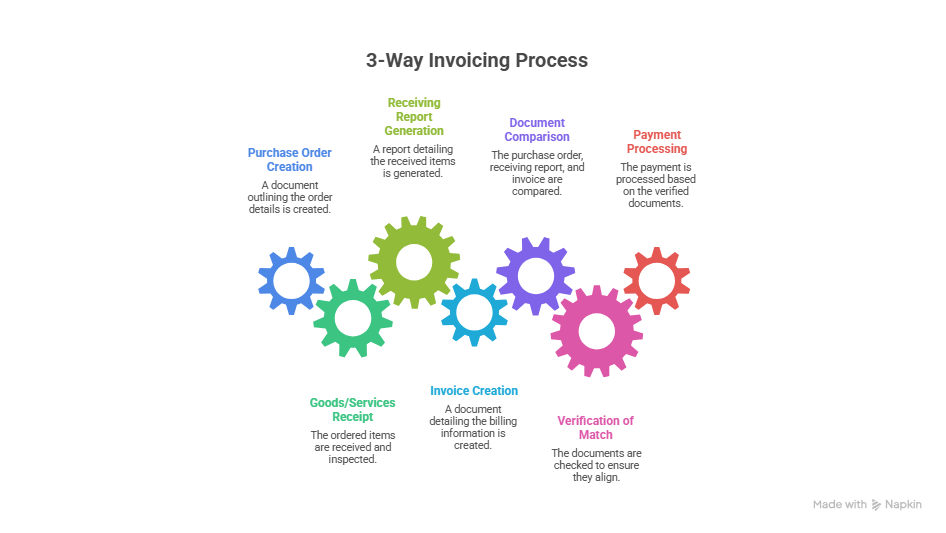
Three-way matching is an accounts payable control that compares a purchase order (PO), receiving record, and supplier invoice before an invoice is approved for payment. The basic purpose is simple: verify that the business is paying for what it authorized, received, and was billed for.
It sounds simple—and the basic concept is—but the details matter.
A business can receive 500 units while being invoiced for 600. A supplier can invoice at a higher price than the purchase order. A shipment can arrive in several partial deliveries while the supplier sends one invoice for the entire order.
Without a proper matching process, those differences can become payment errors, disputes, delays, or unnecessary financial losses.
This guide explains what 3-way invoice matching is, how it works, what documents are involved, how it differs from 2-way and 4-way matching, what happens when documents do not match, and when businesses should consider automating the process.
What Is 3-Way Invoicing?
3-way invoicing is the process of comparing three records before approving a supplier invoice for payment:
- Purchase Order (PO) — what the business ordered
- Goods Receipt or Receiving Report — what the business actually received
- Supplier Invoice — what the supplier is charging
The accounts payable team compares relevant information across these documents.
For example:
| Information | Purchase Order | Goods Receipt | Supplier Invoice |
|---|---|---|---|
| Product | Office chairs | Office chairs | Office chairs |
| Quantity | 50 | 50 | 50 |
| Unit price | $80 | — | $80 |
| Total | $4,000 | — | $4,000 |
If the information agrees within the company’s permitted rules or tolerances, the invoice can move forward for approval and payment.
If there is a discrepancy, the invoice may be placed on hold until someone determines what happened.
This is why the term 3-way match is often more accurate than “3-way invoicing.” The process is not about creating an invoice. It is about verifying a supplier invoice against two supporting records.
What Does a 3-Way Match Check?
A three-way match can check several pieces of information, depending on how the business has configured its purchasing and accounts payable process.
Common checks include:
- Supplier or vendor identity
- Purchase order number
- Product or service description
- Quantity ordered
- Quantity received
- Quantity invoiced
- Unit price
- Extended line amount
- Taxes
- Freight or shipping charges
- Discounts
- Payment terms
- Currency
- Delivery information
- Invoice number
- Invoice date
The exact checks vary by organization and purchasing system.
The central question remains:
Does the supplier’s invoice agree with what the business ordered and what it actually received?
A modern three-way matching workflow may also use tolerance rules. That means an invoice does not necessarily have to match every number down to the smallest possible difference.
For example, a company might permit a small price or quantity variance under its internal policy. An invoice within the permitted tolerance can potentially pass, while a larger difference is routed for review.
This is important because real-world purchasing is not always perfectly clean. Shipping quantities, taxes, freight charges, rounding, and approved price changes can create legitimate differences.
The 3 Documents in Three-Way Invoice Matching
Understanding the three documents makes the entire process much easier.
1. Purchase Order (PO)
The purchase order is created by the buyer before the purchase takes place. It communicates what the business intends to purchase from the supplier.
A purchase order may contain:
- PO number
- Supplier name
- Product or service description
- Quantity
- Unit price
- Total amount
- Delivery address
- Delivery date
- Payment terms
- Tax information
- Shipping terms
- Other purchasing conditions
For example, a retail business might create a PO for:
200 T-shirts × $12 each = $2,400
The PO establishes the approved purchasing information against which the later invoice can be checked.
In simple terms:
PO = What we agreed to buy.
2. Goods Receipt or Receiving Report
The second document records what the business actually received. Depending on the company and country, you may see different names, including:
- Goods Receipt Note (GRN)
- Goods Received Note
- Receiving Report
- Receiving Record
- Delivery Receipt
- Delivery Confirmation
The terminology differs, but the purpose is similar: document the goods or services received.
For physical goods, the receiving team might record:
- 200 units received
- 195 units received
- 200 units received, 5 damaged
- 100 units received in the first shipment
This information is critical because a purchase order proves that the company ordered something. It does not prove that the supplier actually delivered it.
In simple terms:
Goods receipt = What we actually received.
3. Supplier Invoice
The third document is the invoice sent by the supplier. The supplier uses the invoice to request payment.
It normally contains information such as:
- Invoice number
- Supplier information
- Customer information
- Invoice date
- PO number
- Product or service description
- Quantity
- Unit price
- Taxes
- Discounts
- Shipping charges
- Total amount
- Payment terms
- Due date
The invoice answers:
“What is the supplier asking us to pay?”
In simple terms:
Invoice = What the supplier says we owe.
How Does 3-Way Invoice Matching Work?
The process can be broken into a straightforward sequence.
Step 1: The Business Creates a Purchase Order
The purchasing department approves a purchase and creates a PO.
For example:
- 100 laptops
- $700 each
- Total PO value: $70,000
The PO is sent to the supplier.
Step 2: The Supplier Delivers the Order
The supplier ships the products. The receiving team checks the shipment and records what actually arrived.
Suppose all 100 laptops arrive in good condition. The receiving record therefore shows:
100 laptops received.
Step 3: The Supplier Sends an Invoice
The supplier sends an invoice requesting:
100 laptops × $700 = $70,000
The invoice references the purchase order.
Step 4: Accounts Payable Performs the Match
The AP team compares: Purchase Order → Receiving Record → Supplier Invoice
The key information agrees:
- Ordered: 100
- Received: 100
- Invoiced: 100
- PO price: $700
- Invoice price: $700
The invoice passes the matching rules.
Step 5: The Invoice Moves to Approval or Payment
If the invoice meets the company’s matching and approval requirements, it can continue through the payment workflow.
The exact approval process differs from one business to another.
Some companies automatically approve invoices that pass their rules. Others require an additional approval step.
What Happens When the 3 Documents Don’t Match?
This is where three-way matching becomes particularly useful. Suppose the PO says:
100 units × $50 = $5,000
The receiving report says:
100 units received
But the supplier invoice says:
100 units × $55 = $5,500
The quantity is correct, but the price is not.
That creates a price discrepancy.
The invoice may be placed on hold while the AP team investigates.
Possible explanations include:
- The supplier made a billing error.
- The PO was changed after it was issued.
- A new price was legitimately approved.
- The supplier used an outdated price.
- Someone entered the wrong price into the invoice.
- The purchase order was not updated correctly.
The important point is that the system does not blindly pay the invoice simply because the supplier sent it.
A Real-World 3-Way Matching Example
Imagine a small furniture retailer purchases office desks. The purchase order contains:
| Item | Quantity | Unit Price | PO Total |
|---|---|---|---|
| Office desks | 50 | $150 | $7,500 |
The supplier delivers the shipment. The warehouse records:
50 desks received.
The supplier then sends an invoice:
| Item | Quantity | Unit Price | Invoice Total |
|---|---|---|---|
| Office desks | 50 | $150 | $7,500 |
Everything agrees.
Result: Match
The invoice can proceed according to the company’s approval policy. Now change the invoice.
The supplier sends:
| Item | Quantity | Unit Price | Invoice Total |
|---|---|---|---|
| Office desks | 60 | $150 | $9,000 |
The PO says 50.
The receiving record says 50.
The invoice says 60.
Result: Exception
The AP team should investigate before approving the additional 10 desks.
The business might discover that:
- 10 additional desks were shipped under a separate order,
- the invoice contains an error,
- the supplier billed for goods that were never delivered,
- or the purchase order needs to be reviewed.
That is the basic logic behind three-way invoice verification.
Why Is 3-Way Matching Important for Accounts Payable?
Accounts payable exists partly to make sure legitimate business obligations are paid accurately and on time. Without a verification control, an AP team can end up relying heavily on the supplier’s invoice.
Three-way matching adds supporting evidence. It helps answer three different questions:
What did we authorize?
The purchase order provides the purchasing record.
What did we receive?
The receiving report provides evidence of delivery or receipt.
What are we being charged?
The supplier invoice provides the payment request.
Putting those three pieces together creates a stronger basis for approving payment.
Accounting and AP resources describe three-way matching as a control designed to verify that the organization pays for what it ordered and received at the appropriate amount.
Benefits of 3-Way Invoice Matching
1. Helps Prevent Overpayments
A supplier invoice can contain the wrong quantity or price. Three-way matching creates a checkpoint before payment.
For example:
Ordered: 500 units
Received: 500 units
Invoiced: 550 units
The 50-unit difference becomes visible before the payment is finalized.
2. Reduces Billing Errors
Supplier invoices can contain ordinary human errors. Examples include:
- Incorrect quantities
- Incorrect prices
- Wrong PO numbers
- Duplicate invoice numbers
- Incorrect calculations
- Incorrect shipping charges
- Outdated pricing
A matching process makes discrepancies easier to identify.
3. Strengthens Internal Financial Controls
Three-way matching is one component of a broader internal-control environment.
It creates a documented relationship between:
Purchase → Receipt → Invoice → Payment
That makes the transaction easier to review later.
4. Helps With Supplier Disputes
Imagine a supplier claims that the company owes $10,000. Instead of having a vague argument, the AP team can compare the supporting documents.
Perhaps:
- PO = $10,000
- Receipt = goods worth $8,000 received
- Invoice = $10,000
Now there is a specific issue to investigate. Documentation turns a disagreement into a reconciliation problem.
5. Creates a Better Audit Trail
A well-organized AP process can show how a payment was supported. An auditor or internal reviewer can trace:
Purchase Order → Receipt → Invoice → Approval → Payment
The exact documentation and retention requirements depend on the business and applicable regulations, but maintaining organized transaction records is an important part of financial control.
3-Way Matching Does Not Prevent Every Type of Invoice Fraud
This point is worth making because many articles exaggerate what invoice matching can do.
Three-way matching can help identify certain suspicious or incorrect transactions, particularly when the invoice does not agree with the PO or receiving record.
But it is not a complete fraud-prevention system.
For example, suppose a legitimate supplier’s bank account is changed through a fraudulent request.
The PO, receipt, and invoice might all match perfectly. A three-way match could therefore pass while the payment is still sent to the wrong bank account. Likewise, duplicate invoice detection is often a separate control.
Businesses should therefore treat three-way matching as one financial control among several, alongside vendor verification, approval controls, segregation of duties, duplicate-payment checks, and payment authorization procedures.
That distinction makes the process more realistic and more useful.
2-Way vs 3-Way Invoice Matching
One of the most common questions is:
What is the difference between 2-way and 3-way matching?
The answer is simple.
2-Way Matching
Two documents are compared:
Purchase Order + Supplier Invoice
The AP team checks whether the invoice agrees with the PO.
For example:
- PO quantity = 100
- Invoice quantity = 100
- PO price = $20
- Invoice price = $20
The invoice matches the PO. However, the process does not independently verify that the goods were actually received.
3-Way Matching
Three documents are compared:
Purchase Order + Receiving Record + Supplier Invoice
The third document provides evidence about what was actually received.
This makes the control more useful when the business purchases physical goods or inventory.
Amazon Business similarly describes 2-way matching as comparing the invoice and purchase order, while 3-way matching adds the goods receipt to verify delivery.
Simple Comparison
| Feature | 2-Way Match | 3-Way Match |
|---|---|---|
| Purchase Order | Yes | Yes |
| Supplier Invoice | Yes | Yes |
| Receiving Record | No | Yes |
| Verifies delivery | No | Yes |
| Checks ordered vs invoiced | Yes | Yes |
| Checks received vs invoiced | No | Yes |
| Process complexity | Lower | Higher |
| Useful for physical goods | Sometimes | Often |
Neither method is automatically appropriate for every purchase. The correct control depends on the company’s purchasing process, risk, transaction type, and operational requirements.
What Is 4-Way Matching?
There is also a 4-way matching process.
Four-way matching adds another verification document or step to the three-way process, commonly an inspection or acceptance record.
The concept becomes:
Purchase Order + Receipt + Inspection + Invoice
This can be useful where simply receiving a product does not prove that it meets the required specifications.
For example, a manufacturer might receive a batch of components.
The warehouse confirms:
“We received 1,000 components.”
But a quality-control team may still need to confirm:
“The components meet the required specifications.”
That additional inspection step creates another layer of verification.
Amazon Business describes four-way matching as adding inspection or acceptance information to the PO, receipt, and invoice checks.
Common 3-Way Matching Problems
Three-way matching improves control, but it can also create exceptions that AP teams need to resolve.
1. Quantity Mismatch
Example:
PO: 500 units
Received: 450 units
Invoice: 500 units
The supplier may have invoiced the full order even though only part of it has arrived.
The AP team needs to determine whether the invoice should be adjusted, held, or handled under the company’s partial-delivery rules.
2. Partial Delivery
A supplier might deliver:
- 300 units this week
- 200 units next week
The original PO is for 500.
The problem occurs if the supplier invoices all 500 after delivering only 300. The answer depends on the agreed payment terms and the company’s receiving and invoicing policy.
This is why AP teams need a process for partial receipts, rather than simply assuming every PO is delivered in one shipment.
3. Price Mismatch
Example:
PO price: $25
Invoice price: $27
Possible explanations include:
- Approved price change
- Contract update
- Incorrect supplier invoice
- Incorrect PO
- Expired quotation
- Tax or charge being interpreted incorrectly
The discrepancy should be investigated rather than automatically treated as either fraud or an error.
4. Missing Purchase Order
Some suppliers send invoices without a PO number. That can make automated matching difficult.
The AP team may need to determine:
- Who requested the purchase?
- Was the purchase authorized?
- Which PO relates to the invoice?
- Was the purchase supposed to be non-PO?
- Is the invoice legitimate?
A company that wants efficient invoice automation needs a clear policy for non-PO invoices.
5. Receiving Record Has Not Been Entered
Sometimes the goods have physically arrived, but the receiving team has not entered the receipt into the accounting or procurement system.
From AP’s perspective, the invoice may appear unmatched even though the supplier delivered everything correctly.
This is an important distinction: A failed match does not always mean a bad invoice.
It can also indicate incomplete internal data.
6. Unit-of-Measure Differences
A PO might use: 1 box = 100 units
while the supplier invoice uses: 100 individual units
The underlying quantity could be correct even though the documents display it differently.
This is one reason matching systems need properly configured item and unit-of-measure data.
What Are Invoice Matching Tolerances?
Perfect matching sounds simple until businesses start processing real transactions. Suppose:
PO price = $10.00
and the invoice price is:
$10.02
A business might decide that such a small difference can be accepted automatically. That is where matching tolerance comes in.
A tolerance defines how much variation the business allows before an invoice is treated as an exception. Examples could include:
- Price tolerance
- Quantity tolerance
- Percentage tolerance
- Absolute dollar tolerance
For example, a business might establish an internal rule that a small approved variance does not require manual intervention.
The exact threshold should be based on the organization’s policies, purchasing agreements, transaction risks, and accounting system.
The goal is to avoid two extremes:
Tolerance too strict → too many unnecessary exceptions
Tolerance too loose → genuine discrepancies may pass
Current AP guidance emphasizes that tolerance configuration is an important part of making three-way matching practical.
Manual vs Automated 3-Way Matching
A small business might perform three-way matching manually. The AP employee could open:
- The purchase order
- The receiving report
- The invoice
Then compare the information. For a small number of transactions, that may be manageable.
The problem appears when invoice volume increases. Imagine an AP team processing hundreds or thousands of invoices every month.
Manually checking every line can become repetitive and time-consuming. Common operational problems include:
- Searching for missing documents
- Re-entering invoice information
- Checking quantities manually
- Comparing prices
- Routing invoices for approval
- Following up on exceptions
- Finding the correct PO
- Tracking invoice status
This is where accounts payable automation can help.
How Automated 3-Way Matching Works
Modern AP systems can connect purchasing, receiving, and invoice data. A typical automated workflow might look like this:
Purchase Order Created
↓
Goods Received
↓
Supplier Invoice Captured
↓
Invoice Data Extracted
↓
PO + Receipt + Invoice Compared
↓
Match Within Rules?
Yes → Approval/payment workflow
No → Exception review
Automation can reduce repetitive comparison work, but it does not eliminate the need for good business processes.
Current AP resources describe automation as connecting PO, receipt, and invoice information and routing exceptions when the records do not agree.
What Should an Automated 3-Way Matching System Check?
Depending on the software, automated invoice matching may compare:
- PO number
- Vendor
- Item
- Quantity
- Unit price
- Currency
- Tax
- Shipping
- Invoice total
- Received quantity
- Payment terms
- Invoice number
- Matching tolerances
The system may then classify the invoice as:
Matched: The invoice meets the configured rules.
Mismatched: One or more values differ beyond the permitted tolerance.
Exception: The invoice requires human investigation. This is an important concept:
Automation should not mean “approve everything automatically.”
A well-designed system automates routine matches while sending unusual transactions to people for review.
When Is 3-Way Matching Most Useful?
Three-way matching is particularly useful for businesses that regularly purchase physical products, inventory, equipment, supplies, or other goods that can be formally received and recorded.
Examples include:
- Retail businesses
- Wholesalers
- Manufacturers
- Distributors
- Construction companies
- Warehouses
- Restaurants
- E-commerce businesses
- Large offices
- Procurement departments
For example, a retailer purchasing inventory can compare: What was ordered → What arrived → What was billed
That creates a natural three-way control.
Is 3-Way Matching Necessary for Every Invoice?
No. This is another area where overly simplistic articles get it wrong. Not every invoice naturally fits a three-way matching workflow. Consider a monthly software subscription.
There may be:
- No traditional receiving report
- No physical shipment
- No warehouse receipt
The business may instead use a different approval or verification process.
Professional services can present a similar issue.
A consulting firm might bill for:
- 20 hours of work
- A monthly retainer
- A completed project milestone
In those cases, the business may verify the invoice against a contract, statement of work, timesheet, milestone approval, or another record.
The appropriate control depends on the transaction.
Three-way matching is a useful control, not a universal rule for every type of business expense.
3-Way Matching for Small Businesses
Small businesses sometimes assume three-way matching is only for large corporations using expensive ERP systems.
That is not necessarily true. A small business can apply the basic principle without building a complicated enterprise workflow.
For example:
Step 1: Create a purchase order before significant purchases.
Step 2: Record what was actually received.
Step 3: Save the supplier invoice.
Step 4: Compare the three records before paying.
Step 5: Investigate significant differences.
Even if this process is handled through accounting software, spreadsheets, or organized digital records, the fundamental control remains the same.
The technology can change. The logic does not.
A Simple 3-Way Matching Checklist
Before approving a supplier invoice, an AP employee can ask:
Purchase
- Is there an approved PO?
- Does the supplier match?
- Are the products or services correct?
- Was the purchase authorized?
Receipt
- Were the goods actually received?
- How many units arrived?
- Were any items damaged or rejected?
- Has the receipt been recorded?
Invoice
- Does the invoice reference the correct PO?
- Does the quantity match?
- Does the price match?
- Are taxes correct?
- Are shipping charges correct?
- Does the total calculate correctly?
- Are the payment terms correct?
Exception
If something does not match:
- Identify the exact difference.
- Check whether the difference is within the approved tolerance.
- Contact the purchasing or receiving team if necessary.
- Ask the supplier for clarification when appropriate.
- Correct the records or invoice before payment when required.
- Document the resolution.
This turns three-way matching from an abstract accounting concept into a repeatable business process.
How to Improve Your 3-Way Matching Process
If your current AP process is messy, buying software is not necessarily the first solution. Start with the process itself.
1. Standardize Purchase Orders
Use consistent PO numbers and descriptions.
Avoid vague purchase descriptions such as:
“Supplies — $5,000”
when a more useful description is available.
Better records make later matching easier.
2. Record Receipts Promptly
If goods arrive but the receiving record is created several days later, invoices may appear unmatched even when everything is correct.
Make receiving part of the normal purchasing workflow.
3. Keep Documents Together
Store the PO, receiving information, invoice, and approval information in a system or structure that employees can access easily.
Searching through scattered emails and folders creates unnecessary AP work.
4. Define Exception Rules
Decide in advance:
- What counts as a mismatch?
- What price variance is acceptable?
- Who handles quantity differences?
- Who approves exceptions?
- When should a supplier be contacted?
- When should an invoice be rejected?
- Clear rules prevent every exception from becoming an improvised decision.
5. Separate Purchasing, Receiving, and Payment Responsibilities
Where practical, avoid putting the entire purchasing-to-payment process under one person’s control. Separating responsibilities can strengthen internal controls because different people or functions provide different checks.
The exact structure depends on the size of the business.
6. Automate When Volume Justifies It
Automation becomes more attractive when the business has:
- High invoice volume
- Multiple suppliers
- Multiple locations
- Large purchasing teams
- Frequent invoice exceptions
- Complex approval workflows
- Significant manual data entry
A business processing 20 invoices a month may not need the same system as a company processing 20,000.
How 3-Way Matching Fits Into the Procure-to-Pay Process
Three-way matching makes more sense when you see where it sits in the bigger workflow.
A typical procure-to-pay process looks something like:
Need identified
↓
Purchase approved
↓
Purchase Order created
↓
Supplier delivers
↓
Goods received
↓
Supplier sends invoice
↓
3-way match
↓
Invoice approval
↓
Payment
↓
Transaction recorded
The three-way match sits between receiving/invoice processing and payment approval.
Its job is essentially to provide another verification point before the business releases money.
What Happens After a Failed 3-Way Match?
A failed match should not automatically mean the invoice is fraudulent. That would be a poor assumption. Instead, the AP team should identify the specific discrepancy. For example:
Quantity difference
PO: 1,000
Received: 900
Invoice: 1,000
Check whether the supplier delivered the remaining 100 later or invoiced too early.
Price difference
PO: $40
Invoice: $42
Check whether there was an approved price change.
Missing receipt
PO: 100
Invoice: 100
Receipt: Missing
Ask the receiving team whether the goods arrived but were not recorded.
Wrong PO
The supplier may have referenced the wrong purchase order.
The point of exception management is to investigate the difference and determine the correct treatment, not automatically blame the supplier or the AP team.
Does 3-Way Matching Reduce Invoice Processing Errors?
It can. The process is specifically designed to introduce a verification step between purchasing, receiving, invoicing, and payment.
However, the quality of the result depends heavily on the quality of the underlying records.
If:
- the PO is wrong,
- the receipt is not recorded,
- item descriptions are inconsistent,
- prices were not updated,
- or invoice data was entered incorrectly,
the matching process can generate unnecessary exceptions or potentially miss problems.
In other words:
Three-way matching is only as reliable as the information being matched.
That is one reason clean purchase orders and accurate receiving records matter so much.
Does 3-Way Matching Help Cash Flow?
Indirectly, yes—but it should not be described as a magic cash-flow solution. The process can help businesses avoid paying more than they actually owe and can reduce certain payment errors.
At the same time, excessively strict matching rules can delay legitimate invoices and create unnecessary approval bottlenecks.
A good AP process therefore needs to balance:
Control + Accuracy + Speed
The goal is not to hold every invoice.
The goal is to confidently process legitimate invoices while investigating meaningful exceptions.
3-Way Matching vs Invoice Approval
These terms are related, but they are not identical.
3-way matching verifies whether the invoice agrees with the PO and receiving information.
Invoice approval determines whether the invoice is authorized to move forward for payment under the company’s workflow.
A business might have an invoice that passes the three-way match but still requires managerial approval because of its value.
For example:
3-way match: Passed
Manager approval: Required
Payment: Released after approval
This distinction becomes important when designing an accounts payable workflow.
Frequently Asked Questions About 3-Way Invoicing
What is 3-way invoicing?
3-way invoicing, commonly called three-way matching, is an accounts payable process that compares a purchase order, receiving record, and supplier invoice before payment is approved.
What are the three documents in a 3-way match?
The three core documents are:
- Purchase order
- Goods receipt or receiving report
- Supplier invoice
What is the purpose of 3-way matching?
The purpose is to verify that the business is paying for what it authorized, received, and was billed for.
What is the difference between 2-way and 3-way matching?
Two-way matching compares the purchase order with the invoice. Three-way matching adds a receiving record, allowing the business to verify what was actually received.
What happens if a 3-way match fails?
The invoice is generally flagged as an exception or placed on hold until the discrepancy is investigated and resolved according to the company’s policy.
Can 3-way matching prevent invoice fraud?
It can help identify certain billing discrepancies, but it does not prevent every type of fraud. Businesses need additional controls for issues such as fraudulent vendor changes, unauthorized purchases, and duplicate payments.
Is 3-way matching only for large businesses?
No. The underlying process can be used by small businesses as well. The level of automation and documentation can be scaled according to invoice volume and business risk.
Is 3-way matching required for every invoice?
No. The appropriate verification process depends on the type of purchase. Physical goods are often well suited to three-way matching, while services and subscriptions may require different supporting documentation.
What is 4-way matching?
Four-way matching adds another verification step—often an inspection or acceptance record—to the purchase order, receipt, and invoice checks.
Can 3-way matching be automated?
Yes. AP automation systems can capture invoice information, compare it with purchase order and receiving data, apply matching rules, and route exceptions for review.
Final Takeaway: What Is 3-Way Invoicing?
At its core, 3-way invoicing is about answering three questions before paying a supplier:
What did we order?
What did we receive?
What are we being charged?
The three-way match connects those answers through:
Purchase Order + Receiving Record + Supplier Invoice
When the information agrees within the company’s rules, the invoice can move through the normal approval and payment workflow.
When it does not, the difference becomes an exception that needs investigation.
That simple control can help businesses reduce overpayments, identify billing errors, improve documentation, and create a more disciplined accounts payable process.
But it is not a complete financial-control system by itself. Businesses still need appropriate approval procedures, vendor controls, duplicate-payment checks, and payment security measures.
The real value of three-way matching is therefore not that it makes accounting “automatic.”
It is that it creates a clear evidence-based checkpoint before money leaves the business.
For businesses that regularly purchase goods from suppliers, that checkpoint can make the difference between simply processing invoices and actually controlling the payment process.

Akbar Ali is the Founder of InvoiceGeneratorPro.io, a platform dedicated to helping freelancers, small businesses, startups, agencies, and entrepreneurs create professional invoices quickly and efficiently. With years of experience in digital business, SEO content strategy, and online entrepreneurship, he focuses on developing practical tools and educational resources that simplify invoicing, payment management, and financial documentation.As a business writer and digital entrepreneur, Akbar creates in-depth guides, industry insights, and actionable content covering invoicing, freelancing, accounting basics, business finance, taxation, productivity, and payment solutions. His goal is to make complex financial processes easy to understand while helping professionals save time and present their businesses more professionally.Through InvoiceGeneratorPro.io, he continues to build reliable, user-friendly solutions that empower businesses worldwide to streamline their billing workflows and improve financial organization.
1 Comment
Ubaida
October 17, 2026I didn’t realize how useful 3-way invoicing could be for avoiding payment mistakes. This article explains it in a simple way, especially for businesses that deal with lots of invoices and purchase orders.

Akbar Ali