
Plenty of Australian business owners send the wrong document and don’t find out until a client disputes a GST claim or an accountant flags a problem during tax time. The words “invoice” and “tax invoice” get used like they mean the same thing. They don’t. And confusing them can cost you real money.
This isn’t an abstract compliance issue. If you’re registered for GST and you send a regular invoice instead of a tax invoice, your client can’t claim the GST credit on that purchase. That makes you look unprofessional at best and creates accounting headaches for both parties at worst.
So what’s actually the difference? Let’s break it down properly.
A Regular Invoice: What It Is and When It’s Used
A regular invoice is a payment request. It tells your client what they owe you, for what, and when to pay. That’s it. There’s no legal requirement for it to show GST, include your ABN, or meet any specific format under Australian tax law.
Freelancers who aren’t registered for GST use regular invoices. So do businesses whose annual turnover sits below the $75,000 GST registration threshold. If you’re a graphic designer just starting out, earning $40,000 a year, and you haven’t registered for GST, a plain invoice is exactly what you should be sending. No tax component, no ABN required (though including it is still good practice).
Regular invoices work fine in these situations. The problem starts when a GST-registered business sends a regular invoice when they should be sending a tax invoice.
What Is a Tax Invoice in Australia?
A tax invoice is a specific document required by the Australian Taxation Office (ATO) for any GST-registered business making a taxable sale. It’s the document that gives your client the legal right to claim a GST input tax credit.
The GST connection is everything here. When your business is registered for GST, every sale you make above $82.50 (including GST) requires a tax invoice. Your client needs that document to claim back the 10% GST they paid. Without it, the ATO won’t allow the claim. Your client’s accountant will come back to you asking for it, and you’ll have wasted everyone’s time.
Think of it this way: a tax invoice is what makes the GST system actually work between businesses. One party collects the tax, the other claims it back, and the ATO tracks both sides. A regular invoice breaks that chain.
The Legal Distinction the ATO Draws
The ATO is clear on this. Under the A New Tax System (Goods and Services Tax) Act 1999, a GST-registered supplier must issue a tax invoice for any taxable supply over $82.50. The recipient of that supply has 28 days to request one if it wasn’t provided.
A regular invoice has no such legal standing in the GST system. It’s a commercial document, not a tax document. Courts and the ATO treat them differently, and your accountant certainly does.
If you’ve ever had a supplier tell you they’ll “send you an invoice” and then you can’t use it to claim GST, this is exactly why. They sent you the wrong document.
What Does a Tax Invoice Need in Australia?
This is where a lot of businesses get tripped up. Knowing you need to send a tax invoice is one thing. Knowing what actually goes on it is another.
The ATO splits the requirements based on the total amount.
For tax invoices under $1,000, you need:
- The words “Tax Invoice” clearly stated
- Your business name
- Your ABN
- The date the invoice was issued
- A description of the goods or services
- The GST amount (or a statement that the total price includes GST)
- The total price
For tax invoices over $1,000, you also need:
- The buyer’s identity or ABN
- The extent to which each sale is a taxable sale (if the invoice covers both taxable and non-taxable items)
That last point catches people off guard. If you’re invoicing for a mix of GST-taxable and GST-free items (say, general consulting plus exported services), you need to clearly separate them on the invoice. A single lump sum won’t cut it.
What Constitutes a Tax Invoice in Australia
Common Mistakes That Invalidate One
Sending a document titled “Tax Invoice” doesn’t automatically make it one. The ATO cares about the content, not just the label.
Missing the words “Tax Invoice.”
Your document must actually say “Tax Invoice” at the top. “Invoice,” “Sales Receipt,” or “Statement” doesn’t qualify, even if everything else is correct.
No ABN:
Your Australian Business Number must appear on every tax invoice you issue. If it’s missing, the document is invalid for GST purposes.
GST is not clearly shown:
Some invoices show a total price without breaking out the GST component. If the GST isn’t shown separately or there’s no statement confirming the total includes GST, the recipient can’t verify what they’re claiming.
Wrong date or no date:
The ATO requires the issue date. An undated tax invoice creates problems during audits.
Vague service descriptions:
“Professional services” or “consulting work” on an invoice is risky. The description should tell someone unfamiliar with the transaction what was actually provided. “Social media management for March 2025, 4 platforms” is the standard you’re aiming for.
These aren’t minor formatting preferences. Each one is a reason the ATO can reject a GST credit claim.
When Do You Need a Tax Invoice vs a Regular Invoice?
Here’s a practical breakdown by situation.
You’re GST-registered, your client is GST-registered:
Always send a tax invoice. Both parties need the documentation for their GST reporting.
You’re GST-registered, your client is not:
You still need to send a tax invoice. You’ve collected GST on behalf of the ATO, and that has to be documented regardless of your client’s registration status.
You’re not GST-registered:
Send a regular invoice. You cannot charge GST, and you shouldn’t be sending tax invoices. Charging GST without being registered is a serious offence.
You’re selling GST-free goods or services:
You may still need to issue a tax invoice (for administrative purposes), but the GST amount will show as zero, and you’d note the supply is GST-free.
One more scenario that trips people up: selling to international clients. Exports are generally GST-free, so those invoices won’t include GST, but if you’re registered, a tax invoice is still the appropriate document with the GST line showing $0.
What Getting It Wrong Actually Costs You
The ATO can deny GST input tax credit claims if your client doesn’t have a valid tax invoice. That means your client pays 10% more than they expected to, effectively, because they can’t claim it back. They’ll blame you. They should.
During an ATO audit, missing or incorrect tax invoices are one of the first things auditors flag. If you can’t produce valid tax invoices for sales you’ve reported GST on, you may have to repay that GST with penalties and interest.
The ATO also has a “four-year rule” for record keeping. You’re legally required to keep tax invoices for four years. A business that’s been sending regular invoices instead of tax invoices for years is sitting on a compliance problem that compounds over time.
Create Compliant Tax Invoices Without the Guesswork
Getting the format right every time is easier when you have a tool built for it. Invoice Generator Pro is a free, browser-based invoicing tool that lets Australian freelancers and small business owners create professional invoices fast, without needing an accounting degree to figure out what belongs where.
No subscription. No login required. You fill in your details, add your line items, and the tool produces a clean, professional document you can send to clients immediately.
How to Build a Valid Australian Tax Invoice Step by Step
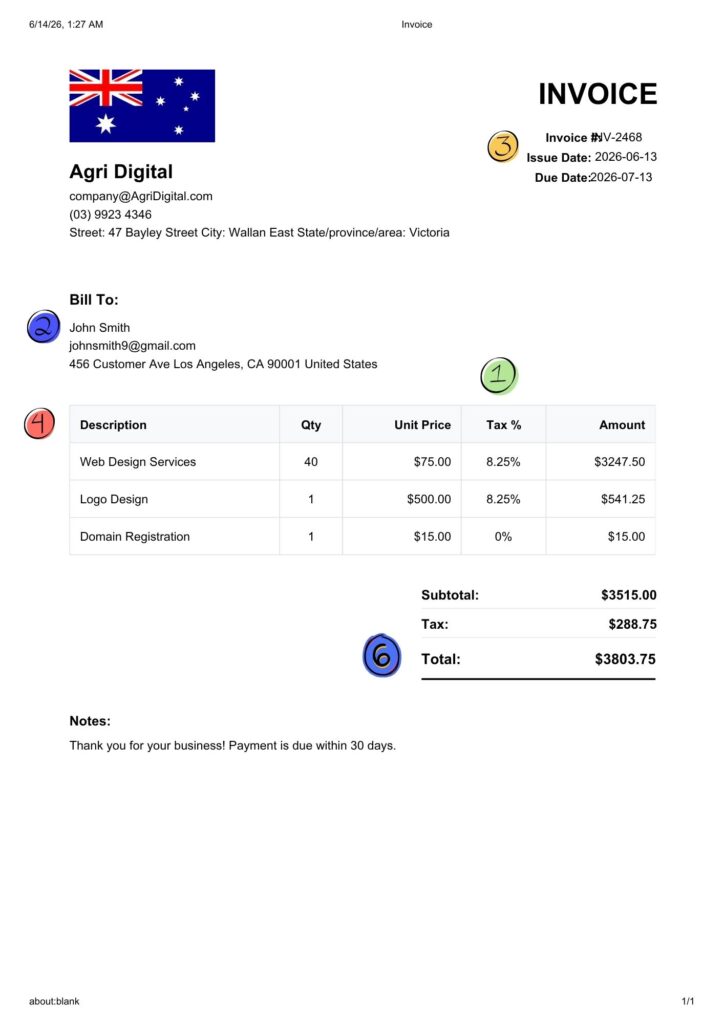
If you’re creating a tax invoice manually or setting up a template, here’s the process.
Step 1: Add “Tax Invoice” at the top:
Prominently. Not buried in a footer.
Step 2: Enter your business name and ABN:
These must match your ATO registration exactly.
Step 3: Add the issue date:
The date you’re sending it, not the date the work was completed (though you can include both).
Step 4: Describe the goods or services specifically:
Quantity, unit price, and what was actually provided.
Step 5: Show the GST clearly:
either as a separate line item (e.g., “GST: $45.00”) or with a clear statement that the total includes GST. Separate subtotal, GST, and total fields are cleanest.
Step 6: For invoices over $1,000, add the buyer’s ABN:
Your client’s accountant will thank you for not making them chase it down.
Step 7: Number your invoices sequentially:
The ATO doesn’t require invoice numbers, but every accountant does. It makes record keeping traceable.
If you want a professional template that handles all of this for you, the Professional Invoice Generator at Invoice Generator Pro is built specifically for this. You get all the required fields in the right place, a clean layout, and a downloadable PDF ready to send.
The Short Version
A regular invoice requests payment. A tax invoice does that, plus documents a GST transaction in a way the ATO recognises, and your client can act on.
If your business is registered for GST and you’re sending regular invoices, you’re creating problems for your clients and compliance risk for yourself. The fix isn’t complicated. It’s a format change, not a business overhaul.
Get the document right, include the right fields, and send it consistently. That’s what keeps your books clean, your clients happy, and the ATO off your back.

Akbar Ali is the Founder of InvoiceGeneratorPro.io, a platform dedicated to helping freelancers, small businesses, startups, agencies, and entrepreneurs create professional invoices quickly and efficiently. With years of experience in digital business, SEO content strategy, and online entrepreneurship, he focuses on developing practical tools and educational resources that simplify invoicing, payment management, and financial documentation.As a business writer and digital entrepreneur, Akbar creates in-depth guides, industry insights, and actionable content covering invoicing, freelancing, accounting basics, business finance, taxation, productivity, and payment solutions. His goal is to make complex financial processes easy to understand while helping professionals save time and present their businesses more professionally.Through InvoiceGeneratorPro.io, he continues to build reliable, user-friendly solutions that empower businesses worldwide to streamline their billing workflows and improve financial organization.
Akbar Ali