
An unpaid invoice creates an awkward situation.
You completed the work. You sent the invoice. The due date passed, and the payment still hasn’t arrived. Now you’re wondering how to ask for your money without making the client feel pressured.
That concern is common among freelancers, consultants, agencies, contractors, and small business owners. A payment reminder can feel uncomfortable when you want to keep working with the same client.
The good news is that a professional follow-up doesn’t have to damage the relationship. Clear communication, good timing, and a calm tone can make an unpaid invoice much easier to handle.
The process also gets easier when your invoice already includes the invoice number, payment terms, due date, amount due, and payment methods.
Here’s how to follow up on an unpaid invoice without turning a payment request into a client conflict.
Why Do Clients Pay Invoices Late?
An overdue invoice doesn’t always mean a client is refusing to pay. There are several reasons an invoice can remain unpaid:
- The client forgot the due date.
- The invoice went to the wrong email address.
- The accounting team hasn’t approved the payment.
- The client is waiting for internal approval.
- The invoice contains an error.
- The client has a temporary cash-flow problem.
- The client disputes part of the work or amount.
- The payment was sent but hasn’t reached your account yet.
- The client never saw the invoice.
This distinction matters because your first invoice follow-up should leave room for a simple explanation.
For example, compare these two messages:
“Why haven’t you paid my invoice yet?”
and:
“Hi Sarah, I’m following up on invoice #1047, which was due on September 15. Could you please confirm when payment is expected?”
The second message gives the client a clear action without making an accusation.
When Should You Follow Up on an Unpaid Invoice?
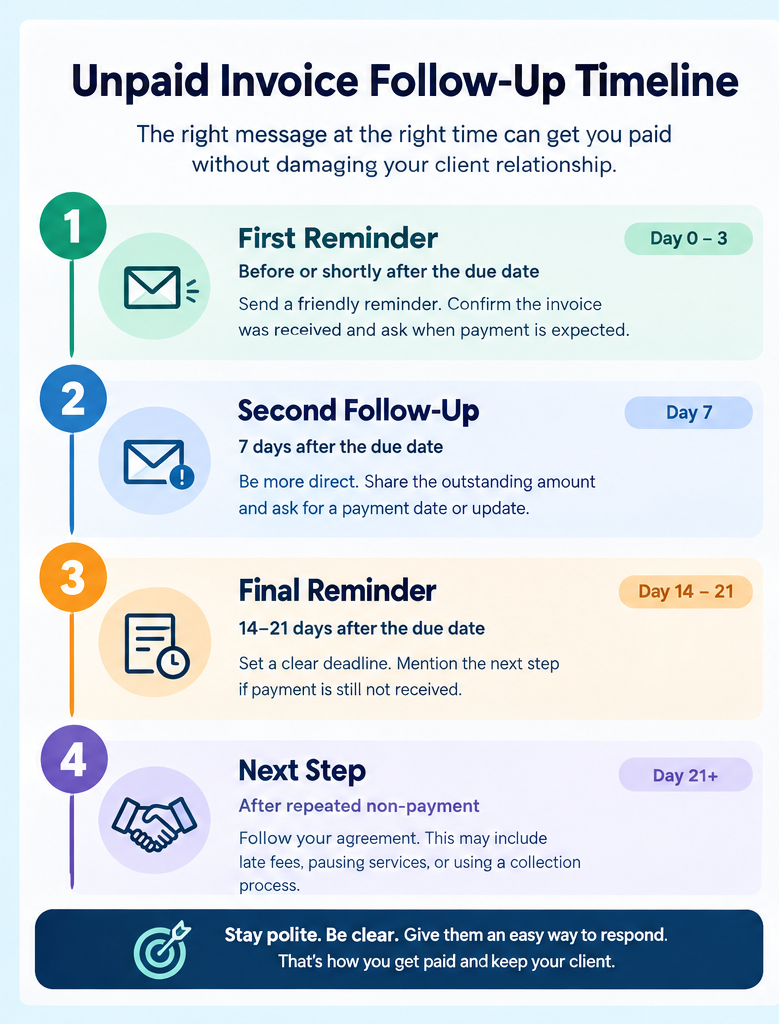
Timing depends on your payment terms and the relationship with the client. A practical invoice reminder schedule can look like this:
| Timing | Action |
|---|---|
| Before the due date | Friendly reminder |
| 1 to 3 days after the due date | First overdue invoice reminder |
| 7 days after the due date | Second payment follow-up |
| 14 to 21 days after the due date | Firmer payment request |
| After repeated non-payment | Final notice and next collection step |
You don’t need to send the same message repeatedly. Each follow-up should have a purpose.
The first reminder can check whether the client received the invoice. The second can request a payment date. The final reminder can give a clear deadline and explain what happens if payment remains outstanding.
Your existing payment terms should guide the process.
If your invoice says Net 30, the payment is due according to those terms. If you agreed to a different payment schedule, use that agreement when calculating the due date.
Start With a Friendly Payment Reminder
Your first unpaid invoice follow up should be short.
You don’t need a long explanation about how much you need the money. The client mainly needs the details required to make or arrange the payment.
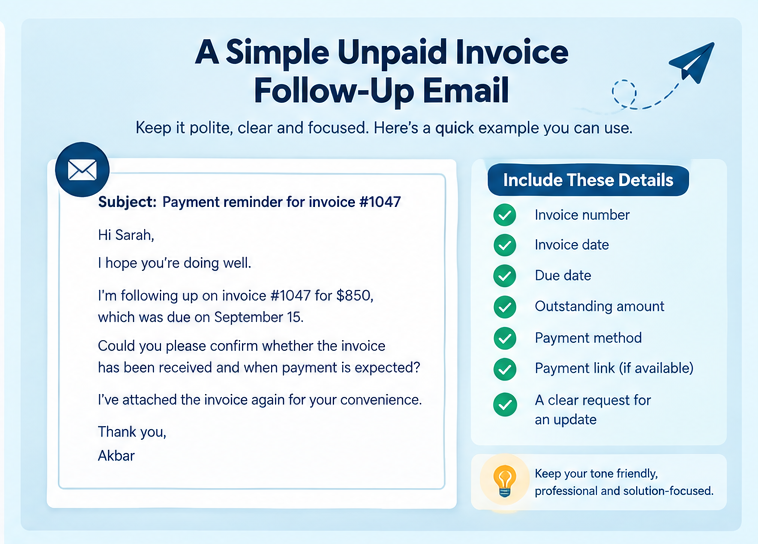
Include:
- Invoice number
- Invoice date
- Due date
- Outstanding balance
- Payment method
- Payment link, if available
- A simple request for an update
Example: Friendly Invoice Payment Reminder
Subject: Payment reminder for invoice #1047
Hi Sarah,
I hope you’re doing well.
I’m following up on invoice #1047 for $850, which was due on September 15.
Could you please confirm whether the invoice has been received and when payment is expected?
I’ve attached the invoice again for convenience.
Thanks,
Akbar
This type of payment reminder works because the message is specific. The client doesn’t have to search through old emails to understand what you’re asking about.
Give the Client an Easy Way to Respond
A payment follow-up becomes harder when the client has to figure out what you want.
Avoid vague messages such as:
“Please update me.”
Update you about what?
Instead, ask a direct question:
“Could you confirm the expected payment date?”
That gives the client a simple response.
They might reply:
“We’ll process it on Friday.”
Now you have a payment date.
If they say:
“Our accounts team hasn’t approved it yet.”
You know what is causing the delay.
If they say:
“We have an issue with the invoice amount.”
You have a chance to resolve the dispute. The goal of an invoice follow-up isn’t to create pressure for its own sake. You want useful information and payment.
What Should You Include in an Unpaid Invoice Email?
A professional overdue invoice email doesn’t need ten paragraphs. Keep the important information visible.
1. Invoice number: The invoice number lets the client and their accounting team identify the exact transaction.
2. Due date: State when payment was due.
3. Outstanding amount: Make the amount clear. If there has been a partial payment, state the remaining balance.
4. Payment method: Tell the client how they can pay. If you accept bank transfer, card payment, PayPal, or another method, provide the relevant details.
5. Payment request: Ask for payment or a confirmed payment date.
6. Contact information: Give the client a way to ask questions if something is wrong.
This structure works for a small business, freelancer, agency, or accounting department.
Follow Up Again if the Client Doesn’t Respond
Sometimes the client doesn’t answer.
You send a friendly payment reminder. Nothing.
You send another message. Still nothing.
At this point, repeating the same sentence won’t solve the problem.
Your second payment follow-up should be more direct.
Example: Second Payment Follow-Up
Subject: Follow-up: Invoice #1047 is overdue
Hi Sarah,
I’m following up again regarding invoice #1047 for $850, which was due on September 15.
The balance is still outstanding. Could you please confirm the expected payment date?
If there is an issue with the invoice or payment process, please let me know and I’ll review it with you.
Thank you,
Akbar
Notice the tone.
It is firmer because the invoice is overdue, but it doesn’t accuse the client of avoiding payment. That distinction matters when you want to continue working together.
What If the Client Says They Need More Time?
This situation needs a practical response.
Suppose a client says:
“We’re short on cash this month. Can we pay next month?”
You have a few options.
You can agree to the new date. You can request a partial payment. You can keep the original deadline and explain your payment policy. The right option depends on your contract, business relationship, and financial position.
If you agree to a new payment date, confirm it in writing.
For example:
“Thanks for letting me know. I can accept payment by October 10. Please confirm that date works for your accounts team.”
Now both sides have a written record.
For larger invoices, a partial payment can sometimes reduce the immediate cash-flow pressure on the client while giving your business some payment now. Put any revised arrangement in writing.
What If the Client Disputes the Invoice?
Don’t treat every unpaid invoice as a collection problem. Sometimes there is a genuine dispute.
The client may say:
- The quantity is incorrect.
- The agreed price was different.
- A service wasn’t completed.
- A payment was already made.
- The invoice includes an item they didn’t approve.
- The work doesn’t match the agreement.
Check your contract, quotation, purchase order, project records, and previous messages.
If you’ve made an error, correct the invoice.
If the client is mistaken, provide the relevant information clearly.
For example:
“I checked the original quotation from August 20. The agreed project fee was $1,200, and the invoice reflects that amount. I’ve attached the quotation for reference.”
Keep the discussion focused on facts.
What If the Client Says They Never Received the Invoice?
This is one of the easiest situations to fix. Send the invoice again. Your message can be simple:
“No problem. I’ve attached invoice #1047 again. The amount due is $850, with payment due by September 30. Please let me know if you have any trouble opening the file.”
You can also ask the client to confirm the correct billing email. This is one reason professional invoices should be easy to identify and read.
What If the Client Keeps Ignoring You?
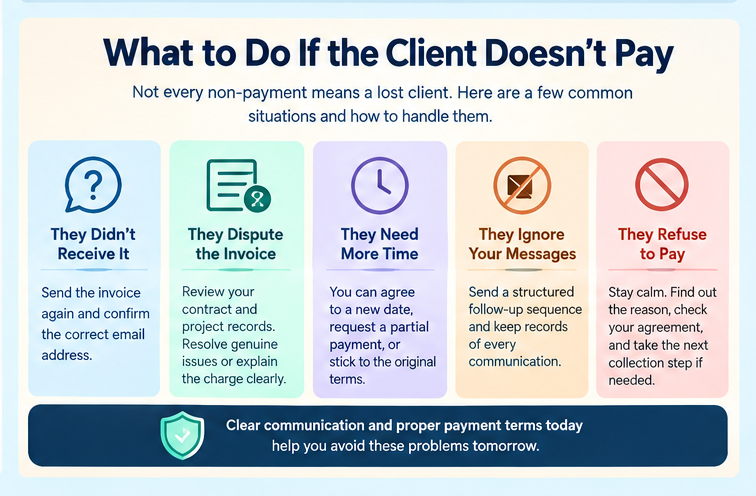
Repeated silence changes the situation. If several payment reminders receive no response, move from casual follow-up to a documented collection process.
Keep records of:
- The original invoice
- Payment terms
- Due date
- Reminder emails
- Client responses
- Revised payment agreements
- Any dispute
- Work completion records
- Contracts or purchase orders
Send a final payment reminder with a specific deadline.
Example: Final Payment Reminder
Subject: Final payment reminder for invoice #1047
Hi Sarah,
I’m following up regarding the outstanding $850 balance on invoice #1047, which was due on September 15.
Please arrange payment by October 5 or contact me before that date if there is an issue with the invoice.
If payment has already been sent, please share the payment details so I can check the account.
Thank you,
Akbar
Don’t add threats you have no intention or authority to carry out.
If your contract includes late payment fees, suspension of services, or another collection step, follow the agreed terms and applicable law.
Don’t Use Emotional Language
An unpaid invoice can become frustrating, especially when you’ve already delivered the work. Still, your client doesn’t need to see your frustration in the payment reminder.
Avoid phrases such as:
- “You keep ignoring me.”
- “Why are you refusing to pay?”
- “I need this money urgently.”
- “This is completely unacceptable.”
- “If you don’t pay today, I’ll take action.”
These statements can turn a payment issue into a relationship problem. A professional payment reminder should focus on the transaction. Invoice. Amount. Due date. Payment date. Next step.
That’s enough in most cases.
How Freelancers Can Handle Late Payments
Freelancers often have less financial room for late payments. A delayed $1,000 invoice can affect rent, software bills, payroll, or the ability to take on the next project.
Freelancers can reduce this risk by setting payment terms before starting work.
Useful options include:
- Deposits before work begins
- Milestone payments
- Shorter payment terms
- Clear due dates
- Late payment fees where appropriate
- Written approval for additional work
- Online payment options
- Automated payment reminders
For a large project, asking for the entire amount after completion can create a bigger collection problem.
A milestone payment structure can divide the risk.
For example:
- 30% before work begins
- 40% after the first milestone
- 30% before final delivery
The exact percentages should fit the project and agreement.
How Small Businesses Can Reduce Overdue Invoices
Small businesses often manage accounts receivable without a dedicated finance team. That makes consistency important.
Create a simple invoice follow-up process. For every invoice, record:
Invoice date → due date → payment status → reminder date → payment date
You can manage this in accounting software, a spreadsheet, or an invoice management system.
Tools such as QuickBooks, FreshBooks, and other accounting platforms can track invoices and payment status. The specific features and pricing vary, so choose based on your actual workflow.
If you create invoices manually, make sure each invoice contains clear payment terms and an easy payment method. An invoice generator can also reduce basic formatting and calculation errors.
Use Payment Terms Before There Is a Problem
The easiest unpaid invoice to collect is often the one with clear terms from the start.
Your client should know:
- How much they owe
- What the payment covers
- When payment is due
- Which payment methods you accept
- Whether late fees apply
- What happens if payment is delayed
Put those details on the invoice and, for larger projects, in the agreement.
Don’t wait until an invoice is overdue to introduce a payment rule that the client never saw.
Should You Charge a Late Payment Fee?
That depends on your agreement, local law, and business relationship.
If you charge late fees, state the terms before the client accepts the work or invoice.
Don’t suddenly add a fee after the due date if the client had no prior notice.
For businesses that work across countries, payment rules can vary by jurisdiction. A local accountant or legal professional can tell you which late-payment rules apply to your situation.
Automate Invoice Reminders When Possible
Manual invoice follow-ups take time.
If you send dozens of invoices each month, an invoice reminder software or accounting platform can send reminders automatically.
A typical system might send:
- A reminder before the due date.
- A reminder shortly after the due date.
- Another reminder when the invoice becomes seriously overdue.
Automation doesn’t mean every client should receive the same cold message. For important or long-term clients, a personal email can still make sense.
Use automation for consistency and personal communication when the situation needs context.
Create Professional Invoices From the Start
A clear invoice makes payment easier. Before sending an invoice, check:
- Client name
- Billing email
- Invoice number
- Invoice date
- Description of services
- Quantity or hours
- Unit price
- Total amount
- Tax, if applicable
- Payment terms
- Due date
- Payment method
Small mistakes can delay payment. A missing invoice number can slow an accounting department. An incorrect billing email can mean the client never sees the invoice. A vague service description can create a dispute. Take a few minutes to check the invoice before sending it.
A Simple Unpaid Invoice Follow-Up Process
You don’t need a complicated system. Use this sequence:
Step 1: Check the invoice: Confirm the amount, due date, client information, and payment terms.
Step 2: Check whether payment has already arrived: Don’t send an overdue invoice email for a payment that is already processing.
Step 3: Send a friendly reminder: Ask whether the client received the invoice and request a payment date.
Step 4: Follow up again: If there is no response, send a more direct payment request.
Step 5: Ask about problems: If the client says there is an issue, resolve the invoice dispute before escalating.
Step 6: Set a final deadline: Give the client a clear date for payment or a response.
Step 7: Follow your agreement: If payment remains overdue, use the collection or legal process allowed by your contract and local rules.
This approach gives the client several chances to resolve a simple delay while protecting your business from endless waiting.
20 FAQs About Unpaid Invoice Follow-Ups
1. How do you politely follow up on an unpaid invoice?
State the invoice number, amount, due date, and payment request. Keep the tone calm and professional. Ask the client to confirm the expected payment date.
2. How long should you wait before following up on an unpaid invoice?
You can send a friendly reminder before the due date and another reminder shortly after the payment becomes overdue. The exact schedule should match your payment terms and client agreement.
3. What is the best way to ask a client for payment?
Use a direct and respectful message. Mention the invoice number, amount due, and payment date, then ask when payment will be made.
4. How do you remind a client to pay an overdue invoice?
Send an overdue invoice email that clearly states the outstanding balance and original due date. Ask the client to confirm when payment is expected.
5. How many times should you follow up on an unpaid invoice?
There isn’t one universal number. A practical process can include a friendly reminder, a second follow-up, and a final payment reminder before you move to the next step allowed by your agreement.
6. What should you say in an overdue invoice email?
Keep it simple. State that the invoice is overdue, include the invoice number and balance, and request payment or an expected payment date.
7. How do you ask for payment without sounding rude?
Avoid accusations and emotional language. Use factual wording and give the client an easy way to respond.
8. How do you follow up on an invoice without losing a client?
Treat payment as a normal business responsibility. Stay polite, avoid threats, and give the client an opportunity to explain a genuine payment problem.
9. What should you do if a client ignores your invoice?
Send a structured follow-up sequence and keep records of every communication. If the client continues to ignore you, follow the collection process in your agreement.
10. What should you do if a client refuses to pay an invoice?
First find out why. The invoice may contain an error, or the client may dispute the work. Review the agreement and supporting records before taking further collection action.
11. When should you send a final payment reminder?
Send one after reasonable earlier reminders have received no payment or useful response. Give a clear deadline and explain the next contractual step if payment remains outstanding.
12. Should you charge a late payment fee?
You can charge one when your agreement and applicable law allow it. The fee and conditions should be disclosed before the payment becomes overdue.
13. How can small businesses reduce late invoice payments?
Use clear payment terms, accurate invoices, reasonable due dates, convenient payment methods, and a consistent reminder schedule.
14. How can freelancers collect unpaid invoices professionally?
Keep written agreements, use clear payment terms, send professional reminders, document disputes, and consider deposits or milestone payments for larger projects.
15. What should you do when a client disputes an invoice?
Review the contract, quotation, project records, and invoice. Correct genuine errors and explain the charge clearly when the invoice is accurate.
16. Can you send a payment reminder before an invoice is due?
Yes. A friendly reminder before the due date can reduce forgotten payments, especially when the client has agreed to receive reminders.
17. What is an outstanding invoice?
An outstanding invoice is an invoice for which payment has not been received. It can be current or overdue depending on its due date.
18. What is the difference between an unpaid and overdue invoice?
An unpaid invoice has not been paid. An overdue invoice is unpaid after its agreed payment due date.
19. Should you stop working for a client who has an unpaid invoice?
That depends on your contract, the size of the outstanding balance, the client’s payment history, and your business policy. If you plan to pause work, communicate the decision clearly and follow your agreement.
20. How can you prevent unpaid invoices in the future?
Use written payment terms, accurate invoices, clear due dates, deposits or milestone payments where suitable, convenient payment methods, and regular payment reminders.
Final Talk
Following up on an unpaid invoice can feel uncomfortable, especially when the client is someone you want to keep. Still, asking for payment is a normal part of running a business.
The safest approach is simple: send accurate invoices, set clear payment terms, remind clients at sensible times, keep your language professional, and document payment problems.
A client who forgot an invoice doesn’t need an aggressive message. A client facing an approval delay needs a clear payment date. A client disputing an invoice needs the facts checked. A client who repeatedly ignores payment requests may require a formal collection process.
Treat each situation according to what is happening.
When your invoice process is clear from the beginning, payment follow-up becomes much less awkward. You know when to send the reminder, what information to include, and what step comes next.
That makes it easier to protect both your cash flow and your client relationships.

Akbar Ali is the Founder of InvoiceGeneratorPro.io, a platform dedicated to helping freelancers, small businesses, startups, agencies, and entrepreneurs create professional invoices quickly and efficiently. With years of experience in digital business, SEO content strategy, and online entrepreneurship, he focuses on developing practical tools and educational resources that simplify invoicing, payment management, and financial documentation.As a business writer and digital entrepreneur, Akbar creates in-depth guides, industry insights, and actionable content covering invoicing, freelancing, accounting basics, business finance, taxation, productivity, and payment solutions. His goal is to make complex financial processes easy to understand while helping professionals save time and present their businesses more professionally.Through InvoiceGeneratorPro.io, he continues to build reliable, user-friendly solutions that empower businesses worldwide to streamline their billing workflows and improve financial organization.
Akbar Ali